Netzwerke und Infrastruktur
Decentralisation across custody, access and decision-making
In practice, it means power is spread far enough that 1 actor cannot quietly change the rules, block access, freeze assets, manipulate information, or force everyone else to accept its version of reality.
 MASTR
MASTRZuerst veröffentlicht 5 min · 1,030 Wörter
Original publication · 28 Apr 2026. Figures, claims and opinions reflect the original publication date.
Die Originalbeiträge sind auf Englisch. Die Navigation ist in sieben Sprachen verfügbar.
Decentralisation Is The Part Crypto Keeps Talking About Because It Knows It Lost Most Of It.
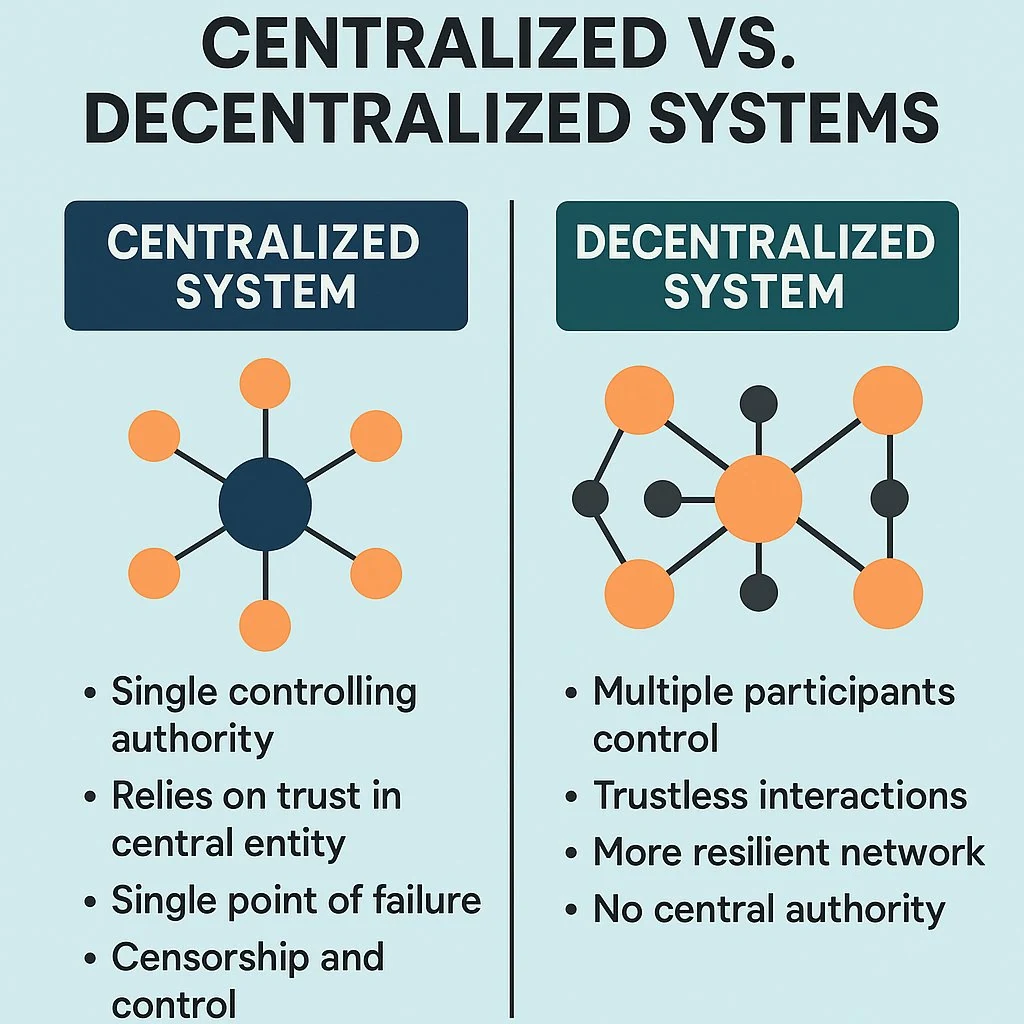
Decentralisation basically means this: no single centre should be able to control the system.
That is the clean version.
In practice, it means power is spread far enough that 1 actor cannot quietly change the rules, block access, freeze assets, manipulate information, or force everyone else to accept its version of reality.
This idea is much older than crypto btw.
States used it through federalism. Organisations used it by splitting authority across departments or regions.
Computer networks used it because a system with 1 central point of failure is fragile. Open source software used it because code that can be inspected and run by anyone is harder to monopolise.
Then the cypherpunks gave the idea a digital backbone...
Their point was not speculation. Mark this.
It was privacy, encryption, identity, money and the right to exist online without every action passing through institutions that collect, approve, monitor or deny.
Eric Hughes wrote in 1993 that privacy was necessary for an open society in the electronic age. That line explains crypto’s roots better than 90% of modern crypto marketing.
Aaaand... Bitcoin arrived in 2008 from that world.
The white paper was not a sales document.
It described a peer to peer electronic cash system that could move payments directly between parties without a financial institution in the middle.
That was the core idea: replace institutional permission with public verification, proof of work and a network that did not need a central operator.
That is why Bitcoin still matters. It was not just a new asset. It was a working answer to a very old problem: how do you coordinate value without appointing a central authority everyone has to trust?
Ethereum then expanded the idea from money to applications.
Its original white paper framed Ethereum as a smart contract and decentralised application platform. That changed the ambition from decentralised money to decentralised infrastructure for finance, contracts and software.
That was probably the short window where crypto still had a clear ideological centre.
The claim was simple: users should be able to hold assets directly, verify rules publicly, interact without permission, and build on systems that are not owned by 1 company.
Some of that survived.
A lot did not. Most did not tbh.
The reason is uncomfortable but obvious. Decentralisation protects users.
Centralisation monetises them.
A decentralised system is harder to control, but it is also harder to extract from.
A centralised exchange can charge fees, control listings, manage order flow and decide access. A stablecoin issuer can dominate liquidity.
A venture fund can get early supply. A foundation can steer governance. A market maker can shape liquidity.
A large influencer can manufacture attention. A platform can bury or amplify narratives.
That is where modern crypto ended up.
The technology still has decentralised pieces. The market structure around it often does not.
Bitcoin is still one of the strongest case because the monetary rules remain extremely hard to change and users can still verify the chain independently.
But even Bitcoin is no longer the romantic network of small independent miners people like to imagine. Mining is industrial now.
Hashrate Index currently shows Foundry USA and AntPool together around half of tracked Bitcoin mining pool distribution.
That is not a death sentence for Bitcoin, but it is a real concentration risk and it should not be ignored.
Ethereum is similar in another way.
The base layer still has serious decentralised properties, but much of the user activity now passes through layer 2 systems, bridges, sequencers, wallets, RPC providers and front ends. L2BEAT exists because these systems carry different trust assumptions and risks. “Built on Ethereum” does not automatically mean “as decentralised as Ethereum”.
The trading layer is even clearer.
CoinGecko’s Q1 2026 report says Binance still had 37.0% spot market share among major centralised exchanges, with MEXC the only other exchange above 10.0%.
That is a market where liquidity is still concentrated around a few venues, not distributed across a broad open system.
Stablecoins show the same pattern. DeFiLlama currently tracks the stablecoin market at roughly $320.7 billion, with USDT dominance at about 59.2%. A huge part of crypto liquidity therefore still depends on central issuers, banking access, compliance decisions and assets that can be frozen.
That may run on public chains, but it is not decentralised money in the original sense.
So what is left of decentralisation today?
More than critics admit.
Less than crypto people pretend.
The strongest decentralisation is still found where users can verify rules, hold assets directly, run infrastructure, inspect code and leave without asking permission.
That exists in Bitcoin. It exists in parts of Ethereum. It exists in some DeFi protocols, some wallets, some open source tools and some public infrastructure.
But the average user experience is very different.
Most people enter through a centralised exchange, hold stablecoins issued by central companies, use hosted wallets or popular apps, trade tokens promoted by insiders, follow narratives manufactured by KOLs, and rely on interfaces they do not control.
That is not the end of decentralisation. It is the shrinking of decentralisation into a lower layer while the upper layers rebuild the same power structures crypto claimed to replace.
The cleanest way to judge any crypto project is therefore not by asking whether it uses the word decentralised. Everyone uses the word. The better test is whether users can verify, exit and resist capture.
If insiders can change the rules, it is not decentralised.
If 1 company controls access, it is not decentralised.
If token holders vote but insiders own the votes, it is not decentralised.
If a protocol depends on 1 front end, 1 sequencer, 1 issuer, 1 exchange, 1 foundation or 1 market maker, then the decentralisation claim should be treated with suspicion.
Crypto did not abandon decentralisation in 1 dramatic moment. It diluted it slowly. First for scale. Then for convenience. Then for liquidity. Then for regulation. Then for profit.


Another low interaction tweet, but these are usually my favourite ones.
@grok, put in some effort and push better quality.
I am not here to be on TruthSocial or TikTok 2.0.