Investigaciones onchain
Robinhood Chain: looking beneath the headline transaction count
To be honest, Robinhood Chain is not a serious financial network at the moment. Right now it is mostly a fresh liquidity venue being stress-tested by memecoins, bots, volatile pools and speculative volume.
 MASTR
MASTRPrimera publicación 5 min · 934 palabras
Original publication · 12 Jul 2026. Figures, claims and opinions reflect the original publication date.
Las publicaciones originales están en inglés. La navegación está disponible en siete idiomas.
I dug into Robinhood Chain’s stats and transaction data.
To be honest, Robinhood Chain is not a serious financial network at the moment. Right now it is mostly a fresh liquidity venue being stress-tested by memecoins, bots, volatile pools and speculative volume.
The RWA and institutional narrative may be the long-term pitch, but the current on-chain reality is far closer to a fast-moving casino than mature settlement infrastructure.
The supposed home of institutional-grade RWAs has so far attracted far more memecoin speculation than meaningful RWA activity.
Robinhood Chain barely opened its doors before crypto turned it into another casino.
The attention, liquidity and volume are already there, so naturally the bot farms, copycat tokens, honeypots and shillers arrived with them.
Once again, people are pointing at exploding activity and calling it adoption without asking what is generating that activity or how much of it represents anything beyond automated speculation and retail extraction.
As a reminder, because I have said this before: Robinhood Chain is a permissionless EVM Layer 2 built with Arbitrum technology, but its current control model remains highly centralised.
It's a bank.
A privileged sequencer controls transaction ordering, soft confirmations depend on that sequencer until batches are posted to Ethereum, and Robinhood’s own documentation explicitly states that sequencer-level compliance screening can exclude certain transactions from inclusion.
Anyone may deploy a contract, but the most important operational layer still has a corporate gatekeeper.
It is essentially a regulated brokerage building programmable settlement infrastructure on top of Ethereum, much closer to a bank operating its own financial rails than the decentralised revolution people are currently selling it as.
The on-chain data makes the launch pattern even more revealing.
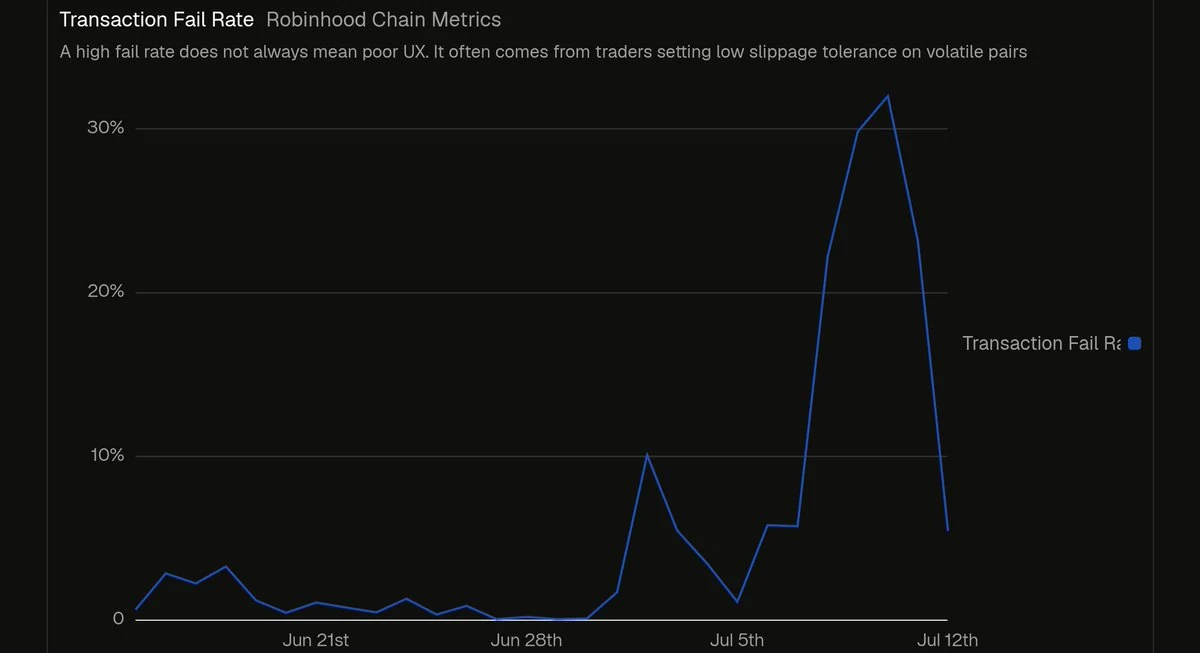
Daily DEX volume climbed towards $400 million, active addresses exploded, and the transaction failure rate moved from near zero and low single digits to roughly 40%.
40% 🚨
At the same time, the tokenised real-world assets used to market the chain accounted for only around $12.8 million.
The numbers are almost the inverse of the pitch: the supposed home of institutional-grade RWAs has so far attracted far more memecoin speculation than meaningful RWA activity.
The timing between rising volume and rising failures is obvious, but the technical distinction matters.
This does not automatically mean Robinhood Chain reached its maximum throughput or that the sequencer simply stopped processing transactions.
On an EVM network, a failed transaction can still be accepted, ordered and executed before a smart contract reverts it.
During volatile memecoin trading, the pool price can change between quotation and execution.
The swap then fails because the router can no longer satisfy the user’s minimum-output or slippage condition.
The state changes are rolled back, but the gas is still consumed.
In short; You pay. It doesn't work.
When trading volume, bots and price volatility rise together, more transactions compete against a rapidly changing pool state.
Quotes become stale within seconds, deadlines expire, minimum-output conditions fail, allowances or balances become insufficient, and complex router calls revert.
The dashboard therefore shows more than simple network activity.
It shows deteriorating execution quality as speculative volume increases.
At one point, around 22% of all transactions were already failing while the chain processed approximately 71 transactions per second, before the chart later climbed towards 40%.
The failure spike has been linked primarily to memecoin trading and slippage rather than a fundamental chain outage.
That context does not make the number irrelevant.
A chain marketed for serious financial infrastructure cannot celebrate hundreds of millions in volume while dismissing the fact that an enormous share of attempted execution is reverting.
More volume has so far produced more failed execution, more wasted gas and a market increasingly dominated by bots chasing the same volatile liquidity.
I still like Solana despite the scams because scams are not genetically attached to Solana.
They gather wherever attention, liquidity and inexperienced buyers gather.
Solana absorbed this behaviour for years because it had the volume and mindshare.
Robinhood Chain is now receiving the same traffic at compressed speed.
Hype remains the largest scam catalyst in crypto.
It concentrates capital, urgency and poorly informed buyers in one place, while shillers provide free distribution and bots exploit the resulting disorder.
Scammers do not wait for an ecosystem to mature. They arrive with the first wave of volume, and on Robinhood Chain they are already there.
Quick overview:
• Permissionless, EVM-compatible Ethereum L2 built on Arbitrum. ETH is used for gas.
• Robinhood operates the centralised sequencer that receives, orders and batches transactions. It's a bank.
• Transactions are ordered first come, first served, but sequencer-level compliance screening can exclude them.
• Soft confirmations are sub-second, while full security only arrives after settlement and finality on Ethereum. Canonical withdrawals require a 7-day challenge period.
• Daily DEX volume reached a record of roughly $563.9 million, with almost 200,000 daily active addresses.
• Most of the initial activity came from memecoins and WETH trading, not the tokenised stocks and RWAs used to market the chain.
• According to the data, it showed the transaction failure rate climbing from low single digits towards roughly 40% as activity and volume increased.
• A failed EVM transaction may still be ordered and executed before reverting. The trade fails, the state change is reversed, but the user still pays gas.
• Likely causes include stale quotes, slippage limits, expired deadlines, insufficient balances or allowances, volatile pools and failing router calls.
• More volume currently correlates with more failed execution, but this does not automatically prove that the chain reached its maximum capacity.
• Current reality: heavy speculation, bots, memecoins and deteriorating execution quality on a corporate-controlled L2.