Exchanges y custodia
Robinhood: trading incentives, custody and the new chain
Crypto X has become embarrassingly excited about Robinhood Chain, a corporate Layer 2 wrapped in the language of permissionlessness.
 MASTR
MASTRPrimera publicación 8 min · 1,739 palabras
Original publication · 26 Aug 2026. Figures, claims and opinions reflect the original publication date.
Las publicaciones originales están en inglés. La navegación está disponible en siete idiomas.
This is what everyone should know about #Robinhood
The second post is a condensed version of this, but I strongly recommend reading the full text.
...........
Crypto X has become embarrassingly excited about Robinhood Chain, a corporate Layer 2 wrapped in the language of permissionlessness.
Apparently, years of screaming about decentralisation can be discarded the moment a large company launches a new casino, supplies enough liquidity and gives influencers another narrative to promote.
Before anyone dismisses this as ideological whining, read the chain documentation, the deployed contract permissions, Robinhood’s regulatory history and the legal structure behind its Stock Tokens.
The evidence is sitting in public documents that almost nobody celebrating the launch appears to have opened.
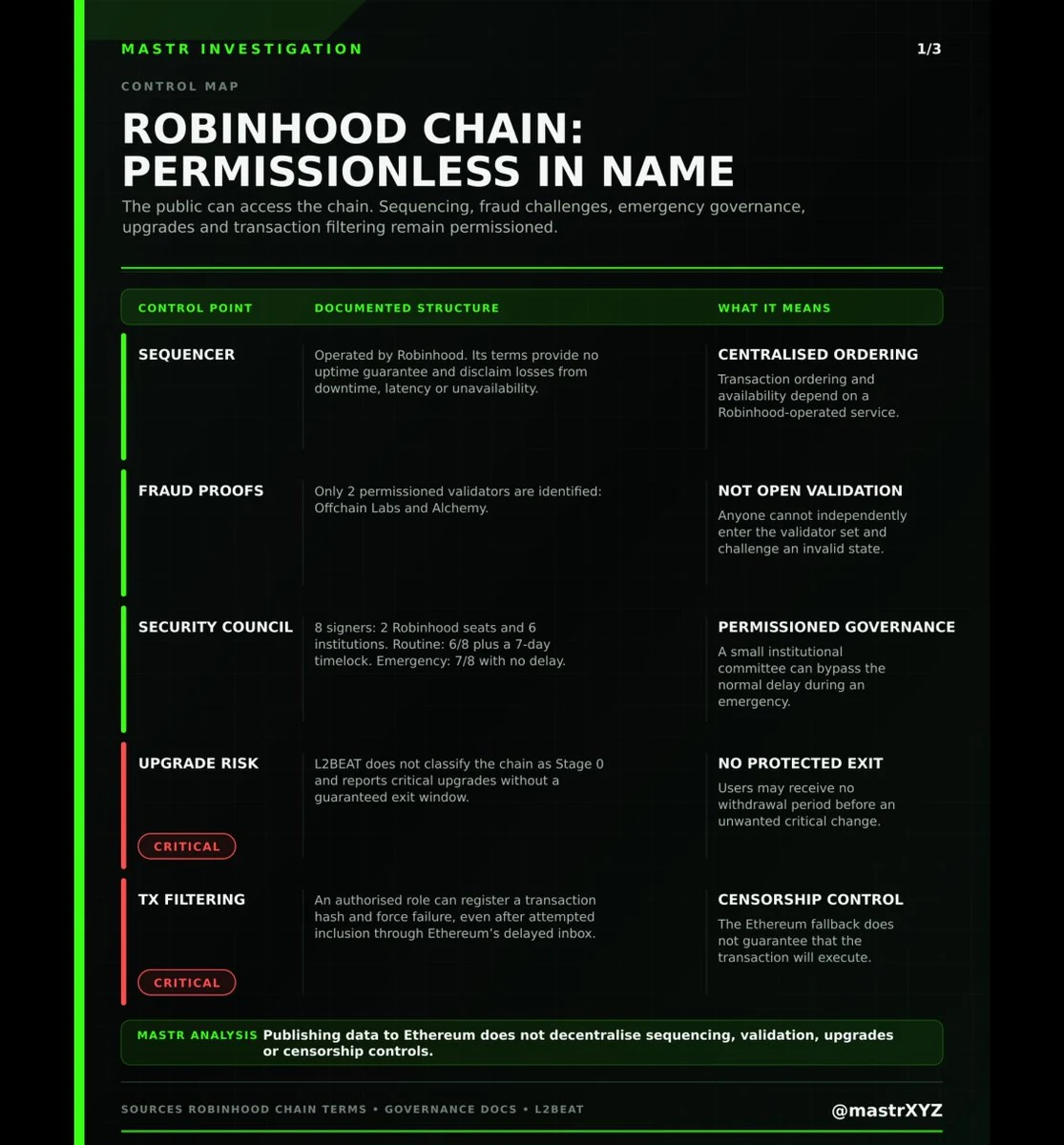
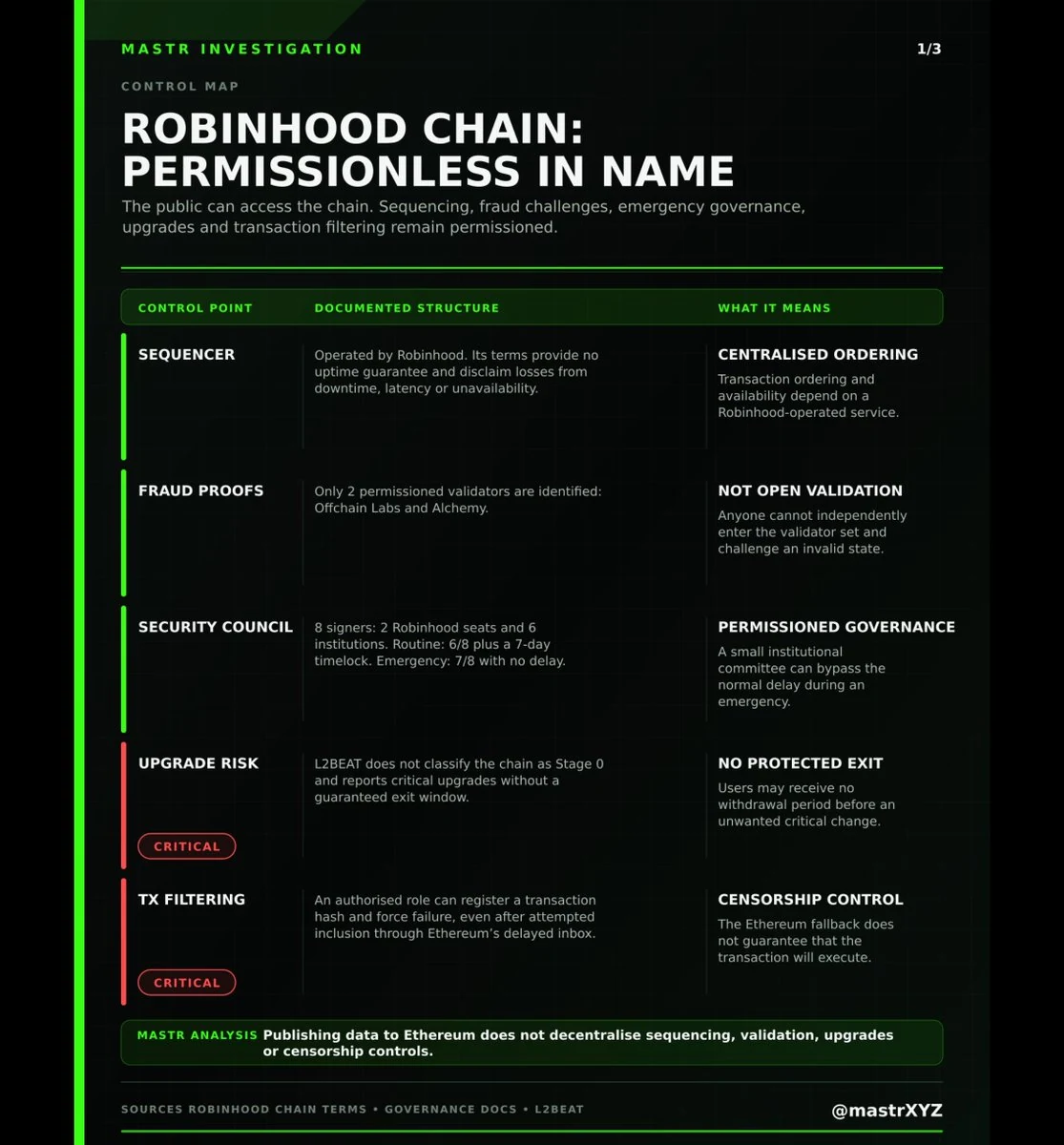
🚨Robinhood operates the chain’s sequencer.
🚨Its own terms provide no guarantee that the sequencer will remain available and reject liability for losses caused by downtime, latency or unavailability.
🚨The fraud-proof system is also not permissionless. Robinhood’s documentation identifies only 2 validators, operated by Offchain Labs and Alchemy, that can challenge invalid state assertions.
🚨 The Security Council contains 8 signers, including 2 Robinhood seats and 6 external institutions.
Routine actions require 6 approvals and normally face a 7-day timelock, while emergency actions require 7 approvals and can bypass that delay.
This is better than a single administrator pretending to be a DAO, but it remains permissioned governance exercised by a small institutional committee.
Describing access as permissionless does not make validation, sequencing and emergency control permissionless.
L2BEAT’s current risk analysis is considerably harsher than Robinhood’s marketing.
It does not classify Robinhood Chain as even a Stage 0 rollup.
It reports that critical contracts can be upgraded without an exit window, meaning users receive no guaranteed period to withdraw before an unwanted upgrade takes effect. It also identifies no guaranteed inclusion mechanism if the sequencer censors a transaction.
🚨 the transaction-filtering mechanism;
An authorised filterer can register a transaction hash in the "ArbFilteredTransactionsManager", causing that transaction to fail even when a user attempts to force its inclusion through Ethereum’s delayed inbox.
Read that carefully.
A transaction can reach the supposedly censorship-resistant fallback route and still be deliberately failed by an authorised role.
The data may be published on Ethereum, but data availability alone does not decentralise transaction ordering, validation, upgrades or censorship controls.
Robinhood Chain inherits parts of Ethereum’s infrastructure while introducing its own trusted operators and administrative powers above it.
Crypto X has reduced that entire distinction to “built on Ethereum” because examining the actual trust model would ruin the launch party.
Robinhood has already demonstrated what centralised market access means when its own infrastructure comes under pressure.
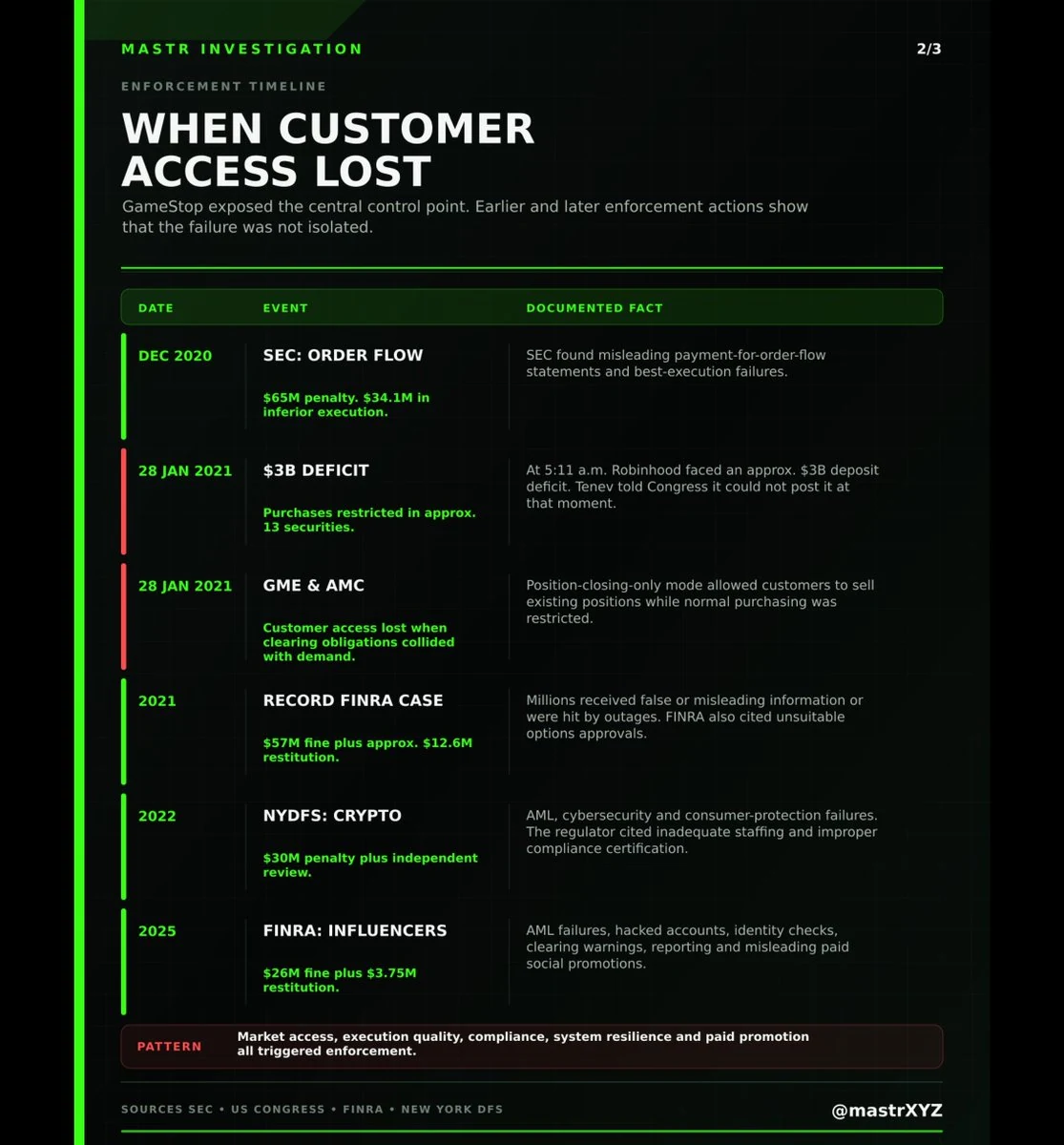
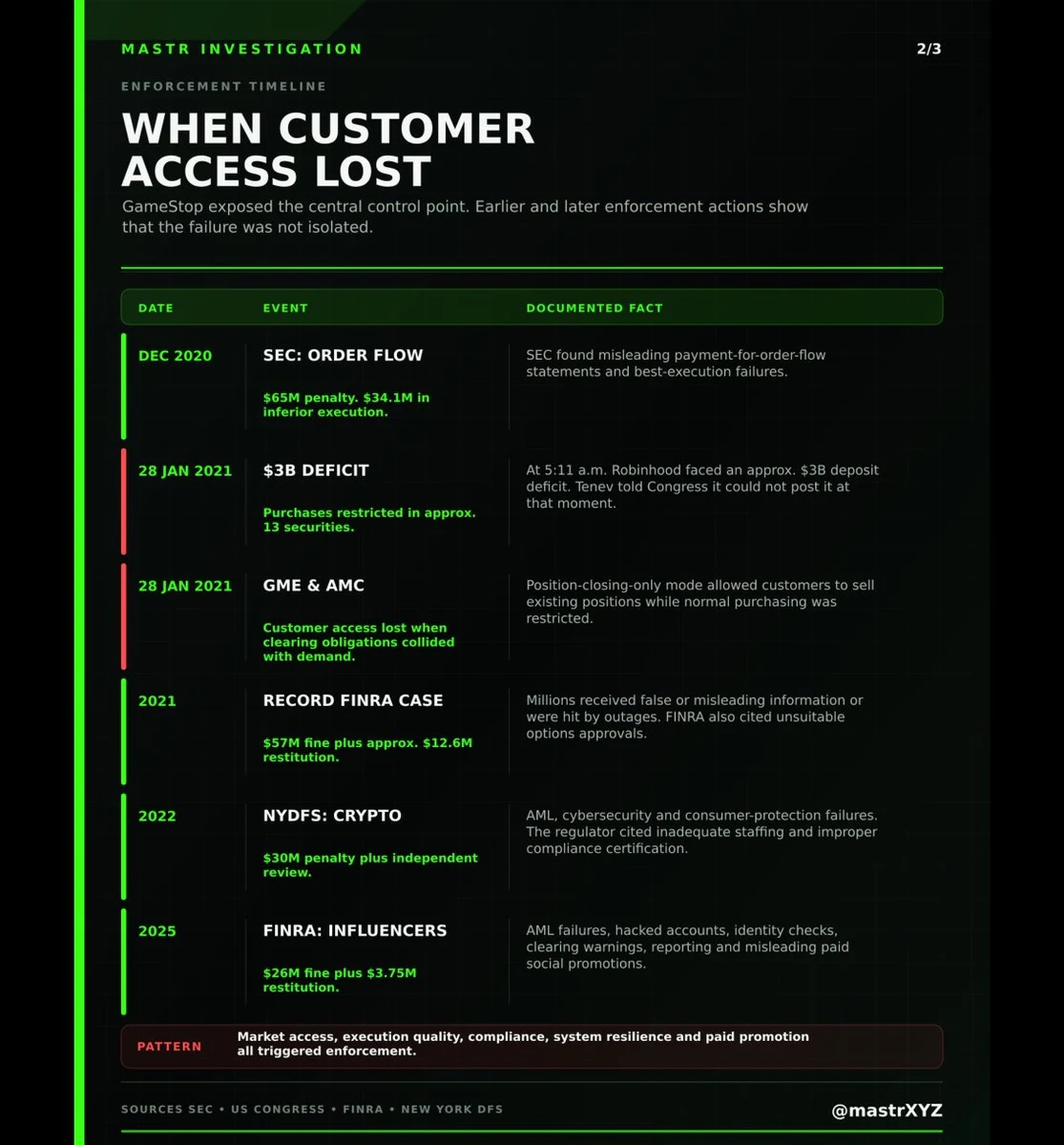
At 5:11 a.m. on 28 January 2021, Robinhood received an automated clearing requirement showing a roughly $3 billion deposit deficit.
During congressional testimony, CEO Vlad Tenev acknowledged that Robinhood could not have posted that collateral at that moment. He also confirmed that Robinhood responded by restricting purchases in approximately 13 securities.
GameStop and AMC were placed into position-closing-only mode.
Customers could sell existing positions but could not purchase normally. GME was never delisted, as people still incorrectly repeat.
Robinhood selectively disabled one side of the market because its own clearing infrastructure could not support the financial obligations created by customer activity.
Robinhood later attributed the restrictions to extraordinary NSCC collateral requirements caused by volatility and trading volume.
That explanation matters because it kills the lazy conspiracy theories, but it also exposes the real structural failure.
Retail lost access because its intermediary could not meet the financial demands imposed on its clearing operation.
When Robinhood’s infrastructure and its customers’ market access came into conflict, customer access lost. That is the only lesson required.
This was also not an isolated embarrassment inside an otherwise spotless history.
➡️ In December 2020, the SEC charged Robinhood with misleading customers about how it made money through payment for order flow and failing to satisfy its duty of best execution.
The SEC found that Robinhood customers received inferior trade prices that deprived them of $34.1 million even after commission savings were considered.
Robinhood paid $65 million to settle without admitting or denying the findings.
➡️ In 2021, FINRA imposed a $57 million fine and approximately $12.6 million in restitution, then the largest financial penalty FINRA had ever ordered.
The regulator cited millions of customers receiving false or misleading information, millions affected by system outages and thousands approved for options trading despite limited experience or low risk tolerance.
➡️ In 2022, the New York Department of Financial Services imposed another $30 million penalty on Robinhood Crypto over anti-money-laundering, cybersecurity and consumer-protection failures. The regulator said Robinhood’s compliance programmes were inadequately staffed and that the company had improperly certified compliance despite deficiencies.
Then came the finding that should interest everyone watching Robinhood spread through Crypto X.
🚨 In 2025, FINRA fined Robinhood entities another $26 million and ordered $3.75 million in restitution.
The regulator found failures involving anti-money-laundering controls, suspicious activity, hacked customer accounts, identity verification, clearing-system warning signs and regulatory reporting. It also found that Robinhood failed to supervise paid social-media influencers whose promotions included statements that were misleading, promissory or not fairly balanced.
A company previously sanctioned over misleading paid influencer promotions is now launching a chain being aggressively amplified across social media, and almost nobody asks who is paid, who received access, who holds ecosystem positions or which financial relationships sit behind the excitement.
Crypto apparently learned nothing because disclosure interferes with engagement.
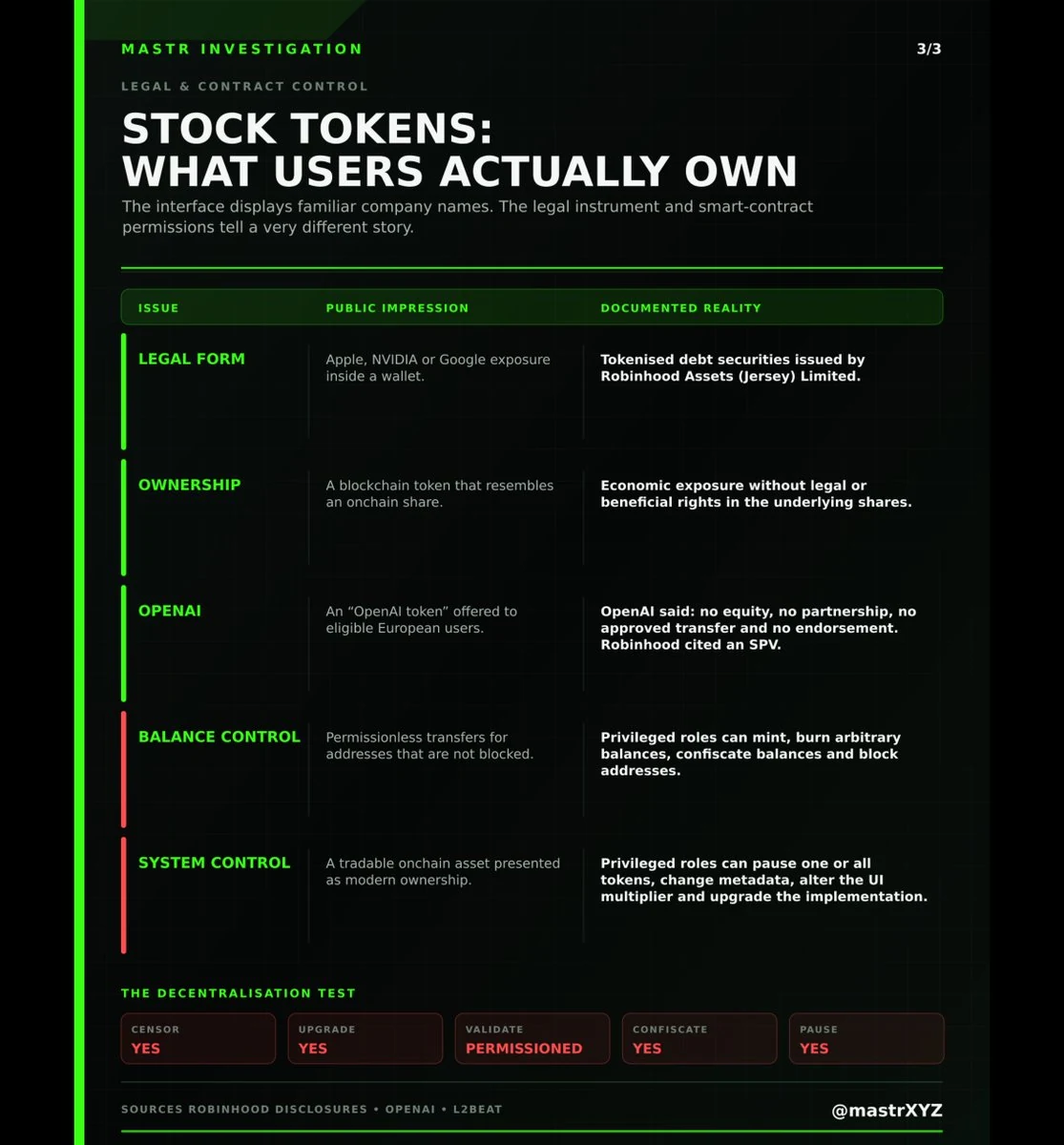
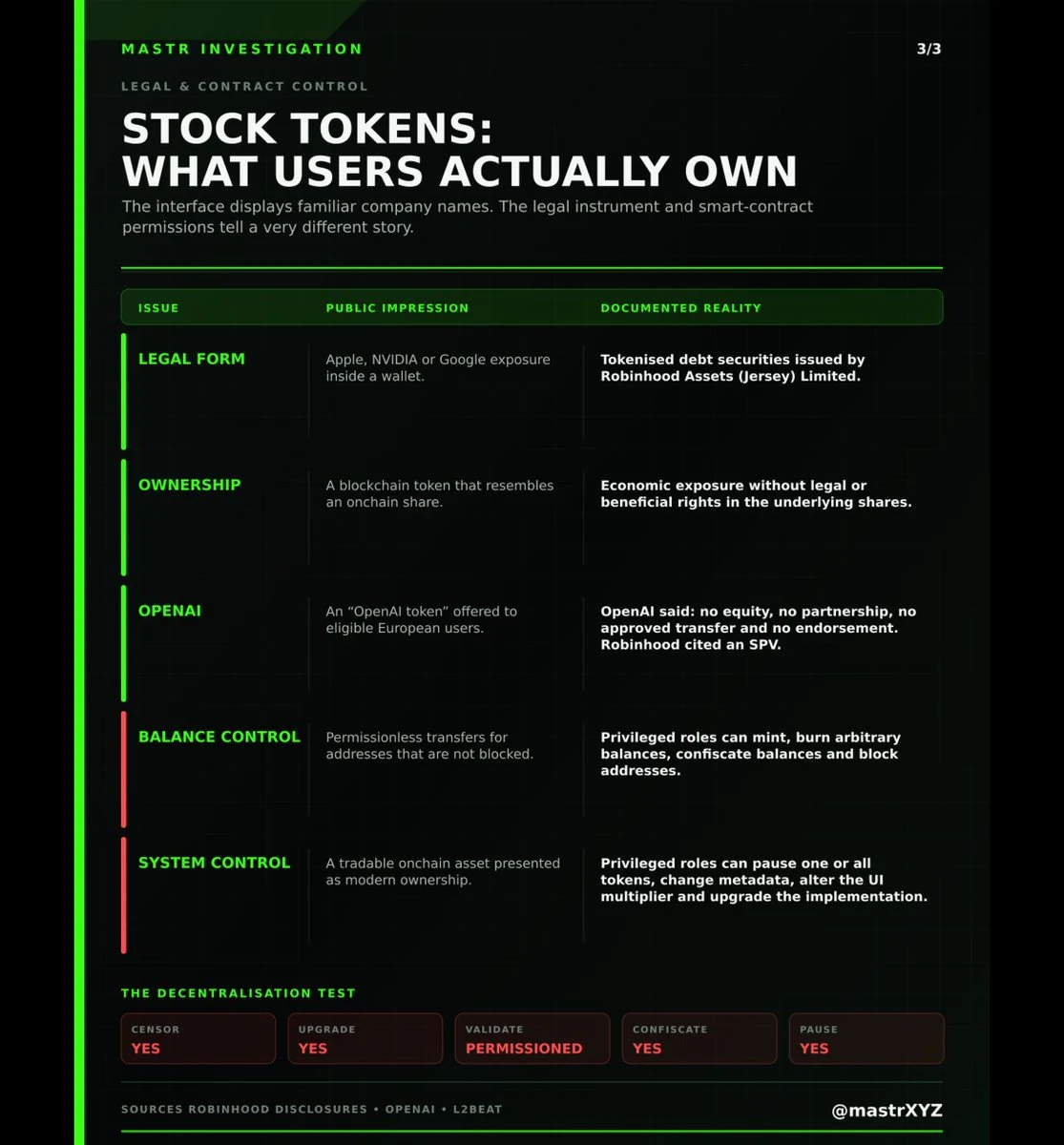
➡️ The Stock Tokens deserve even more scrutiny. Robinhood’s own disclosure says these instruments are tokenised debt securities issued by Robinhood Assets Jersey Limited.
They provide economic exposure to underlying securities but grant no legal or beneficial ownership rights in those securities. The user may see Apple, NVIDIA or Google branding inside a wallet, but the legal object being held is an issuer-dependent instrument carrying counterparty risk.
➡️ The OpenAI incident demonstrated how misleading the surrounding language can become. Robinhood offered eligible European users tokens linked to OpenAI and SpaceX. OpenAI publicly responded that the tokens were not OpenAI equity, that it had not partnered with Robinhood, had not approved any transfer and did not endorse the product. Robinhood answered that the exposure came through its interest in a special-purpose vehicle.
That is several legal layers away from “owning OpenAI onchain,” regardless of how attractive the token symbol looks in a wallet.
The onchain control model is equally revealing.
Analysis of Robinhood’s Stock Token contracts says privileged registry roles can mint tokens, burn balances held by arbitrary users, confiscate balances, block addresses, pause individual tokens or every token, change metadata, alter the user-interface multiplier and upgrade the shared implementation.
Transfers may be permissionless for addresses that have not been blocked, but the asset remains subject to extensive administrative control.
Imagine Crypto X’s reaction if an unknown DeFi team launched a token whose administrators could confiscate user balances, globally pause transfers, rewrite metadata and upgrade the implementation.
The same people now calling Robinhood Chain revolutionary would publish red warning threads within minutes. Add a recognisable corporation, institutional signers and enough marketing, and those controls are suddenly described as adoption.
Robinhood Chain may become fast, useful and commercially successful. None of that settles whether it is meaningfully decentralised.
Those answers are already public.
Crypto X simply prefers the promotional version because reading contract permissions does not generate the same referral income as hyping the next corporate chain.
Robinhood: The Most Important Events
1. 2015–2018: Payment-for-order-flow deception
The SEC found that Robinhood misled customers about its largest revenue source and failed to provide the best reasonably available execution. Customers allegedly lost $34.1 million through inferior prices even after commission savings. Robinhood paid a $65 million penalty in 2020.
2. March 2020: Major trading outages
Robinhood suffered repeated outages during extreme market volatility. FINRA later said millions of customers were affected while being unable to access or manage positions.
3. 28 January 2021: GameStop and AMC purchase restrictions
Robinhood faced an approximately $3 billion collateral deficit that it could not cover at that moment. It restricted purchases in around 13 securities, including GME and AMC, while customers could still close existing positions. CEO Vlad Tenev confirmed the liquidity problem and restrictions during congressional testimony.
4. June 2021: Record FINRA penalty
FINRA fined Robinhood $57 million and ordered approximately $12.6 million in restitution. The case involved false or misleading customer information, technology failures, options approvals for unsuitable customers and inadequate supervision. At the time, it was FINRA’s largest financial penalty.
5. August 2022: Crypto compliance and cybersecurity failures
New York’s financial regulator imposed a $30 million penalty over significant anti-money-laundering, transaction-monitoring, cybersecurity and consumer-protection deficiencies. Robinhood was also required to retain an independent compliance consultant.
6. January 2025: Another $45 million SEC settlement
Robinhood Securities and Robinhood Financial agreed to combined penalties of $45 million over violations involving recordkeeping, trade reporting, suspicious-activity obligations and other securities-law requirements.
7. March 2025: AML, hacked accounts and paid influencers
FINRA imposed another $26 million fine and ordered $3.75 million in restitution. Its findings included inadequate anti-money-laundering controls, thousands of accounts opened without reasonable identity verification, failures to detect hacked accounts, ignored clearing-system warning signs and inadequate supervision of paid influencers whose promotions contained misleading or unbalanced claims.
8. July 2025: OpenAI publicly rejected Robinhood’s tokens
Robinhood promoted tokens linked to OpenAI and SpaceX. OpenAI stated that the tokens were not OpenAI equity, that no partnership existed, that it had approved no transfer and that it did not endorse the offering. Robinhood said the exposure came through an unidentified special-purpose vehicle. OpenAI, Reuters
9. Stock Tokens do not provide ownership of the shares
Robinhood’s disclosures classify its Stock Tokens as tokenised debt securities issued by Robinhood Assets Jersey Limited. Holders receive economic exposure but no legal or beneficial rights in the underlying securities.
10. July 2026: Robinhood Chain launches with permissioned control
Robinhood operates the sequencer, while only 2 permissioned validators are identified for fraud-proof challenges. Emergency governance can bypass the normal timelock through a 7-of-8 Security Council vote.
11. Current chain contracts permit transaction filtering
L2BEAT reports that an authorised filterer can force a selected transaction to fail even when the user attempts to include it through Ethereum’s delayed inbox. It also reports no guaranteed exit window before certain critical upgrades.
12. Stock Token administrators retain extensive powers
According to L2BEAT’s contract analysis, privileged roles can mint tokens, burn or confiscate user balances, block addresses, globally pause tokens, change metadata and upgrade the shared implementation.