Struttura del mercato
Tokenisation: the asset, the claim and the marketing
I want to take a closer look at the tokenization hype and explain why most of what is being marketed as “tokenization” in this space is completely pointless garbage.
 MASTR
MASTRPrima pubblicazione 5 min · 998 parole
Original publication · 29 Jul 2026. Figures, claims and opinions reflect the original publication date.
Le pubblicazioni originali sono in inglese. La navigazione è disponibile in sette lingue.
I want to take a closer look at the tokenization hype and explain why most of what is being marketed as “tokenization” in this space is completely pointless garbage.
Yes, I am probably making a few more enemies here again, but so be it.
A large part of what is marketed as tokenization is narrative theatre.
Someone takes a watch, a bottle of wine, a Pokémon card, a barrel of whiskey or almost any other object, creates a token and then announces that a new global financial market has been created.
But putting an asset onchain does not automatically create ownership, liquidity or value.
In many cases, nothing fundamental has changed. A company still controls the physical asset, the storage, the redemption process and the legal relationship. The buyer merely receives a tradable token representing a promise made by that company.
➡️ A Token Is Not Automatically Ownership
A token is initially just an entry in a database.
It only represents meaningful ownership if the holder has a clear, legally enforceable and verifiable claim to the underlying asset.
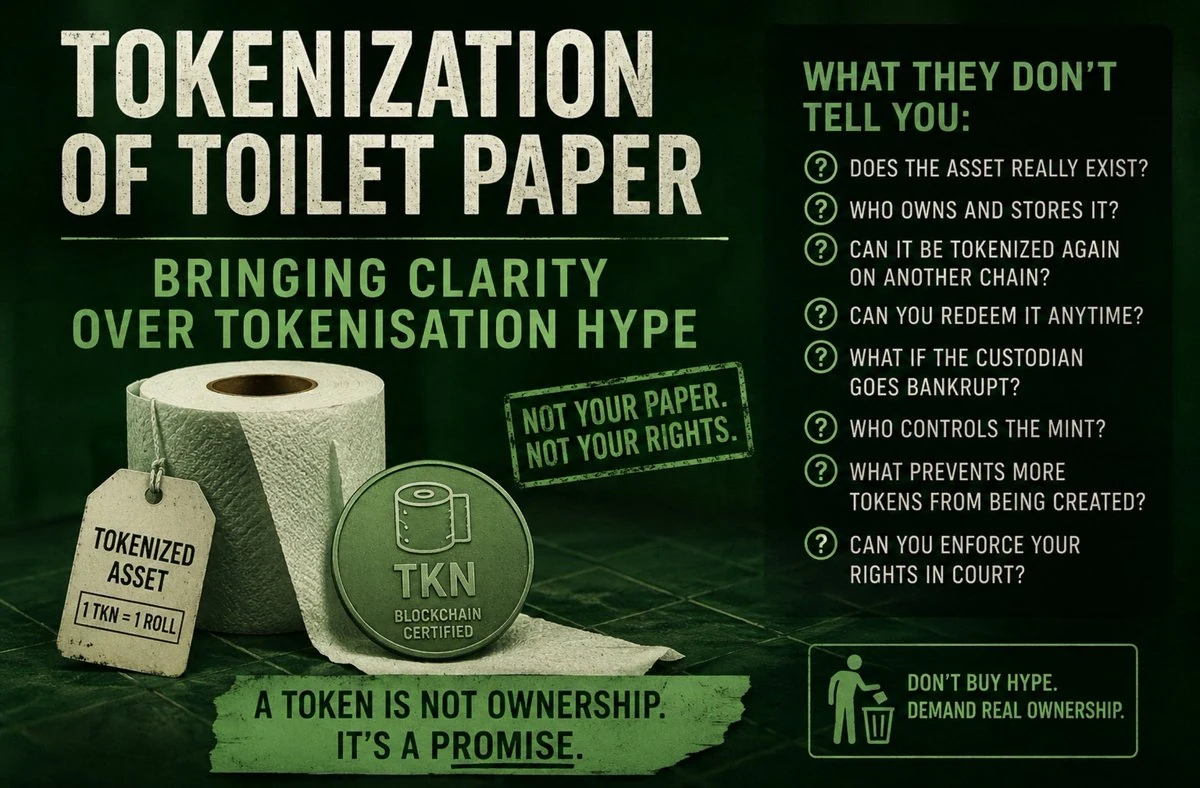
The relevant question is not whether toilet paper, olive oil, watches or trading cards can be tokenized. Almost anything can be assigned a token.
➡️ The relevant questions are:
- Does the underlying asset actually exist?
- Does the token holder legally own it?
- Or does the holder merely have a contractual claim against the issuer?
- Who controls and stores the physical asset?
- Can the token be redeemed for the asset?
- Can redemption be refused, delayed or suspended?
- What happens if the issuer or custodian becomes insolvent?
- What prevents the same asset from being tokenized more than once?
- What prevents the issuer from creating additional tokens?
- Can the holder enforce the claim in court?
🚨 Without clear answers, you do not own a watch, a bottle of wine or a Pokémon card or whatever the fuck they promise you.🚨
You own a token and the promise that someone might honour it.
➡️ Tokenization Does Not Create Value by Itself
-Representing an asset onchain does not make the asset more valuable.
-It does not improve the quality of the asset.
-It does not guarantee demand.
-It does not remove custody risk.
-It does not remove legal risk.
-It does not turn an illiquid object into a liquid market simply because the token can be traded 24/7.
The token may trade instantly while the underlying asset remains difficult to value, difficult to sell and expensive to deliver.
That is not necessarily liquidity. It may only be a liquid market for claims on an illiquid asset.
➡️ Fractionalization Is Not a Business Model
Another popular claim is that fractionalization suddenly gives everyone access to assets they previously could not afford.
In theory, this can be useful.
In practice, dividing an obscure asset into 1 million tokens does not create 1 million interested buyers. It merely divides the ownership claim into smaller pieces.
A fractionalized asset still needs:
- genuine demand
- credible valuation
- reliable custody
- legal enforceability
- a functioning redemption process
- buyers willing to purchase the fractions later
Without those conditions, fractionalization does not democratize ownership. It democratizes exposure to the issuer’s risk.
➡️ The Same Centralization Usually Remains
Many tokenization projects use decentralization as part of their marketing while keeping every meaningful decision centralized.
-The company chooses the asset.
-The company values it.
-The company selects the custodian.
-The company controls redemption.
-The company may control the mint authority.
-The company writes the legal terms.
-The company decides what happens when something goes wrong.
The blockchain records transfers, but the real-world asset remains dependent on institutions, contracts and people outside the chain.
🚨 Calling that decentralized ownership does not make it decentralized.🚨
➡️ When Tokenization Can Be Useful
Tokenization can create real value when it improves an existing process in a measurable way.
For example:
- faster settlement
- lower administrative costs
- easier transfer of legally recognized ownership
- automated distributions
- better collateral management
- fewer intermediaries
- transparent supply and transaction records
But the value comes from solving those problems.
🚨 It does not come from attaching a token to an object and inventing a financial narrative around it.🚨
➡️ A Tokenized Watch Example
Imagine a dealer holding 1,000 authenticated watches in an insured warehouse.
Each watch has a unique identity. An independent custodian confirms its existence and condition. Exactly 1 token can exist for each watch. The token represents legally enforceable ownership. It can be redeemed for the watch, and the token is destroyed after redemption.
That may improve inventory financing and allow ownership to move without shipping the watch after every sale.
There is a possible economic purpose.
But if the dealer controls the warehouse, the certificates, the minting, the valuation and the redemption process, while token holders have no enforceable ownership rights, then nothing meaningful has been tokenized.
The company has simply issued digital claims against its own promises.
➡️ The Central Question
The question should never be:
“Can this asset be tokenized?”
Of course it can. A token can be created for almost anything.
The question should be:
“What specific right does this token give me, who is legally required to honour it, and what happens when they refuse or fail?”
🚨 If nobody can answer that clearly, the token is not financial innovation.🚨
It is a speculative wrapper around counterparty risk.
➡️ The Actual Problem?
The industry loves talking about hundreds of billions in untapped markets because large numbers attract investors, users and attention.
But tokenizing every conceivable object does not automatically expand finance.
Sometimes it simply expands the number of things people can speculate on.
“Internet capital markets” sounds impressive. But without legally enforceable ownership, reliable custody and credible redemption, much of it is merely a globally tradable market for unsecured corporate promises.
You are not necessarily buying the asset.🚨
You may simply be buying another token and trusting another company.