The Decline of U.S. Power, the Rise of China, and What It Means for Crypto 🚨
This is an independent analysis — a longer tweet for those interested. Please take the time to read it carefully. Being prepared is important.
Crypto has never been as dependent on global events as it is right now.
⬇️⬇️⬇️⬇️⬇️⬇️
We may be living through the end of an era — the decline of American global dominance. For over a century, the United States has functioned as the world’s uncontested superpower, shaping the global order through military strength, economic leadership, and cultural influence. But in 2025, the signs of imperial fatigue are undeniable — and they carry major consequences for global politics, technology, and the financial system, including cryptocurrencies.
A Nation in Decline?
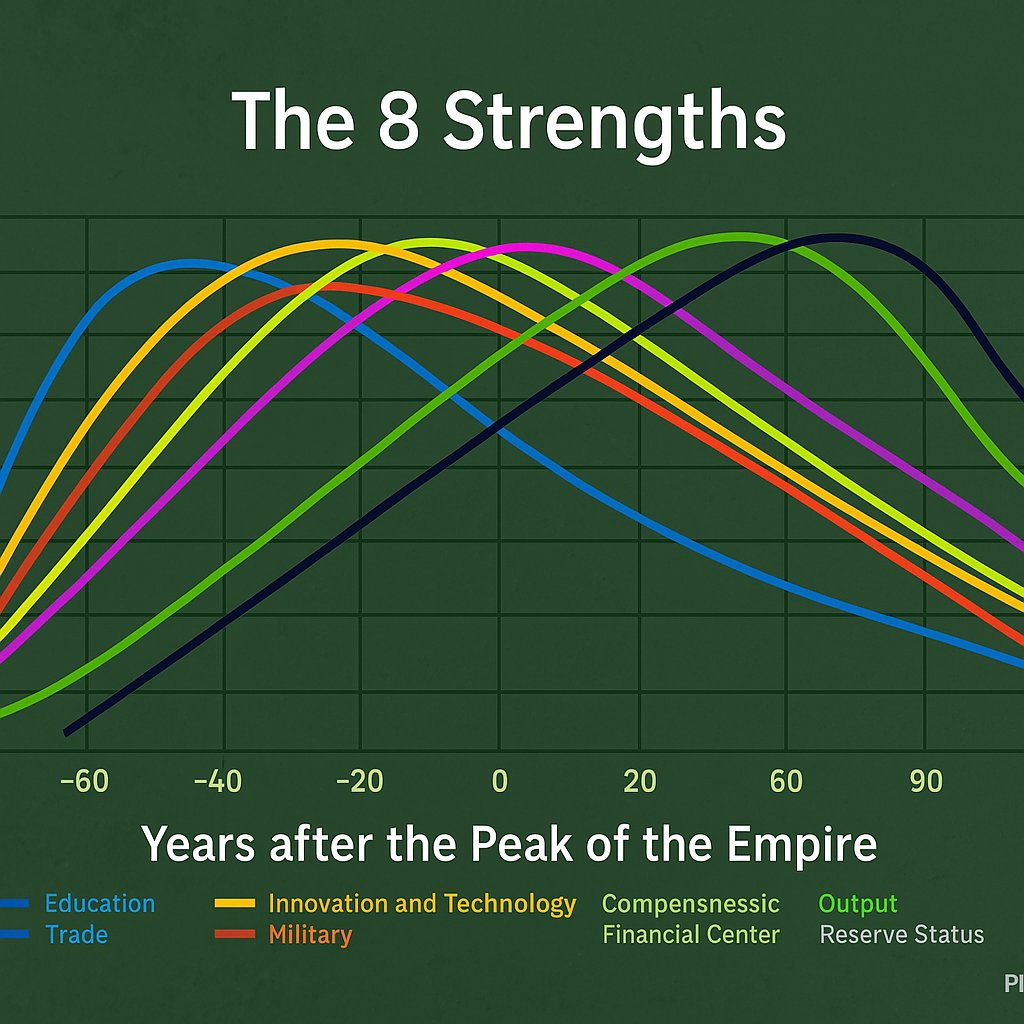
According to Ray Dalio, billionaire investor and author of "Principles for Dealing with the Changing World Order," the rise and fall of empires follow predictable cycles. From the Dutch to the British to the Americans, each dominant power experiences a similar trajectory: a rise through innovation and education, followed by prosperity, financial excess, inequality, internal conflict, and eventual collapse.
Dalio identifies eight key pillars of power: education, competitiveness, innovation, military strength, financial center status, reserve currency status, output, and trade. The U.S. is still strong in many areas, but is visibly declining in several — particularly debt, inequality, political polarization, and educational performance.
➡️U.S. national debt is projected to exceed $40 trillion by 2026.
➡️The income gap between the richest 1% and the rest has returned to Gilded Age levels.
➡️Political trust is at historic lows, and violent polarization is on the rise.
➡️As Dalio notes: "When empires become too indebted, divided, and complacent, it opens the door for others to rise."
The China Challenge: A New Superpower Emerges
China is seizing the moment. With a population more than four times that of the U.S., a tightly centralized government, and a long-term geopolitical vision, it is quickly transforming from the "world's factory" to a global innovation powerhouse.
According to the Australian Strategic Policy Institute (ASPI), China now leads the world in 36 of 44 key technologies, including:
-Artificial Intelligence (AI)
-Quantum computing
-Hypersonic weapons
-Advanced materials
-Green energy
And it’s not just innovation. China has been systematically locking in strategic control over rare earth elements, critical for electronics, EVs, and defense tech. With over 70% of global rare earth production, it now holds a powerful geopolitical lever.
In response to U.S. tariffs, President Xi Jinping has threatened to restrict exports of these materials to the U.S. — a move that could paralyze tech industries and defense production.
Let me make this clear once again: what Trump is doing right now is hurting the U.S. — and mostly the U.S.
Trump’s Tariffs and America’s Turn Inward
Donald Trump’s return to the political spotlight has reignited his “America First” strategy — one that emphasizes tariffs, border walls, and economic nationalism. In early April 2025, Trump imposed sweeping new tariffs on Chinese goods, escalating tensions and prompting immediate retaliation from Beijing.
Trump’s stance signals a broader trend: the United States is isolating itself from global cooperation. From pulling out of the Paris Climate Agreement and WHO, to weakening ties with NATO and other alliances, Washington is retreating from its role as a global stabilizer.
The consequences? While America turns inward, others are filling the vacuum.
➡️Europe Shifts: Between America and China
➡️Europe, traditionally aligned with the U.S., is now strategically repositioning. It has no choice left. Faced with U.S. unpredictability and Chinese opportunity, leaders across the EU are moving toward pragmatic cooperation with Beijing:
European Commission President Ursula von der Leyen has held direct talks with Chinese Premier Li Qiang about trade coordination and investment.
Spain’s Prime Minister Pedro Sánchez visited Beijing, positioning his country as a diplomatic bridge between China and Europe.
Key ports like Trieste (Italy) are now linked to China’s Belt and Road Initiative, deepening infrastructure ties.
While cautious of becoming economically dependent, Europe sees engagement with China as a necessary hedge against U.S. volatility.
The Global Order Is Reshuffling
As the U.S.–China trade war intensifies, many experts see this not as a temporary dispute, but as a systemic transition. According to Ray Dalio, power shifts are often followed by 10 to 20 years of instability — marked by economic shocks, civil unrest, or even wars.
The key difference this time: China is playing the long game. Instead of military force, it is building data-driven platforms (like Temu and TikTok), economic dependencies, and infrastructure dominance. It's winning not through confrontation, but through integration.
Meanwhile, the U.S. risks becoming an increasingly self-contained consumer market rather than a global economic driver.
What This Means for #Crypto
In this unfolding multipolar world, the financial system is ground zero — and crypto sits right at the fault line.
Here’s why this matters:
1. De-dollarization Is Real
As global trust in U.S. leadership fades and nations move away from dollar-based trade, cryptocurrencies and stablecoins offer an appealing alternative for cross-border payments. Bitcoin, Ethereum, and USDT already function as financial escape routes in fragile economies. Now, they may become a hedge against sovereign instability.
2. Decentralized Finance Is Neutral Ground
In a polarized world where institutions are seen as biased, DeFi (decentralized finance) protocols provide permissionless, borderless, and uncensorable systems for lending, borrowing, and exchanging value. While states play power games, crypto keeps building trustless infrastructure.
3. China’s Digital Yuan vs. U.S. Hesitation
China is far ahead in developing its CBDC (central bank digital currency). It’s already piloted the e-CNY in dozens of cities. The U.S., on the other hand, has stalled progress on a digital dollar — held back by politics, regulatory confusion, and banking lobbies.
As digital currencies become tools of economic influence, the crypto-native public blockchains may serve as non-aligned monetary alternatives.
4. Increased Volatility = More Attention on Bitcoin
Geopolitical shocks are market shocks. As we’ve already seen, tariffs, sanctions, and political instability drive Bitcoin volatility — but also fuel long-term adoption. Bitcoin isn’t just an asset — it’s a protest, a lifeline, and a bet against fiat decay.
---
The Empire Shakes, Crypto Rises?
We are witnessing a seismic shift in global power. The U.S., once the architect of the global order, is showing all the signs of imperial fatigue. China is rising — strategically, technologically, and economically. Europe is recalibrating. The rules are changing.
In this environment, crypto becomes more than a speculative asset. It becomes a parallel system, a hedge, a resistance, and an escape route.
Empires may fall. Alliances may shift. But on the blockchain, trust is math — not politics.
#CryptoImpact #Bitcoin #DeFi #Stablecoins #DigitalYuan #CBDC #Decentralization #CryptoFuture #FinancialReset #DeDollarization