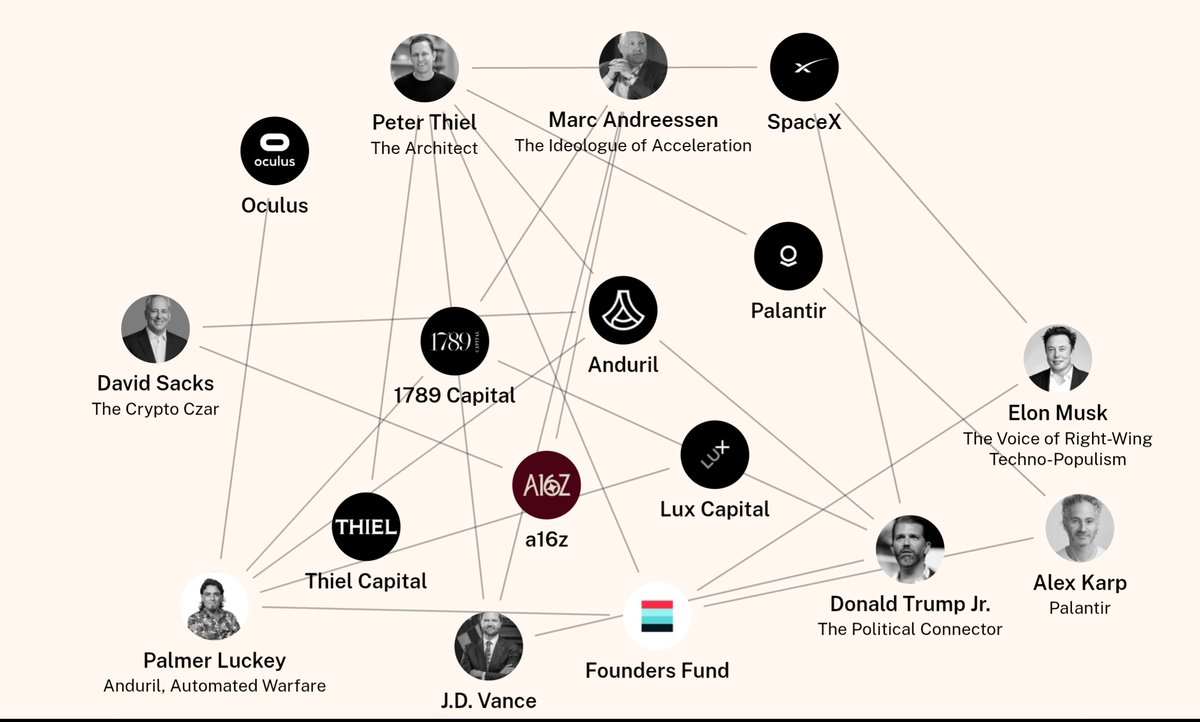
There is another form of centralisation far more dangerous than the price discovery of cryptocurrencies.
It is the centralisation of our freedom. Our words. Our informations. Our Data. Our movements.
We are centralising information at a scale humanity has never seen before.
And stopping these corporations and billionaires, who like hyenas always want more, stopping these power hungry and dangerous institutions through democratic processes and data protection is not a bad thing. It is absolutely necessary.
And very few people care, because it is complex and uncomfortable, and because it demands attention in a world that punishes long thought and long texts.
Communication, money, identity, memory, truth distribution, all flowing through fewer and fewer corporate arteries.
When information centralises, power follows.
When power follows, abuse is not a risk, it is a certainty.
I think humanity peaked in the 90s. Not because the 90s were perfect, but because the incentives were still human.
In the 90s I felt like technology was being built to extend my freedom. Today I feel like technology is being built to compress my behaviour.
In the 90s I used the internet. In 2025 the internet uses me. The difference is not speed or graphics. The difference is the business model.
Back then, the default was privacy. Not the legal definition. The lived reality. I could exist for hours, days, a whole weekend, without generating a readable trail that could be packaged, scored, sold, and fed back into a system designed to shape me.
Now the default is total capture. The phone in my pocket is not just a tool, it is a sensor suite. And the scale is basically universal. In the US, smartphone ownership went from 35% in 2011 to 91% in 2025. In high income countries, 93% of the population is estimated to be using the internet in 2024.
When nearly everyone is online and nearly everyone is carrying a tracking device, society quietly changes its definition of normal. Being reachable becomes expected. Being trackable becomes assumed. Being silent becomes suspicious. Being offline becomes deviance.
That is what people miss when they say nostalgia. I am not just missing aesthetics. I am missing the old baseline of freedom.
And here is the part I refuse to sugarcoat: modern tech is not mainly about empowering me. It is mainly about extracting me.
The proof is not a vibe. The proof is the economy built around it. One market estimate puts the global data broker market at USD 277.97 billion in 2024.
That is a giant machine that turns human lives into products.
In the 90s, I was a person who bought things. Now I am a stream of signals that gets auctioned.
In the 90s, ads were something I saw. Now ads are something that studies me. At global scale, WPP Media projected global advertising revenue reaching USD 1.08 trillion in 2025, and Reuters reported that digital advertising dominates, with digital around 73.2% of the market in that forecast. This is not marketing like it used to be. This is behavioural engineering with a budget larger than the GDP of most countries.
And it does not just show me things. It trains me.
It trains my attention span.
It trains my emotional range.
It trains what I dare to say.
It trains what I dare not say.
It trains what I click.
It trains what I believe is popular.
It trains what I believe is safe.
I know exactly how this sounds, so I anchor it in something concrete: the Cambridge Analytica scandal. Facebook said up to 87 million users may have had their data accessed in that context. That moment was not an anomaly. It was a demonstration. It showed what happens when a society outsources its public square to companies that monetise prediction.
The 90s had propaganda, yes. Every era does. But the 90s did not have globally scaled, real time, personalised persuasion delivered into my pocket, tuned to my psychology, constantly A B tested, constantly refined.
Back then, culture moved slower, and that slowness protected us.
In the 90s, I listened to albums. A whole album. I lived inside a track list that an artist actually sequenced like a story. I learned patience. I learned taste. I learned depth.
Now music is often engineered for skip resistance. Hooks arrive faster. Songs get shorter. Everything competes in a feed. Art becomes content, content becomes output, output becomes analytics, analytics becomes conformity.
In the 90s, tech felt like curiosity. You installed something because it was cool. You explored. You broke things. You learned. The machine served you.
In 2025, tech often feels like compliance. Log in. Accept. Update. Verify. Scan your face. Prove you are real. And while I am doing that, it is watching everything. The machine does not serve me first. It serves a business model first.
That business model needs predictability.
And predictability needs conformity.
So I watch the world get more standardised every year. Not in fashion. In thought.
In the 90s, people still argued, but argument was not instantly converted into a public performance with social penalties attached. People wrote fewer things, and because they wrote fewer things, they thought longer before they wrote. Words had weight.
Now the interface rewards speed, not sense. The fastest emotion wins. Outrage wins. Mockery wins. Certainty wins. Nuance loses because nuance is slow, and slow dies in a feed.
It is not that people suddenly became worse. It is that the system punishes reflection and pays impulsivity.
Even trust itself has degraded, and that matters because low trust societies are easier to steer. Pew documents long term erosion in trust in the US federal government, noting that in 1958 73% trusted the federal government to do the right thing almost always or most of the time. Pew also reports that the share saying most people can be trusted declined from 46% in 1972 to 34% in 2018. And Gallup notes that when it began measuring trust in the news media in the 1970s, 68% to 72% expressed confidence, but trust later fell substantially and hit new lows in recent readings.
When trust collapses, people become easier to manage through fear. Fear is the most profitable emotion on the internet. Fear increases engagement. Engagement increases data. Data increases prediction. Prediction increases power.
That is the loop. And I live inside it.
This is where the 90s comparison becomes painful for me.
In the 90s, Western leaders at least spoke like progress and democracy were real ideals. Sometimes it was theatre, yes, but the theatre still mattered because it set expectations. There was still a cultural assumption that leaders should aim for legitimacy, institutions should aim for fairness, and the public should aim for truth.
Now politics often feels like content warfare, and leaders feel like influencers with state power. Everything is brand. Everything is narrative. Everything is engagement.
Even language changed. We used to talk about citizens. Now we talk about users. Customers. Targets. Segments. Cohorts.
That is the vocabulary of a system that sees humans as units to optimise.
And it reaches into identity itself.
In the 90s, identity was something I explored privately, through books, music, friends, mistakes, conversations at 2am, experiences that did not leave a permanent record.
Now identity is a profile with a history. It is searchable. It is screen shotted. It is archived. It is judged by strangers. It is scored by algorithms. It is punished by mobs, extremists, ppl who never read a book. So people adapt.
They self censor.
They simplify.
They perform.
They copy safe opinions.
They say what will not get them banned, shamed, fired, or downranked.
And then we pretend this is authenticity.
I feel nostalgic because I remember when the world still had space for private growth. When a wrong sentence was just a wrong sentence, not a forever label. When people, men and women, actually paused before writing because writing was not a reflex, it was an act.
In the 90s, if I made a mistake in public, the mistake stayed local. Today mistakes go global, permanent, monetised. The internet never forgets, and the market never forgives, because outrage is profitable.
So when I say things got worse, I am not saying technology bad. I am saying the incentives got predatory, and the incentives shape everything.
I miss the era when technology felt like a ladder, not a net.
A ladder lifts you and then lets you go.
A net catches you, holds you, maps you, weighs you, and sells the measurement.
And I am tired of being told to accept it as inevitable.
I am tired of being told it is convenience, when it is enclosure.
I am tired of being told it is personalisation, when it is surveillance.
I am tired of being told it is safety, when it is control.
I am tired of being told it is connection, when it is extraction.
The 90s were not paradise. But the 90s still felt like a world where humans were the point.
Now too often, humans feel like inputs.
And I cannot unsee it, because once you see the machine, you start noticing how often it asks the same thing from everyone: be simpler, be louder, be more predictable, be more conforming, be more monetisable.
That is a factory for obedient patterns.
And here is the part that keeps me awake:
We are centralising information at a scale humanity has never survived before. Communication, money, identity, memory, truth distribution, all flowing through fewer and fewer corporate arteries. When information centralises, power follows. When power follows, abuse is not a risk, it is a certainty.
This is why blockchains mattered to me. Not as a hype cycle, but as a structural counterweight. A rare attempt to design systems that do not require blind trust, that do not collapse into a single point of control, that resist total surveillance by design rather than by policy.
But even here, I watch the same gravity pull everything back into centralised hands. Exchanges, custodians, interfaces, narratives. A decentralised technology wrapped in centralised convenience, because convenience is how control enters quietly.
And influence today is terrifyingly cheap. One algorithm tweak can reshape millions of minds. One feed can manufacture consensus. One click can trigger mass formation. Not through lies alone, but through selective visibility.
You do not need to silence people anymore. You just need to make sure they are never seen.
This is mass indoctrination without uniforms, without slogans, without violence. It feels voluntary. It feels normal. That is why it works.
And this is why I genuinely believe we are standing in front of darker chapters of humanity if we do not push back. Dark not in a cinematic way. Dark in a bureaucratic, optimised, manipulative, frictionless way.
A world where dissent is allowed but irrelevant.
A world where freedom exists but is economically punished.
A world where obedience feels like a personal choice.
I miss the 90s because I miss the last time the future felt open, unoptimised, unfinished.
Now the future feels engineered.
And I miss the 90s because I miss the last time the future felt like it belonged to us.
Thanks for reading.
You are probably one of the 0.3% reading it to the end.