Influencer e promozione
X, algorithmic amplification and crypto’s declining signal
It was a gradual takeover by low effort posters, 100x hunters, launchpads, giveaways, and an environment where scamming faced NO resistance and often direct amplification.
 MASTR
MASTRPrima pubblicazione 5 min · 900 parole
Original publication · 12 Jan 2026. Figures, claims and opinions reflect the original publication date.
Le pubblicazioni originali sono in inglese. La navigazione è disponibile in sette lingue.
CT guys. Crypto ppl:
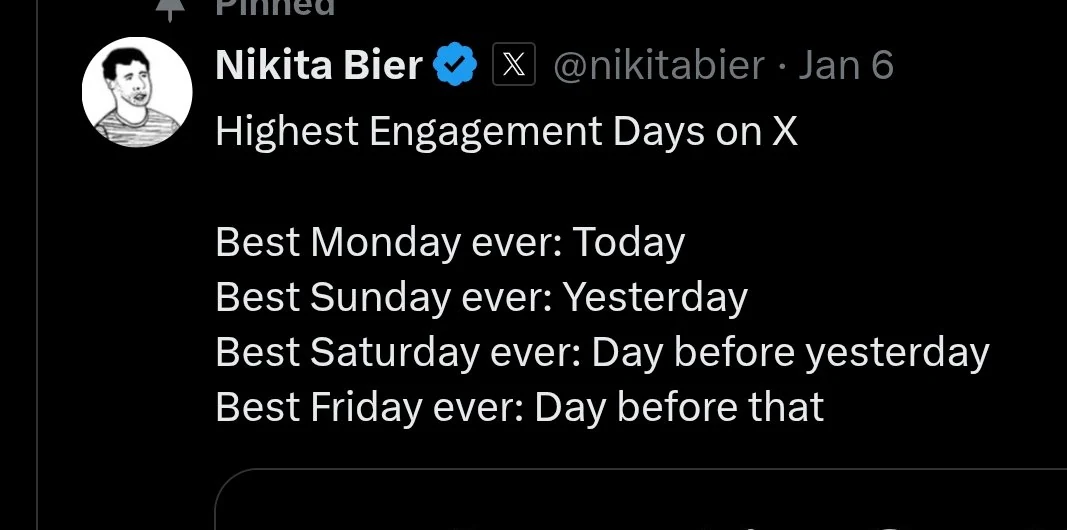
You wonder why CT has turned into shit and why people like Nikita Bier are saying what they are saying. Let’s look at what is actually measurable.
CT has been broken for a long time.
It was a gradual takeover by low effort posters, 100x hunters, launchpads, giveaways, and an environment where scamming faced NO resistance and often direct amplification.
➡️ The reasons are measurable.
After reviewing multiple datasets and reports, a consistent pattern emerges.
Content quality collapsed since Musk took over and since 2023.
Large scale analyses from 2024 and early 2025 by Similarweb, LunarCrush, Kaiko, and Messari show that more than 75% of crypto tagged posts fall into low effort categories.
GM spam, engagement bait, recycled memes, copy pasted narratives, and price predictions without data.
Despite low informational value, these posts receive the majority of impressions because they optimize for replies, likes, and short term interaction velocity.
According to LunarCrush, posts under 280 characters with no external links outperform long form analysis by more than 3x in reach, regardless of accuracy.
Financial incentives worsened the problem....
Chainalysis and TRM Labs estimate that over 40% of crypto promotional posts in 2024 were directly or indirectly incentivized through referrals, token allocations, or paid campaigns.
This shifts timelines toward marketing content rather than analysis. Launchpad promotions alone increased by over 2.5x year over year, crowding out organic research.
At the same time, the surrounding environment changed dramatically.
Since mid 2024, political content impressions on X more than doubled according to platform traffic data and independent tracking by Similarweb.
Moderation and contextual labeling declined in parallel.
Research from the Center for Countering Digital Hate and NewsGuard shows misinformation exposure on X increased by more than 60% year over year into 2025.
More than 60%!
This content is algorithmically amplified due to high emotional engagement.
This breaks discovery. High effort crypto analysis still exists, but it no longer propagates.
Engagement with high quality accounts does not solve the problem because the recommendation system prioritizes outrage velocity, repetition, and ideological alignment over relevance or expertise.
According to internal creator analytics shared publicly in 2025, posts triggering political or moral reactions receive up to 4x algorithmic resurfacing compared to neutral informational posts.
Nikita Bier was right that GM style posts are low value.
The deeper issue is systemic. Even high quality content has lost distribution surface area. It is buried under political misinformation, incentive driven spam, and emotionally optimized noise.
Network dynamics increasingly resemble platforms like Truth Social, where volume, tribal signaling, and repetition outperform accuracy, nuance, and expertise.
This is no longer a user behavior problem.....itis an algorithmic distribution failure.
Misinformation, disinformation, and low quality content are pushed by default.
Scams are a direct consequence of this environment.
According to Chainalysis and TRM Labs, crypto scam promotion on X increased sharply through 2024 and into 2025, with social media being the primary distribution channel for phishing links, fake presales, impersonation accounts, and coordinated rug pull marketing.
Scam posts consistently outperform legitimate warnings because they use the same engagement mechanics the algorithm rewards. urgency, promises of outsized returns, and social proof.
As moderation declined, scam networks adapted faster than users.
This results in a paradox where scams scale efficiently while education and prevention do not, further degrading trust and reinforcing dissatisfaction across CT.
And Web3 is effectively centralized on this garbage platform. How are we supposed to get smarter or better under these conditions?

For the few who are actually interested, here are the sources mentioned and links for a deeper dive.
➡️Algorithmic Amplification and Platform Dynamics on X
Platformer
How X’s algorithm increasingly boosts political and outrage content
https://t.co/ryI0QhdDMW
Washington Post
Elon Musk’s X algorithm amplifies anger, misinformation, and extreme content
https://t.co/PmMHRyk4dw
Pew Research Center
Engagement-based algorithms reward extreme, repetitive, and low-quality content
https://t.co/Ja3nVBuC29
➡️Political Content, Misinformation, and Moderation Decline
Center for Countering Digital Hate
Misinformation exposure on X increased by more than 60% year over year
https://t.co/8NzCN41JvM
NewsGuard
X is now the largest distributor of political misinformation among major platforms
https://t.co/Jw9XDj8I4I
Reuters
Reduced moderation on X correlates with increased disinformation reach
https://t.co/Hg6zPYjjYZ
➡️Content Quality Collapse and Engagement Farming
Similarweb
Traffic and content trends on X show shift toward short, high-engagement, low-information posts
https://t.co/3bTbn9rq8V
LunarCrush
Crypto social engagement analytics and content performance metrics
https://t.co/UpIePn2Lz0
Kaiko Research
Market narratives and social signal distortion in crypto markets
https://t.co/QWe6Sl9gRJ
Messari
Crypto media, incentives, and narrative degradation
https://t.co/RXKKOJsmqX
➡️Bots, Spam, and Incentivized Posting
Oxford Internet Institute
Coordinated inauthentic behavior and bot amplification on X
https://t.co/QDAyoVP98q
Atlantic Council DFRLab
Financial incentives distort online information ecosystems
https://t.co/3NW0ZZLmcN
➡️Why High-Quality Content Does Not Scale
MIT Media Lab / Science Journal
False and emotional content spreads up to 6x faster than factual information
https://t.co/IdGcp2wD0O
Harvard Kennedy School
Algorithmic amplification penalizes nuance and expertise
https://t.co/LV0FbD8br6
➡️Scams as a Systemic Outcome
Chainalysis
2025 Crypto Crime Report
https://t.co/1YCrEHMczl
TRM Labs
2025 Crypto Crime Report
https://t.co/JfeUiffPIK
Reuters
Crypto scams likely hit record levels in 2024 and 2025
https://t.co/4cea0PQgDr
Europol
Internet Organised Crime Threat Assessment
https://t.co/BBAvjtSyGg
➡️My Conclusion Supported by Evidence
Crypto collapsed earlier because it is highly incentive-sensitive.
The same dynamics are now visible across politics, science, journalism, and education.
Algorithms reward: Emotion over information
Speed over substance
Repetition over truth
This is documented, measured, and reproducible across platforms and datasets.
Thanks to the few who actually see this, read it, and engage with it.
These are hard times for us.
Fonti e pubblicazioni originali
Prove originali (19)
- www.platformer.news/p/x-algorithm-politics-engagement
- www.washingtonpost.com/technology/2024/10/12/x-algorithm-misinformation-anger/
- www.pewresearch.org/internet/2024/11/20/social-media-algorithms-and-content-quality/
- counterhate.com/research/x-twitter-election-misinformation-report/
- www.newsguardtech.com/special-reports/twitter-x-misinformation/
- www.reuters.com/world/us/social-media-scams-disinformation-2024-2025/
- www.similarweb.com/blog/insights/social-media-news/x-twitter-traffic-trends/
- lunarcrush.com/
- www.kaiko.com/research
- messari.io/research
- www.oii.ox.ac.uk/news-events/news/coordinated-inauthentic-behavior-on-x/
- www.atlanticcouncil.org/in-depth-research-reports/report/information-disorder-and-incentives/
- www.science.org/doi/10.1126/science.aap9559
- www.hks.harvard.edu/publications/algorithmic-amplification-and-democratic-decline
- go.chainalysis.com/2025-Crypto-Crime-Report.html
- www.trmlabs.com/reports-and-whitepapers/2025-crypto-crime-report
- www.reuters.com/technology/crypto-scams-likely-set-new-record-2024-helped-by-ai-chainalysis-says-2025-02-14/
- www.europol.europa.eu/iocta-report
- x.com/MastrXYZ/status/2010633858325033154