História e cronologias
Claude Shannon and the ideas beneath digital money
Every crypto transaction, every encrypted message and every computer running today ultimately rests on ideas that were formalized by one man: Claude Shannon.
 MASTR
MASTRPrimeira publicação 5 min · 989 palavras
Original publication · 15 Mar 2026. Figures, claims and opinions reflect the original publication date.
As publicações originais estão em inglês. A navegação está disponível em sete idiomas.
Most people using crypto today have never heard his name.
Yet every single transaction they make depends on his ideas.
Before Bitcoin.
Before the internet.
Before modern computers.
One man figured out something extraordinary.
He discovered that information itself obeys mathematical laws.
His name was Claude Shannon.
And without him, the digital world you use every day would not exist.
Every crypto transaction, every encrypted message and every computer running today ultimately rests on ideas that were formalized by one man: Claude Shannon.
Long before the internet, long before blockchain and long before modern computing exploded into everyday life, Shannon asked a deceptively simple question.
What is information?
In 1948 he published A Mathematical Theory of Communication. In it he did something revolutionary. He treated information not as language or philosophy, but as something that could be measured mathematically.
He introduced the smallest practical unit of information: the bit.
A binary digit.
Zero or one.
That simple abstraction became one of the foundations of the digital world.
Computers process bits.
Networks transmit bits.
Cryptography secures bits.
Blockchains record bits.
Without Shannon’s framework, none of these systems could exist in their modern form.
He also discovered something profound about communication itself. Every system that transmits information has a fundamental limit. A maximum rate at which data can travel without being corrupted by noise.
This boundary is known today as the Shannon Limit, and engineers still design communication systems around it, from fiber optics to satellites.
Before Shannon, communication engineering was largely based on experimentation. After Shannon, it became a mathematical science.
But Shannon’s influence goes even deeper.
He also laid crucial mathematical foundations for modern cryptography. During World War II he worked on secret communication systems for the U.S. military and later published a landmark paper called Communication Theory of Secrecy Systems.
In it he introduced the concepts of confusion and diffusion, principles that still define how modern encryption algorithms are designed today.
He also proved something astonishing: a system called the One-Time Pad is mathematically unbreakable when used correctly. This was the first time in history that secrecy had been proven with mathematics rather than trust.
Many of the ideas that later enabled secure digital systems, online banking and even cryptocurrencies build on this theoretical foundation.
Even the concept of data compression comes from Shannon’s theory. He showed that every message contains redundancy and that information can be compressed down to a theoretical limit determined by its entropy.
Every ZIP file, every streaming service, every compressed image and audio format relies on principles derived from this insight.
Yet Shannon himself was an unusual figure.
At Bell Labs, one of the greatest research institutions ever created, he spent his days working on abstract mathematics and his nights building strange machines purely out of curiosity.
He built a robotic mouse called Theseus that could learn its way through a maze and remember the correct path. It was one of the earliest demonstrations of machine learning decades before the term became popular.
He built mechanical puzzle solving machines.
He designed juggling robots.
He even created a wearable computer to predict outcomes in roulette, one of the earliest experiments in wearable computing.
Colleagues often saw him riding a unicycle through the halls of Bell Labs while juggling, thinking through difficult problems. For Shannon, play and curiosity were inseparable from discovery.
Despite shaping the digital age, he never pursued fame. He published relatively little compared to other scientists, but almost everything he wrote changed an entire field.
And perhaps the most fascinating detail is this:
Claude Shannon also wrote the very first academic paper on artificial intelligence in chess. In 1950 he proposed algorithms for how a computer could evaluate positions and search moves. Modern chess engines and many AI search systems still rely on concepts that trace back to that work.
He was also among the first scientists to explore the mathematics of machine learning, communication networks and complex systems decades before these fields became mainstream.
What makes Shannon remarkable is not just what he discovered, but how quietly he changed the world.
By turning information into mathematics, he gave humanity the tools to build the digital age.
Every computer, every secure communication channel, every compressed file, every AI model and every crypto transaction ultimately depends on principles that trace back to that single insight.
Information can be measured.
Information can be encoded.
Information can be transmitted.
And once Shannon showed how, the modern world began to take shape.
In many ways, the digital civilization we live in today is not just built on silicon and software.
It is built on Shannon’s idea that information itself obeys the laws of mathematics.
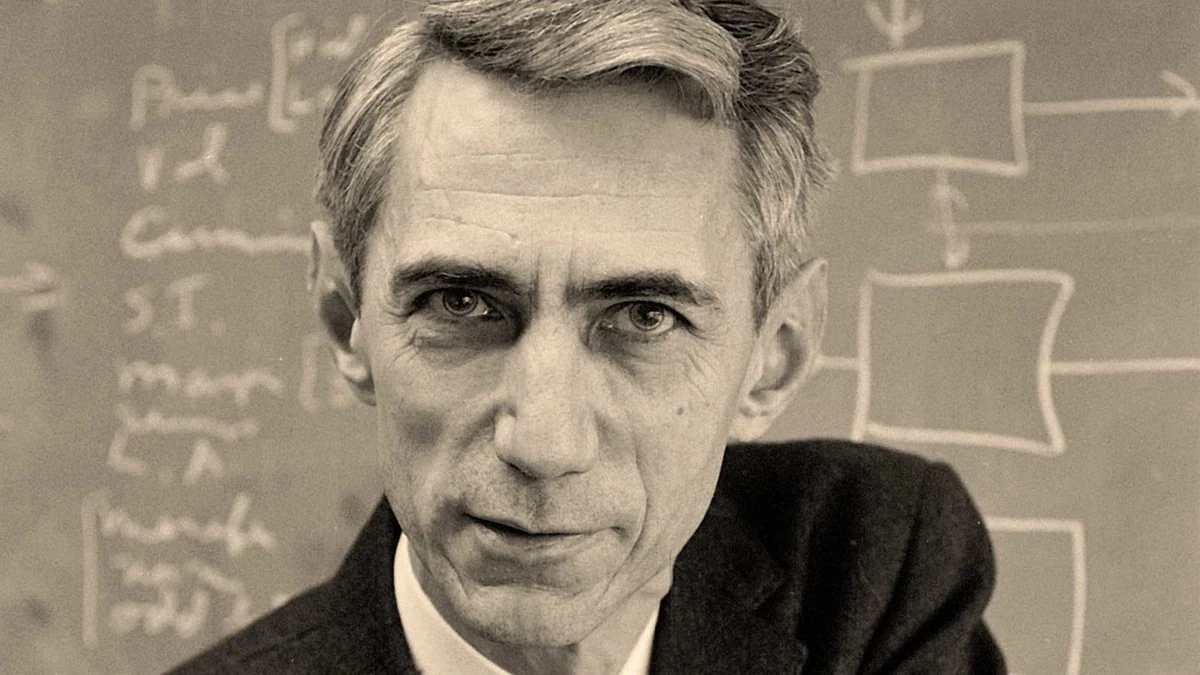
If you want to learn more about Claude Shannon, these are some of the best links I've found:
1. The original paper that started the digital age
Claude Shannon’s 1948 paper that founded information theory and introduced the concept of the bit. This work explains how information can be measured, transmitted and compressed.
https://t.co/LXWK8BWfEX
2. MIT overview of Shannon and information theory
Clear explanation of how Shannon transformed communication engineering into a mathematical science and why his ideas are the foundation of modern computing and networks.
3. IEEE Information Theory Society resources
Collection of lectures, papers and educational resources about information theory from the main professional organization in the field.
4. Shannon’s cryptography breakthrough
Explanation of Shannon’s work that made cryptography a mathematical science and introduced the concepts of confusion and diffusion.
5. Claude Shannon biography
A detailed biography covering Shannon’s life, Bell Labs research and his influence on computing, cryptography and digital communication.
6. One of the best books about Shannon
A Mind at Play tells the story of how Shannon invented information theory and quietly shaped the entire digital world.
7. Documentary about Shannon
The documentary The Bit Player explores Shannon’s life, his inventions and why his ideas still power the digital world today.
Fontes e publicações originais
Provas originais (7)
- people.math.harvard.edu/~ctm/home/text/others/shannon/entropy/entropy.pdf
- cmsw.mit.edu/claude-shannon-making-information-theory/
- www.itsoc.org/resources/resources-on-information-theory
- en.wikipedia.org/wiki/Communication_Theory_of_Secrecy_Systems
- en.wikipedia.org/wiki/Claude_Shannon
- www.amazon.com/Mind-Play-Claude-Shannon-Invented-Information/dp/1476766681
- www.thebitplayer.com/