

MASTR · CRYPTO & WEB3
The launch economy: bots, bundles and the meaning of a holder count
The research literature and MASTR’s archive help separate activity, execution advantage, revenue and evidence of coordinated ownership.
Los capítulos y gráficos técnicos están en inglés. La navegación está disponible en siete idiomas.
Who is paid even when the trader does not profit?
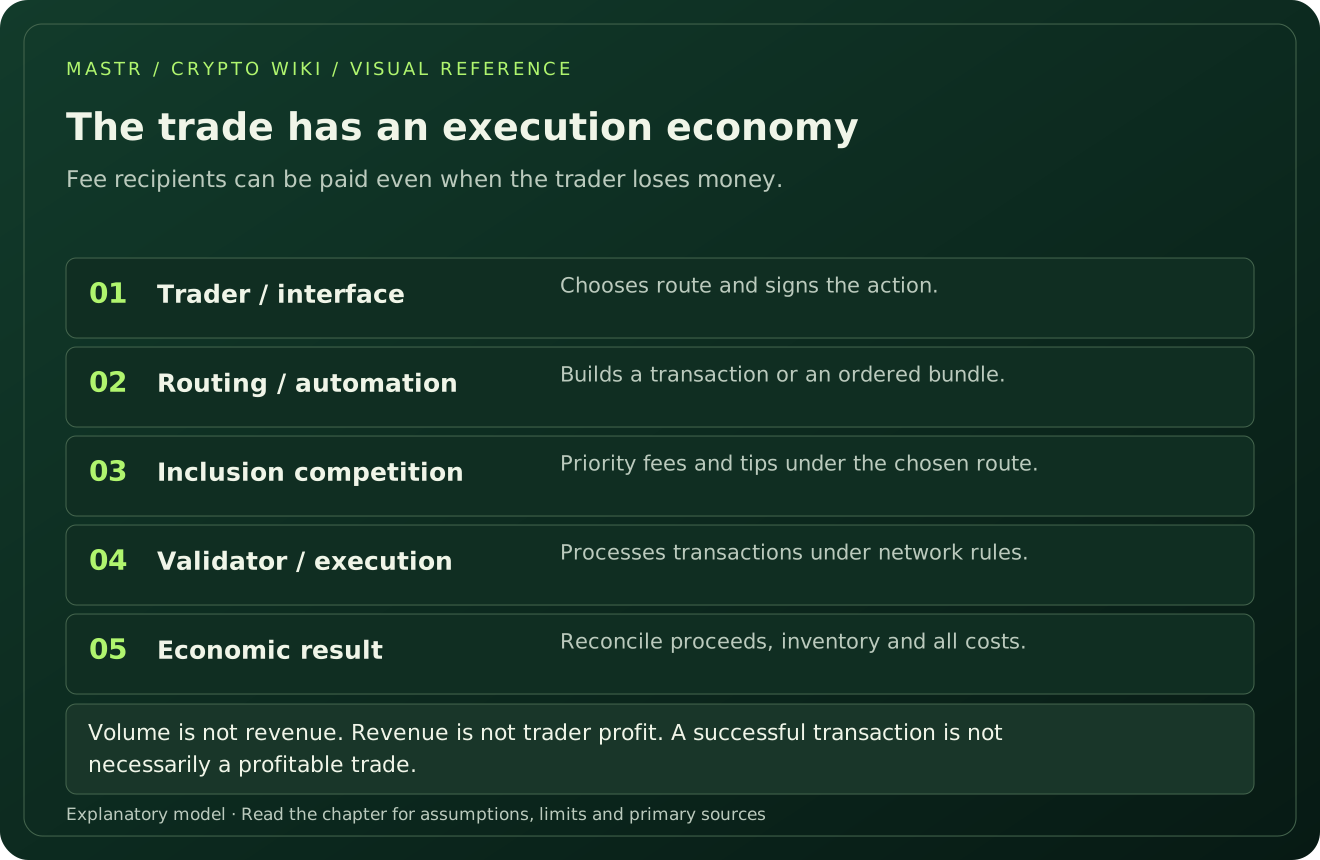
A token launch is also an execution market
Before a human sees a chart, automated participants may already be monitoring state changes, constructing transactions and competing for inclusion. A trader can pay network fees, priority fees, routing or interface fees and tips under the chosen execution path. Those recipients need not share the trader’s economic outcome. A technically fast network can support useful applications and very intense competition over trading opportunities at the same time.
Research samples have boundaries
The 2026 paper Demystifying Solana Bots studies 586 public repositories and 200 bot-associated addresses with more than 44 million transactions. The repository sample and address sample answer different questions. The paper’s observations should not be treated as a census of all bots, a complete measure of their profit or proof that all automated trading is abusive. Arbitrage, execution management and liquidation can provide useful functions; sandwiching raises a different question about another trader’s worsened execution.
Surviving launches are not all launches
MemeTrans studies more than 40,000 launches that successfully migrated to a public DEX, using activity before and after migration and features including wallet relationships. That selection is important: a result for migrated tokens is not automatically a result for every token created on a launchpad. Statistical risk labels also do not establish a legal finding against an individual project. Preserve the denominator, observation window and labelling method whenever quoting a headline percentage.
Addresses are not independent people
A holder list can contain several addresses controlled by one party. Conversely, a shared service or funding source can connect addresses that belong to different people. Same-block purchases and shared bundles may be useful leads, but their meaning depends on transaction instructions, funding, timing and service behaviour. The right response is to investigate the relationship, not to convert every line on a graph into an identity claim.
Follow the payments and the inventory
Start with the token mint, the creation transaction and the earliest acquisitions. Separate newly obtained inventory from later transfers of the same inventory. Then distinguish sale proceeds from swaps, fees and internal movements. Measure execution costs alongside trading results. MASTR’s longer source article is available as a dated reading edition; this reference chapter explains how to assess its categories without turning historical snapshots into current market statistics.
Ejemplo explicado
Ten addresses each holding 2% do not by themselves prove ten independent holders or one 20% insider. Common funding can strengthen a hypothesis, but an exchange withdrawal service could also explain part of the pattern. The claim should grow only as the evidence grows.
Preguntas para recordar
- Preserve the sample and denominator.
- Separate fees, revenue, volume and profit.
- Treat clustering as a hypothesis requiring evidence.