Structure des marchés
Solana extraction: fees, launches and retail losses
A dated examination of value leaving the Solana trading ecosystem through launches, fees and promotional incentives.
 MASTR
MASTRPremière publication 7 min · 1,472 mots
Original publication · 26 Apr 2025. Figures, claims and opinions reflect the original publication date.
Les publications originales sont en anglais. La navigation est disponible en sept langues.
Originally published as “Up to $10 billion extracted from Solana? Greed and Scams”
How Much More Money Would Be in Solana’s Circulation Without Scams and Rug Pulls?
The Solana blockchain, renowned for its high-speed transactions and low fees, has emerged as a powerhouse in the cryptocurrency ecosystem. However, its meteoric rise has been marred by a darker side: scams and rug pulls that have siphoned off billions of dollars from investors. These fraudulent activities, particularly prevalent in the meme coin and decentralized finance (DeFi) spaces, have not only eroded trust but also significantly reduced the capital circulating within Solana’s ecosystem. This article explores how much more money might be in circulation on Solana if these scams and rug pulls had been prevented, delving into the scale of losses, their impact, and the potential for a healthier financial ecosystem.
The Scale of Scams and Rug Pulls on Solana
Rug pulls, a type of exit scam where developers abandon a project and abscond with investor funds, have become a persistent issue on Solana. The blockchain’s low transaction fees and ease of token creation, particularly through platforms like Pump.fun, have made it a fertile ground for fraudsters. According to a 2024 report by Hacken, Solana became the top platform for rug pulls, with over 80% of the 4 million tokens launched on the network ending in scams. In April 2024 alone, 27 presale scams on Solana resulted in over $122.5 million in losses.
High-profile incidents further illustrate the problem. The $LIBRA token, endorsed by Argentine President Javier Milei in February 2025, collapsed in a rug pull, contributing to Solana’s tarnished reputation. Similarly, the HAWK token, launched by Haliey Welch in December 2024, plummeted over 90% in hours after reaching a $490 million market cap. Posts on X estimate that between $3 billion and $10 billion has been extracted from Solana’s meme coin ecosystem by various actors, with the real figure likely leaning toward the higher end.
Historical data also paints a grim picture. A 2021 rug pull in the Solana ecosystem stole nearly $10 million, while the Big Daddy Ape Club NFT scam in 2022 defrauded investors of $1.3 million. Luna Yield, another Solana-based project, vanished with $10 million in investor funds. Cumulatively, these incidents suggest that rug pulls and scams have drained billions from Solana’s ecosystem over the years.
Estimating the Financial Impact
Quantifying the exact amount lost to scams and rug pulls is challenging due to the decentralized and often opaque nature of blockchain transactions. However, combining available data provides a rough estimate:
- 2024 Hacken Report: Over 80% of Solana’s 4 million tokens were rug pulls, with $122.5 million stolen in April 2024 alone from presale scams. If we extrapolate this figure across the year, assuming similar activity, losses could range from $1.5 billion to $3 billion for 2024 alone.
- suggests $3 billion to $6 billion extracted from Solana’s meme coin ecosystem, with the true figure potentially exceeding $10 billion.X Post Estimates: A rough estimate by@0xngmi
- Historical Scams: Major rug pulls like Luna Yield ($10 million), Big Daddy Ape Club ($1.3 million), and others likely account for hundreds of millions in additional losses from 2021 to 2023.
Conservatively, let’s assume $5 billion has been lost to scams and rug pulls since Solana’s rise to prominence in 2021. This figure aligns with the lower end of X post estimates and accounts for documented incidents. However, given the exponential growth of token creation and the lack of comprehensive tracking, the actual amount could be closer to $10 billion or higher.
Impact on Solana’s Circulating Capital
Solana’s native token, SOL, powers its ecosystem, and its market capitalization reflects the capital available for transactions, staking, and DeFi activities. As of April 26, 2025, SOL’s price is approximately $162, with a circulating supply of roughly 470 million tokens, yielding a market cap of about $76 billion. The money lost to scams and rug pulls directly reduces the capital that could have been reinvested into legitimate projects, staked for network security, or used to drive transaction volume.
If $5 billion to $10 billion had not been lost, this capital could have remained in circulation, potentially:
- Boosting Market Capitalization: An additional $5 billion in circulation could increase Solana’s market cap by roughly 6.6% (from $76 billion to $81 billion), assuming no immediate price impact. A $10 billion injection could raise it by 13.2%, pushing the market cap to $86 billion.
- Enhancing DeFi and DEX Activity: Solana’s decentralized exchange, Raydium, has outperformed Ethereum’s Uniswap in trading volume, but scams like Pump.fun have drained liquidity. The lost $5 billion to $10 billion could have bolstered liquidity pools, increasing trading volumes and attracting more developers and users to Solana’s DeFi ecosystem.
- Strengthening Network Security: Staking is critical for Solana’s proof-of-stake consensus. Additional capital could have been staked, increasing the number of validators and enhancing network security, which is vital as Solana competes with Ethereum and other layer-1 blockchains.
- Fostering Innovation: The lost funds could have supported legitimate projects, fostering innovation in areas like decentralized applications (dApps), gaming, and NFTs. Instead, the prevalence of scams has deterred some developers and investors, slowing ecosystem growth.
The Ripple Effects of a Scam-Free Solana
Beyond the direct financial impact, a Solana ecosystem free of scams and rug pulls would likely enjoy:
- Improved Reputation: Solana’s reputation has suffered due to its association with meme coin scams and rug pulls, as noted by analysts like DonAlt and Ethereum’s Vitalik Buterin. A cleaner ecosystem could restore investor trust, attracting institutional capital and mainstream adoption.
- Higher Token Prices: Increased trust and capital retention could drive SOL’s price higher. If $10 billion remained in circulation, demand for SOL could push its price beyond $200, assuming a supply-demand dynamic similar to past bull runs.
- Regulatory Relief: The U.K.’s Financial Conduct Authority (FCA) blocked Pump.fun in 2025 to curb fraud, highlighting regulatory scrutiny. A scam-free Solana might face less regulatory pressure, allowing for smoother global expansion.
Challenges in Preventing Scams
Preventing rug pulls is not straightforward. Solana’s open and permissionless nature, while a strength, enables bad actors to launch tokens with minimal oversight. Tools like RugCheck and Jupiter have introduced indicators to detect suspicious activity, such as the “Permanent Delegate” extension used to burn tokens. However, scammers continue to evolve, exploiting platforms like Pump.fun and manipulating tokenomics to evade detection.
Community efforts, like the takeover of a rug-pulled coin by its investors, show resilience but are not scalable solutions. Regulatory interventions, third-party audits, and investor education are critical but face challenges in a decentralized ecosystem. As one Reddit user noted, “99.9% of stuff released on Solana is a scam,” reflecting the pervasive distrust that hampers growth.
A Vision for a Stronger Solana
If Solana had avoided the $5 billion to $10 billion lost to scams and rug pulls, its ecosystem could be significantly richer, with a market cap potentially exceeding $80 billion, deeper DeFi liquidity, and a stronger developer community. The absence of these losses would have bolstered investor confidence, reduced regulatory headwinds, and positioned Solana as a more formidable competitor to Ethereum.
To realize this vision, Solana’s community and leadership must prioritize fraud prevention through enhanced token creation controls, mandatory audits, and better investor education. While the blockchain’s technical prowess remains unmatched, its long-term success hinges on restoring trust and ensuring that capital stays in circulation for legitimate innovation. Only then can Solana fulfill its potential as a cornerstone of decentralized finance.
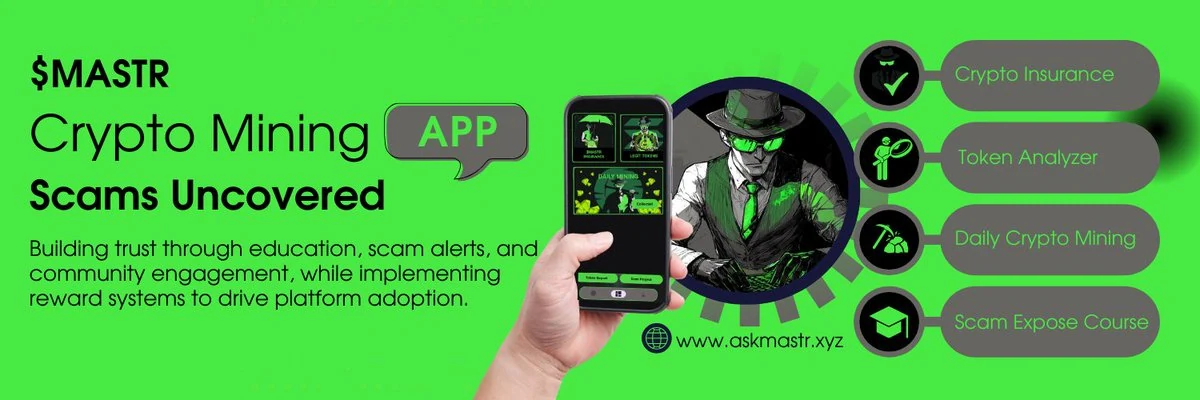
Why $MASTR Is the Real Movement Against the Scam Crisis
Billions of dollars have been stolen from honest investors — and now, ironically, cheap imitators pretend to fight scams while offering no real protection.
Some of them are not just ineffective - they are scams themselves.
$MASTR is different.
We are the original movement that dared to attack this issue at its root: before the scams happen.
Not with empty promises.
Not with lazy tools.
But with real human investigation, live pre-investment checks, ongoing monitoring, and an ecosystem built for prevention — not reaction.
Why $MASTR?
Because we didn’t just notice the problem — we committed to fixing it while everyone else was silent or complicit.
Because we aren’t here to ride the trend — we are here to end the era where scams drain billions and honest builders get buried.
Because we expose scams before they can destroy, not after.
Because trust is built through action, not empty marketing.
$MASTR is not a clone, not a reaction, not a trend.
It is the shield crypto needs, the standard Solana deserves, and the frontline of the fight to reclaim the billions that should fuel real innovation — not fraud.
The future doesn’t belong to copycats. It belongs to builders.
$MASTR is leading. The rest are just chasing.
Sources:
- Hacken Report on Solana Rug Pulls, 2024
- Bitrue Article on Solana’s Rug Pull Phenomenon, 2025
- Reddit Discussions on Solana Scams, 2021–2024
- X Posts on Solana Meme Coin Losses, 2024–2025
- Decrypt Articles on Solana NFT Scams, 2022–2024