Réseaux et infrastructure
Solana’s infrastructure and ecosystem: a December 2025 review
Solana won the speed war, then spent years paying interest on that architectural debt. Today the brand lives in 2 parallel realities: a high-throughput base layer that genuinely ships, and an ecosystem layer where outages, exploits, insider…
 MASTR
MASTRPremière publication 7 min · 1,470 mots
Original publication · 21 Dec 2025. Figures, claims and opinions reflect the original publication date.
Les publications originales sont en anglais. La navigation est disponible en sept langues.
Solana is my chain, but it is time to grow up.
Heads must roll.
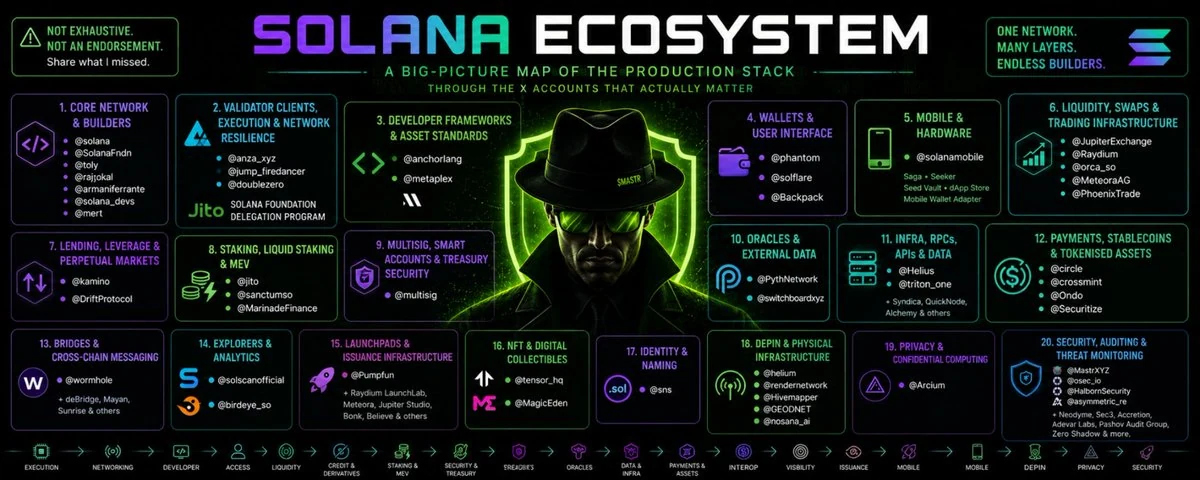
Here is a non-exhaustive list.
Solana won the speed war, then spent years paying interest on that architectural debt. Today the brand lives in 2 parallel realities: a high-throughput base layer that genuinely ships, and an ecosystem layer where outages, exploits, insider coordination, MEV extraction, political theatre, and retail liquidation repeat with industrial consistency.
The issue is not that Solana has scandals.
Every major chain does.
The issue is the pattern.
The problem is that it is embedded in the culture, and everyone who built it profits from it.
1) Reliability: the chain that kept stopping:
Solana has a documented history of mainnet halts and severe performance degradation that required coordinated validator restarts. These were not cosmetic slowdowns. They were liveness failures.
On June 1, 2022, Solana itself reported that the network stopped producing blocks due to stalled consensus triggered by a bug in durable nonce transactions. Validators had to manually coordinate a restart and temporarily disable functionality to restore the chain.
A system that markets itself as global financial infrastructure but requires human orchestration to recover from load is not neutral software. It is managed infrastructure under stress.
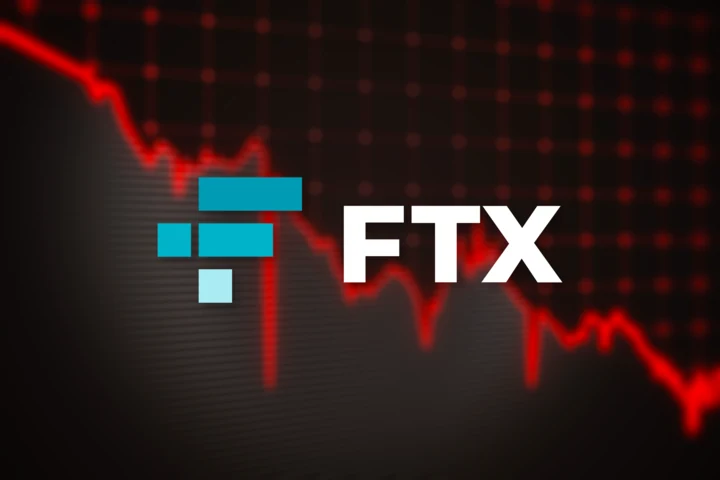
2) The FTX stain: not a meme, an actual dependency shock:
When FTX collapsed, Solana took disproportionate damage because the ties were real. Solana Foundation publicly disclosed exposure to FTX-related entities, assets, and ecosystem components.
This was not narrative contagion. It was dependency risk materialising.
Solana was structurally intertwined with FTX-era liquidity, tooling, and reputation, and when that pillar collapsed, confidence collapsed with it.
3) Serum: when upgrade authority becomes a single point of failure:
Serum became the clearest illustration of Solana’s governance blind spots. The protocol’s upgrade authority was tied to FTX. Once FTX collapsed, Serum was effectively dead.
The community fork was not innovation. It was damage control.
One compromised key invalidated an entire market. This exposed how much “decentralised” DeFi on Solana relied on invisible trust assumptions that retail never consented to.
4) Wormhole: bridges are systemic honeypots:
The Wormhole exploit in February 2022 drained approximately 120000 ETH, valued at over $320 million. It became one of the largest DeFi hacks in history.
Jump later backstopped the losses, but that does not negate the lesson.
Solana did not break at the base layer. Everything built on top of it did.
Composability plus bridges plus speed equals systemic blast radius.
5) Cashio: stablecoin design failure as a money printer:
Cashio collapsed in March 2022 due to an infinite mint vulnerability caused by missing collateral validation. Over $52 million was drained.
This was not advanced adversarial cryptography.
It was absent checks.
A stablecoin marketed as functional collapsed because fundamental verification logic was missing.
6) Mango Markets: manipulation as exploit, then regulators:
Mango Markets lost roughly $116 million after an attacker manipulated the price of the MNGO token to inflate collateral value and drain funds.
The attacker called it a “trading strategy.”
US regulators called it fraud and market manipulation.
Courts agreed.
This case permanently shattered the myth that economic exploits are morally neutral when incentives allow them.
7) The 2022 wallet drain: not Solana core, but Solana reality:
In August 2022, more than 9000 wallets were drained. Solana stated that private keys were compromised at the application wallet level, not the core protocol.
For users, this distinction is irrelevant.
Their funds were gone.
Security is not defined by where responsibility ends on a diagram. It is defined by outcomes.
8) Decentralisation: better metrics, but power is still power:
Solana promoted a Nakamoto coefficient of 20 in 2025, implying that 20 validators would need to collude to censor the network.
This sounds reassuring.
It ignores where power actually lives.
Transaction ordering, private relays, validator client dominance, and MEV routing determine who extracts value and who becomes exit liquidity.
9) MEV and order flow: when “fast” becomes “rigged”:
Solana’s MEV stack matured into an arms race.
Private order flow, priority fees, Jito dominance, and validator side agreements recreated mempool asymmetry in compressed timeframes.
Academic research in 2025 quantified sandwiching attacks on Solana despite architectural differences from Ethereum.
Speed did not remove extraction.
It made it harder to see and faster to execute.
10) Pumpfun: memecoin manufacturing as an extraction pipeline:
Pumpfun industrialised memecoin launches into an assembly line.
Solidus Labs reported that the overwhelming majority of Pumpfun tokens showed indicators of fraud or manipulation.
Raydium pools linked to these launches showed similar patterns.
This is not a few bad actors.
This is scale.
11) “5000 private messages”: lawsuits alleging an insider-rigged casino:
Legal filings and reporting described lawsuits referencing roughly 5000 private messages allegedly coordinating insider behaviour, early access, queue jumping, and extraction strategies.
Whether every allegation survives court is secondary.
The existence of such evidence at this scale indicates systemic rot.
12) LIBRA: political memecoin theatre, Meteora as the launch rail:
The LIBRA token scandal linked to Argentina’s president Javier Milei followed the same template seen elsewhere: concentrated early ownership, bot-driven early buys, rapid liquidity extraction, and political branding as camouflage.
The token launched on Meteora.
Solana’s infrastructure was not adjacent to the event.
It was the execution layer.
13) Meteora: when “just infrastructure” keeps appearing at the crime scene:
Meteora repeatedly appears at the centre of controversial launches.
Reuters reported that LIBRA launched on Meteora and that Meteora co-founder Ben Chow later stepped down amid scrutiny.
Separate lawsuits alleged that many other tokens launched via Meteora saw up to 95% of supply controlled by roughly 150 insider wallets within minutes.
Infrastructure neutrality collapses when the same venue repeatedly produces the same outcome.
14) Melania, jail time, and hacked megaphones: the full pipeline:
Legal filings described Melania Trump being used as window dressing in a repeatable memecoin pump-and-dump template involving the same actors and mechanics.
At the same time, enforcement did occur at the edges. A former Pumpfun developer received a 6-year prison sentence in London for stealing approximately $2 million in SOL.
Operators get punished.
The machine survives.
The final layer is distribution: hacked celebrity and high-reach social accounts repeatedly used to push Solana memecoin scams.
Compromised trust becomes instant liquidity.
15) Trump tokens: political branding as exit liquidity:
Trump-branded tokens followed the same mechanical pattern already observed with LIBRA and Melania: early insider concentration, fast liquidity bootstrapping, aggressive social amplification, then sharp drawdowns.
The Trump name functioned as political legitimacy theatre.
Whether Trump himself was directly involved or merely symbolically leveraged is irrelevant.
Retail liquidity flowed into structures optimised for early extraction.
16) Recycled insider wallets: the same hands, different tickers:
On-chain analysis repeatedly shows overlapping wallet clusters across supposedly unrelated Solana memecoin launches.
The same early wallets appear in Pumpfun launches, Meteora launches, political tokens, celebrity tokens, and “fair launch” experiments.
They enter early, exit early, and leave identical liquidity cliffs behind.
This is not coincidence.
17) The Solana main account problem: when the chain behaves like a memecoin:
The official @solana account on X increasingly behaves like a memecoin marketing account rather than a neutral protocol steward.
It amplifies hype, retweets questionable projects, interacts with meme launches, and indirectly legitimises accounts that later turn out to be scams or extraction vehicles.
Whether intentional or negligent, the effect is the same: scammers receive protocol-level social validation.
When the chain’s own main account acts as an engagement engine instead of a gatekeeper, it collapses the boundary between infrastructure and promotion.
18) The grey zone: plausible deniability as a business model:
Most actors never explicitly promise profits.
They retweet.
They comment.
They “react.”
This creates legal fog while maintaining economic effect.
Solana’s ecosystem has become fluent in operating just below enforcement thresholds while preserving extraction efficiency.
19) Validators, relays, and silent alignment:
Validators running the same clients, connected to the same relays, routing through the same MEV pipelines create silent alignment without explicit collusion.
No meeting is required.
Incentives align automatically.
This is why decentralisation metrics fail to capture lived reality.
20) The normalisation problem:
Outages became memes.
Rugs became content.
Exploits became “learning experiences.”
When failure is normalised, accountability disappears.
When accountability disappears, abuse scales.
21) Why “just infrastructure” is no longer credible:
Infrastructure is not neutral when it repeatedly enables the same outcome.
Exchanges, launch platforms, tooling, and social amplification form a pipeline.
If the same pipeline produces the same harm, responsibility is shared.
Neutrality is a choice.
22) The adult standard:
Solana is no longer small.
It is no longer experimental.
It is no longer naive.
With scale comes duty.
With duty comes accountability.
Solana is my chain.
That is exactly why the standard must be higher.
Growing up means consequences.
Not threads.
Not PR.
Not “we are investigating”.
Real exclusions.
Real liability.
Real accountability.
Heads must roll.
Thanks for reading



Thanks for reading.
Maybe you would like to support our movement.