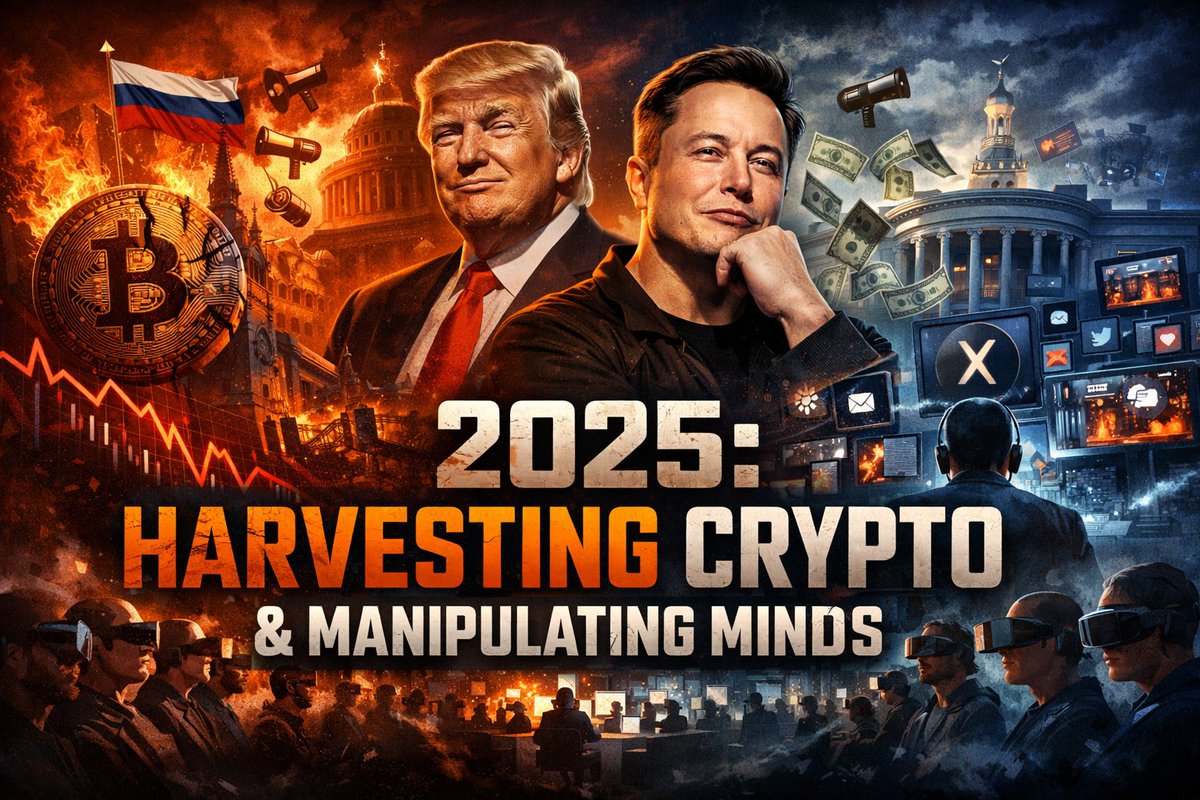
2025 was a damn disgrace of a year.
A damn disgrace for crypto.
A damn disgrace for this garbage app swamp of steaming nonsense.
A damn disgrace for truth and decency.
A damn disgrace for the world.
To understand 2025 properly, it must be analysed as a systemic convergence of political economy, cognitive science, and platform engineering.
What collapsed was the boundary between power, narrative, and extraction.
Crypto in 2025 entered what economists describe as an extraction equilibrium.
Value was no longer primarily created through innovation or adoption. It was harvested through asymmetry.
This follows the logic described by George Akerlof. When insiders control information, markets select against quality and in favour of exploitation. Rational actors do not build better products. They design better exit timing.
The October liquidation event made this visible in raw data. Waaay more than 19000000000 USD in leverage was erased within hours. Binance printed anomalous lows across 103 USDT pairs, many exceeding 50 percent deviation from other major exchanges. In market microstructure theory, this is price discovery failure. When the dominant venue produces distorted reference prices, liquidation engines downstream treat distortion as truth. The cascade becomes self validating.
This is precisely why the pardon of Changpeng Zhao mattered.
When Donald Trump granted clemency to the Binance founder after a guilty plea and a 4.3 billion USD settlement, it altered the expected cost of misconduct. Regulatory economics is clear on this point. Deterrence requires certainty, not severity.
Once enforcement becomes reversible through political power, expected punishment approaches zero. Extraction becomes the dominant strategy.
Political extraction did not stop at exchanges.
The presidential family identified crypto as a monetisation vector. Public financial reporting showed more than 800000000 USD in crypto related income tied to Trump affiliated entities in the first half of 2025 alone.
This was rent extraction via brand authority. Political legitimacy was converted into token issuance, preferential access, and narrative insulation.
The deeper implication is structural. Crypto stopped being adversarial to power and became instrumental to it. This marks a regime shift.
Once political elites treat tokens as revenue instruments, the system no longer disciplines power. It services it.
All of this unfolded within a degraded epistemic environment. Manipulation in 2025 was rarely explicit lying. It was saturation.
Cognitive psychology describes the illusory truth effect, where repetition increases perceived accuracy independent of evidence.
This effect has been replicated across decades of experimental research. Scale turned it into a weapon.
Research from the MIT demonstrated that false information spreads faster and further than factual corrections, especially when emotionally charged.
Platform incentives amplify this bias. Engagement based ranking systems reward content that triggers arousal.
Outrage outperforms accuracy. Certainty outperforms nuance.
The ownership and signal amplification role of Elon Musk intensified these dynamics. High status engagement acts as algorithmic endorsement.
Markets, political discourse, and social consensus responded not to evidence, but to visibility. At that scale, intention is irrelevant. Structural impact dominates.
Russian information operations exploited the same substrate. Intelligence research describes the firehose of falsehood model as high volume, rapid, repetitive messaging with no commitment to internal consistency. The objective is not belief. It is confusion. Confusion lowers coordination capacity. When shared reality dissolves, resistance fragments.
This aligns precisely with the warning issued by Hannah Arendt. She observed that the most dangerous condition is not widespread belief in lies, but the collapse of the distinction between fact and fiction.
In such conditions, truth loses authority entirely. Power no longer needs persuasion. It needs repetition.
Crypto discourse converged on X because it had no functional alternative. Price discovery narratives, developer coordination, governance debates, and crisis response all occurred there.
This dependence is structural. But X is optimised for speed, virality, and conflict. Complex systems require slow cognition. X selects for fast conviction.
An additional accelerant in 2025 was the role of KOLs. Key opinion leaders in crypto functioned less as analysts and more as distribution nodes. Economic incentives aligned them with volume, not accuracy.
Sponsored narratives, undisclosed allocations, and reflexive promotion created feedback loops where belief preceded understanding. This mirrors classic principal agent problems. The audience assumed expertise. The incentive structure rewarded persuasion.
This dynamic fed directly into widespread financial illiteracy. Large segments of market participants lacked basic understanding of leverage, liquidity, counterparty risk, or market microstructure.
Behavioral finance has long shown that low literacy environments amplify herd behavior and overconfidence. In 2025, complexity met ignorance inside engagement driven platforms. The result was predictable. Retail participants absorbed volatility they could not model, risks they could not price, and narratives they could not verify.
Decades of cognitive science show that environments shape reasoning.
Constant exposure to low quality, high velocity information degrades analytical capacity over time. Probability collapses into certainty. Skepticism is reframed as weakness. Confidence without comprehension scales effortlessly.
This is why crypto did not merely become corrupt. It became intellectually thinner. Technical arguments lost ground to slogans. Risk modelling lost to memes. Governance discourse lost to personality cults.
Intelligence was selected against by the environment.
The system functioned exactly as designed.
Platforms optimised for engagement.
Political actors optimised for extraction.
Exchanges optimised for dominance.
Influencers optimised for reach.
None of this required conspiracy. It required alignment of incentives.
As Noam Chomsky noted, control does not require suppressing debate. It requires limiting the range of acceptable conclusions.
Crypto discourse in 2025 appeared pluralistic, but foundational assumptions were rarely questioned. Centralisation was debated, but rarely rejected. Manipulation was individualised, not structural.
So 2025, a year where extraction outpaced creation, repetition outperformed evidence, and power discovered that crypto was no longer a threat, but a tool.
The tragedy is not that people were deceived.
The tragedy is that the system made deception efficient.