Estrutura de mercado
Conflict, liquidity and crypto: a March 2026 scenario analysis
Within the first 24 hours after the large-scale US-Israeli strike on Iranian strategic targets, total crypto market capitalisation fell by roughly 5 – 8 %, Bitcoin dropped about 6 – 9 %, and leveraged long positions worth more than $1…
 MASTR
MASTRPrimeira publicação 6 min · 1,157 palavras
Original publication · 1 Mar 2026. Figures, claims and opinions reflect the original publication date.
As publicações originais estão em inglês. A navegação está disponível em sete idiomas.
How Will the Renewed Open Middle East Conflict Impact Crypto? What does that mean for your wallet?
And what the foolish warmongers will not tell you:
An analysis and interpretation:
The first market reaction confirms a structural truth that has been visible since 2020.
In acute geopolitical shocks, crypto behaves as the most liquid global risk proxy.
Within the first 24 hours after the large-scale US-Israeli strike on Iranian strategic targets, total crypto market capitalisation fell by roughly 5 – 8 %, Bitcoin dropped about 6 – 9 %, and leveraged long positions worth more than $1 billion were liquidated across derivatives exchanges.
It is a function of liquidity, 24 / 7 price discovery and the fact that Bitcoin is now held inside institutional multi-asset portfolios.
The macro transmission mechanism runs through energy, rates and the dollar.
Iran produces about 3.3 – 3.5 million barrels of oil per day and sits on the northern side of the Strait of Hormuz, through which around 20 % of global oil consumption and roughly 30 % of seaborne oil trade flows. Even a partial disruption historically adds $10 – $25 per barrel in risk premium within days.
Every $10 increase in oil raises global inflation by approximately 0.3 – 0.4 percentage points. That directly reduces the probability of rate cuts and tightens global dollar liquidity.
Crypto is highly sensitive to global M2 and real yields. When real yields rise by 1 %, Bitcoin has historically repriced downward by 15 – 25 % in the following months.
So the short-term reaction is not about war in a moral sense. It is about the repricing of global liquidity.
The strategic question is whether a military strike can produce the political outcome it claims to target.
🚨
Regime-change-through-external-force has a measurable empirical record.
Since 1945, there have been more than 20 major attempts to remove governments through direct or indirect US military intervention. In the cases of Iraq, Libya and Afghanistan, the removal of the existing regime did not produce stable pro-Western democracies.
It produced power vacuums, civil war or the return of the original ideological force in a more radical form. Afghanistan ended with the Taliban controlling more territory in 2021 than in 2001.
Iraq’s war caused over 200 000 civilian deaths, destabilised the region and strengthened Iran’s strategic depth rather than weakening it.
Iran is structurally different from those cases in one crucial dimension. The regime has a deep internal coercive architecture.
Key internal control pillars:
• Islamic Revolutionary Guard Corps approximately 190 000 personnel
• Basij paramilitary network estimated 1 – 2 million mobilisable members
• Ministry of Intelligence and extensive surveillance infrastructure
• State-controlled economic conglomerates controlling roughly 20 – 40 % of GDP
This creates a vertically integrated security state.
The regime does not rely on electoral legitimacy. It relies on control capacity.
Even during the largest protests in recent years, with hundreds of thousands of participants, the state maintained territorial and institutional control.
External military pressure historically increases internal cohesion in such systems.
Political science data shows that countries under direct external attack experience a “rally-around-the-flag” effect that can increase regime support by 10 – 25 percentage points, even when the regime is unpopular beforehand.
That is the core strategic contradiction.
An external strike weakens the civilian population economically and physically, while strengthening the narrative monopoly of the security state.
Sanctions already reduced Iran’s oil exports from about 2.5 million barrels per day in 2017 to below 500 000 in 2020, collapsed the rial by more than 90 % against the dollar since 2015, and pushed inflation at times above 50 %.
These measures did not produce regime collapse.
They produced economic hardship for the population and the expansion of black-market networks controlled by regime-linked entities.
From a purely systems perspective, the probability that external military force produces a liberal internal transformation in a highly centralised security state with ideological cohesion and large paramilitary capacity is historically low.
The comparison to Western political polarisation is analytically useful in one specific dimension.
Authoritarian systems with a monopoly on force and media can maintain control with a relatively small but organised core of loyalists. The relevant metric is not popularity. It is control over violence, resources and information.
This matters for crypto through three structural channels.
-Sanctions and financial fragmentation
Every escalation expands the sanctioned-economy bloc. Countries under financial restrictions increasingly experiment with non-dollar settlement systems. Crypto, stablecoins and commodity-backed digital payment rails become tools for bypassing correspondent banking. This does not immediately increase prices. It increases long-term network relevance.
When a national currency loses more than 80 – 90 % of its value in a decade, access to a censorship-resistant store of value becomes economically rational for households. Local adoption in such environments is driven by survival, not ideology.
War increases structural deficits, military spending and sovereign-debt issuance. Global public debt is already above $300 trillion, more than 330 % of world GDP.
A persistent geopolitical fragmentation reduces the efficiency of global trade and increases inflation volatility. In that macro regime, assets with fixed supply and no sovereign liability gain long-term relative attractiveness, even if they are sold in the initial shock phase.
The critical conclusion is therefore two-layered.
Militarily, external attacks on deeply entrenched security states have a low historical success rate in producing the intended political transformation and often strengthen the internal hard-line factions.
Financially, the same escalation accelerates the fragmentation of the global monetary order, which is one of the primary structural adoption drivers for neutral, permissionless settlement networks.
In the short term, war is bearish for crypto because liquidity contracts.
In the long term, every step toward a world of sanctions, capital controls, weaponised currencies and regional power blocs increases the strategic relevance of non-sovereign digital value systems.
The market trades the first effect immediately.
History tends to price the second with a delay.
Honestly, in the face of such stupidity, tragedy, and the risk of World War III, I don’t feel like talking about crypto, but as a crypto account, I think this has to be analysed.
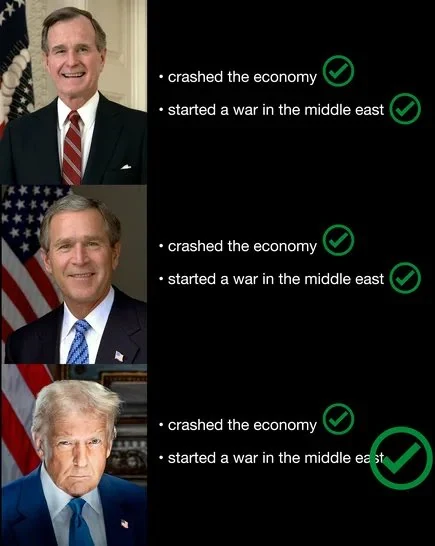
It risks becoming another war with high civilian costs while the probability of real internal political change in Iran through external force remains historically low.
The post-1945 record of US interventions is not one of consistent success.
Germany, Japan and South Korea were unique cases built on total defeat, long occupations and massive reconstruction.
In later conflicts such as Vietnam, Iraq, Libya and Afghanistan, regime change produced prolonged instability, power vacuums and regional chaos rather than durable political transformation.
Highly centralised authoritarian systems with strong security apparatuses tend to become more internally cohesive under foreign attack.
External pressure often strengthens hard-line factions instead of weakening them.
That creates a strategic asymmetry: the human and geopolitical costs are immediate and measurable, while the chance of achieving the stated objectives is uncertain and historically low, and every escalation increases the systemic risk of a much wider war.