

智能账户与治理
EIP-4788: a beacon root is a commitment, not the whole beacon state
Ethereum exposes a consensus-layer commitment to contracts; the proof and interpretation still need work.
文章正文和技术图表为英语,导航提供 7 种语言。
参考指南
A bridge between Ethereum’s layers
EIP-4788 makes parent beacon block roots available to the execution layer through a protocol-maintained contract. Execution clients check the root supplied by the consensus layer. This gives applications an authenticated reference point for reasoning about consensus data without treating an arbitrary external reporter as the sole authority. 1
A root is compact by design
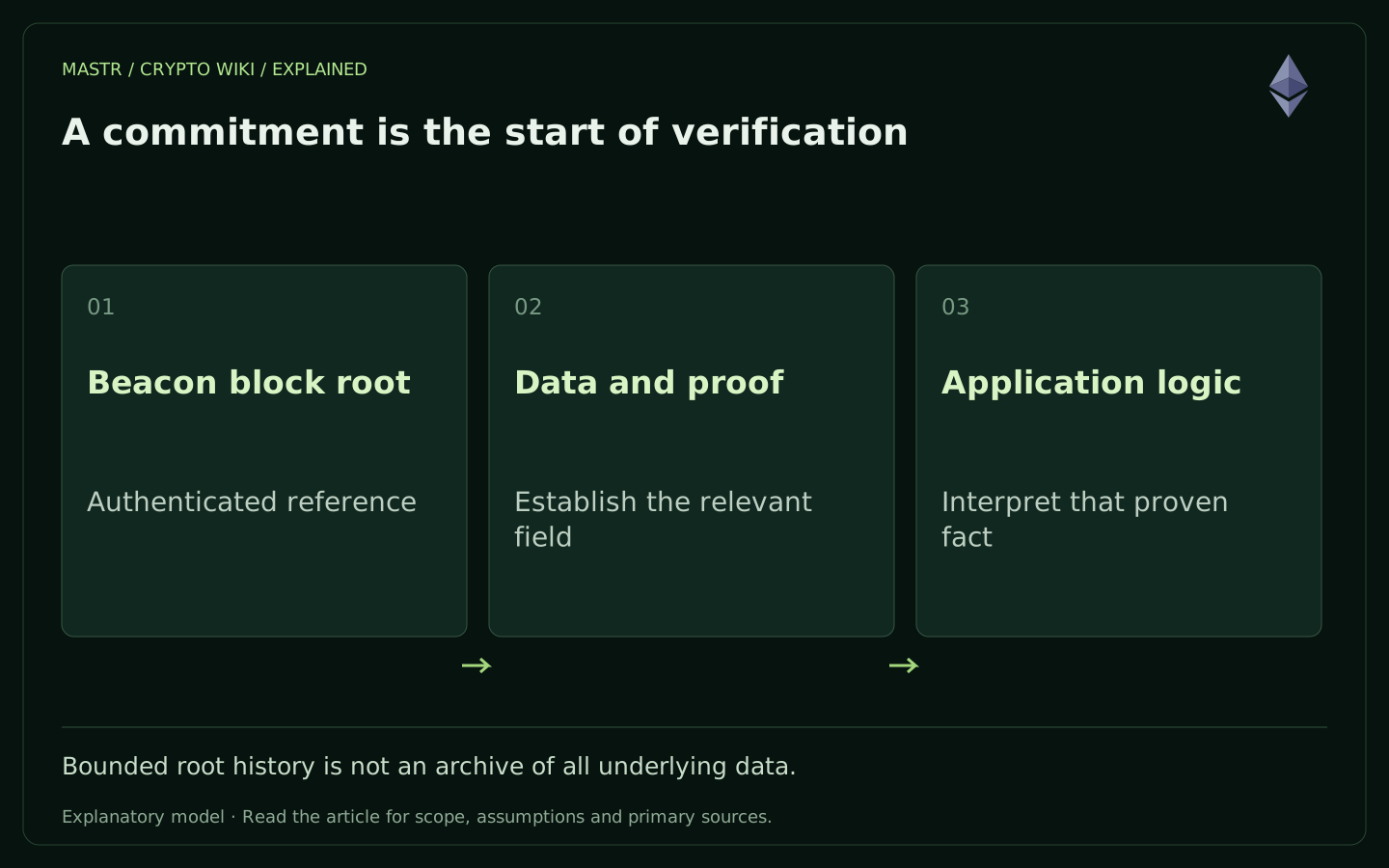
The root is a cryptographic commitment, not a copy of every validator balance or consensus field. To establish a particular fact under that commitment, an application still needs the appropriate data and proof, interpreted against the correct structure. A valid proof can establish inclusion; it cannot decide whether an application’s economic conclusion is sensible. 2
History has a retention boundary
The contract uses a bounded ring buffer indexed with timestamps. It is not an unlimited archival database. Queries must match retained timestamps, and applications that need older evidence must account for how it is preserved or independently linked to a retained commitment. A guide should not present ‘on-chain root access’ as permanent availability of all historical state.
Useful questions for a protocol review
Identify which root is being used, the associated time, the field being proven and the assumptions in the verifier. Distinguish a recent valid root from a claim of finality or an up-to-date economic balance. The mechanism can reduce dependence on some external reporting arrangements, but does not automatically remove application bugs, stale data or incorrect proof interpretation.
具体示例
A staking application wants to demonstrate a fact about a validator. Reading a beacon root supplies the reference commitment. It still needs the corresponding data and proof to establish that fact. Showing only the root’s hexadecimal value would not explain the validator’s position to a reader.