2004 / REFERENCE
RPOW: reusable tokens and the hardware trust boundary
Hal Finney’s 2004 experiment made proof-of-work tokens reusable through an attested server, with a different trust model from Bitcoin.
Texto de referencia en inglés · Navegación en 7 idiomas
En esta página
The experiment
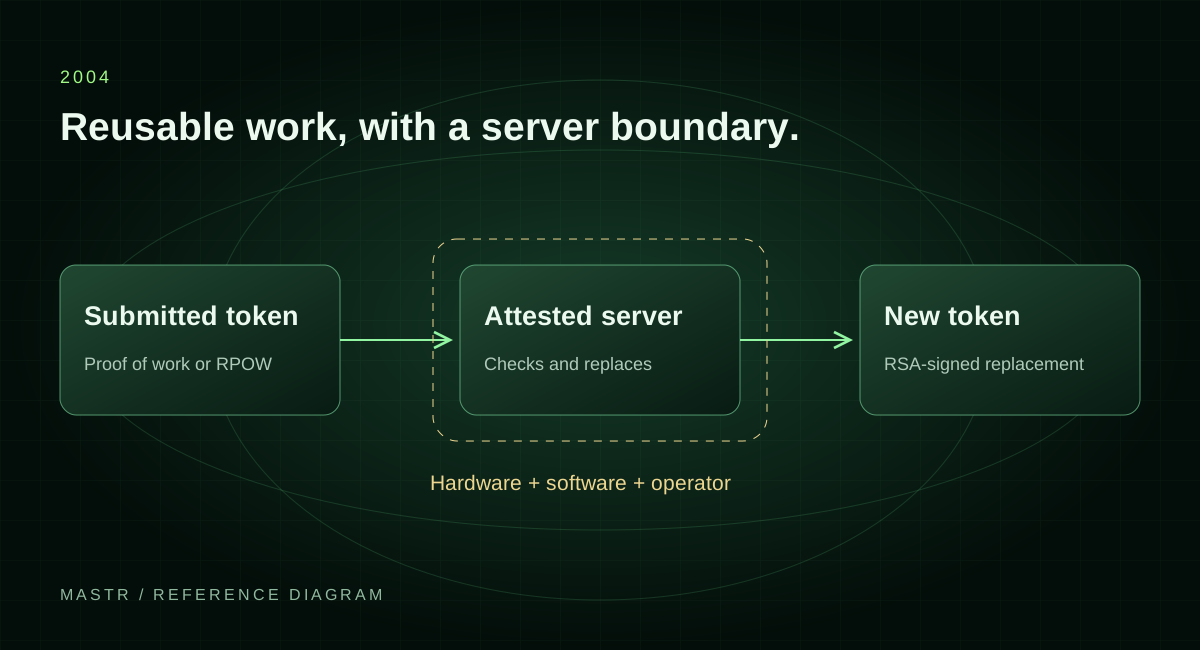
On 15 August 2004, Hal Finney invited users to test a Hashcash-based system called Reusable Proof of Work. A server accepted proof-of-work tokens and issued RSA-signed replacement tokens. A token could be exchanged only once, but its replacement could circulate and be exchanged again. This made the underlying work reusable through a sequence of substitutions. [1]
Where trust remained
Finney’s announcement describes an IBM 4758 secure cryptographic coprocessor and signed attestation of the software running on it. Users could compare the attested configuration with the published source. The intended assurance was that the server issued replacement tokens only for equivalent submitted value. This is a hardware-and-server security model; describing it as a Bitcoin-style permissionless consensus network would erase the important difference. [1]
An experiment is not a promise of permanence
The announcement called the system an early beta and warned that reloading the server could invalidate tokens. Preserve that warning when describing RPOW historically. It tells readers something concrete about the operational dependency rather than leaving them to infer that “cryptographic” means permanent. [1]
Why the distinction still matters
For any digital-asset system, draw the point at which 2 claims to the same value are resolved. Who can replace a token, reject it, reset the system or change its software? Which evidence can a participant verify independently? These questions apply beyond RPOW. Bitcoin’s white paper offers a useful comparison because it describes a network-based ordering mechanism instead of relying on the attested replacement server. The comparison is about architecture, not a claim that all historical experiments were trying to deliver the same product. [2]