

MASTR · CRYPTO & WEB3
Rollups: execution is only one part of the security model
Separate transaction ordering, state verification, data availability and the user’s ability to exit.
Los capítulos y gráficos técnicos están en inglés. La navegación está disponible en siete idiomas.
What can a user do if the sequencer stops cooperating?
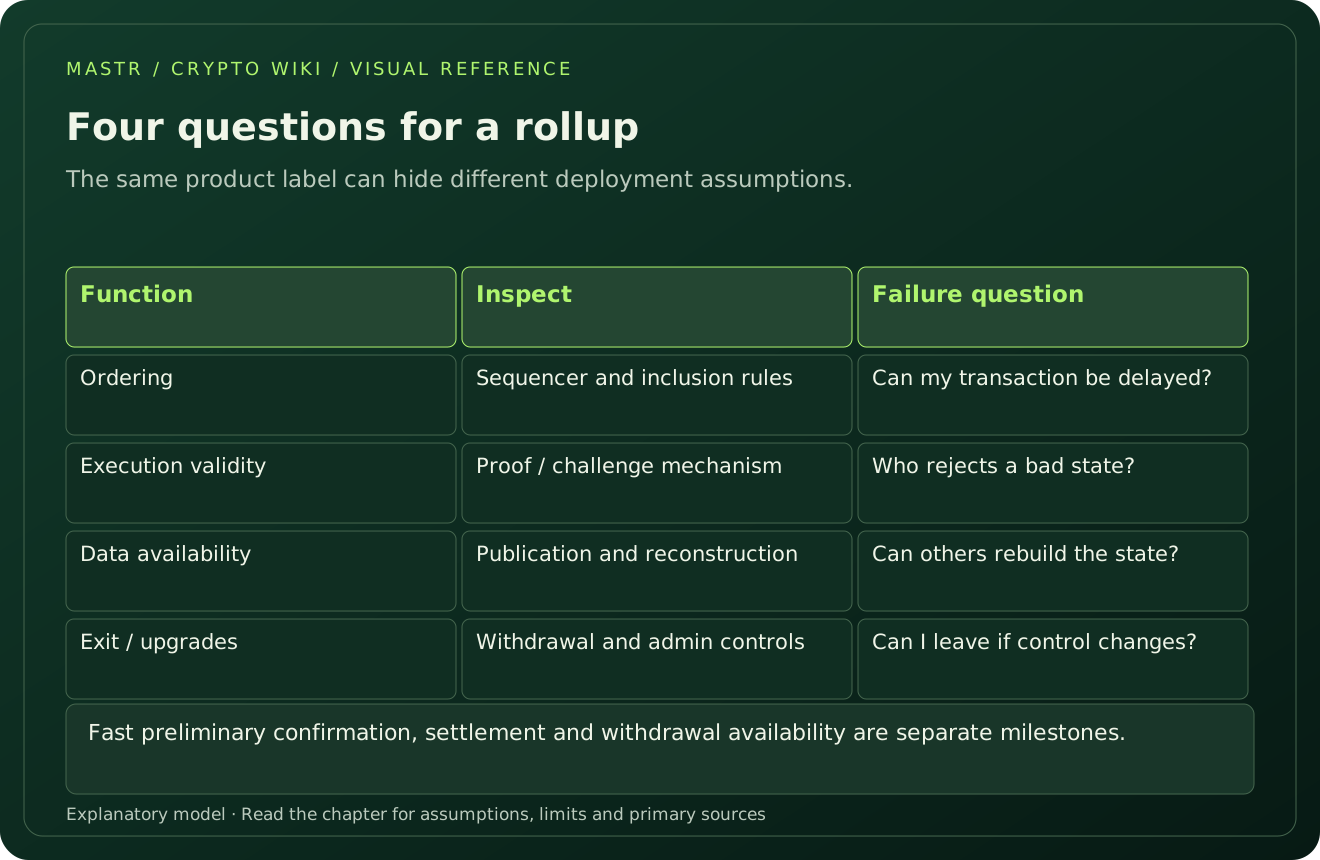
Four jobs are often compressed into one label
A scaling system must execute transactions, order them, make the necessary data available and establish which resulting state is accepted. A rollup can move execution away from a base chain while using that chain for settlement and data. The details determine its security. A cheap transaction fee is a user experience; it does not reveal which component can censor, upgrade or withhold information.
Optimistic and validity systems use different checks
An optimistic design accepts assertions subject to a dispute mechanism and its conditions. A validity design supplies a proof that the relevant computation satisfies specified rules. In both cases the actual implementation matters: who can submit or challenge, which verifier runs, what is upgradeable and how a failure is handled. “Proven” describes a statement about computation under a particular system, not the correctness of an application’s economics.
The sequencer has operational power
A sequencer orders transactions and commonly gives users fast preliminary confirmations. That role can introduce downtime and censorship dependencies even when it cannot finalise arbitrary invalid states. Forced-inclusion and exit mechanisms may reduce dependence, but their timing, costs and restrictions need to be read. A theoretical escape route that users cannot practically execute deserves a different description from an ordinary working withdrawal.
Data is needed to reconstruct the state
A state commitment can tell a verifier what result was asserted without providing all the information needed to rebuild it. Data availability is therefore distinct from validity. Systems using an external committee or alternative data layer may introduce different assumptions from those publishing data to the settlement chain. The label layer 2 should not erase those distinctions.
A useful comparison follows the failure path
Read what happens when the sequencer is unavailable, a proposer submits a bad state, a challenger is censored, the proof system fails or the upgrade authority changes code. Identify the minimum set of parties whose cooperation the user needs. Then distinguish a protocol’s documented design from its current deployment configuration. That produces a more informative comparison than a single decentralisation score.
Ejemplo explicado
An immediate sequencer acknowledgement can appear before the base chain finalises the data or a withdrawal becomes available. A user interface may call the payment confirmed while the exit path still has a separate process. Record each milestone instead of assigning one ambiguous finality time.
Preguntas para recordar
- Separate preliminary confirmation from settlement.
- Find the forced-inclusion and withdrawal mechanisms.
- Read the deployed upgrade controls.