Influencers y promoción
Crypto’s attention economy and the cost to useful work
Crypto is starving while directing an absurd share of its attention toward disposable tokens, manufactured narratives and products designed to monetize impulse before anyone has time to ask what they actually bought.
 MASTR
MASTRPrimera publicación 5 min · 1,056 palabras
Original publication · 4 Aug 2026. Figures, claims and opinions reflect the original publication date.
Las publicaciones originales están en inglés. La navegación está disponible en siete idiomas.
Read it to understand.
Crypto’s Attention Economy Is Eating the Industry Alive... Some numbers and facts here.
Crypto is starving while directing an absurd share of its attention toward disposable tokens, manufactured narratives and products designed to monetize impulse before anyone has time to ask what they actually bought.
@coingecko Q2 2026 data makes the imbalance visible, but it needs to be read correctly.
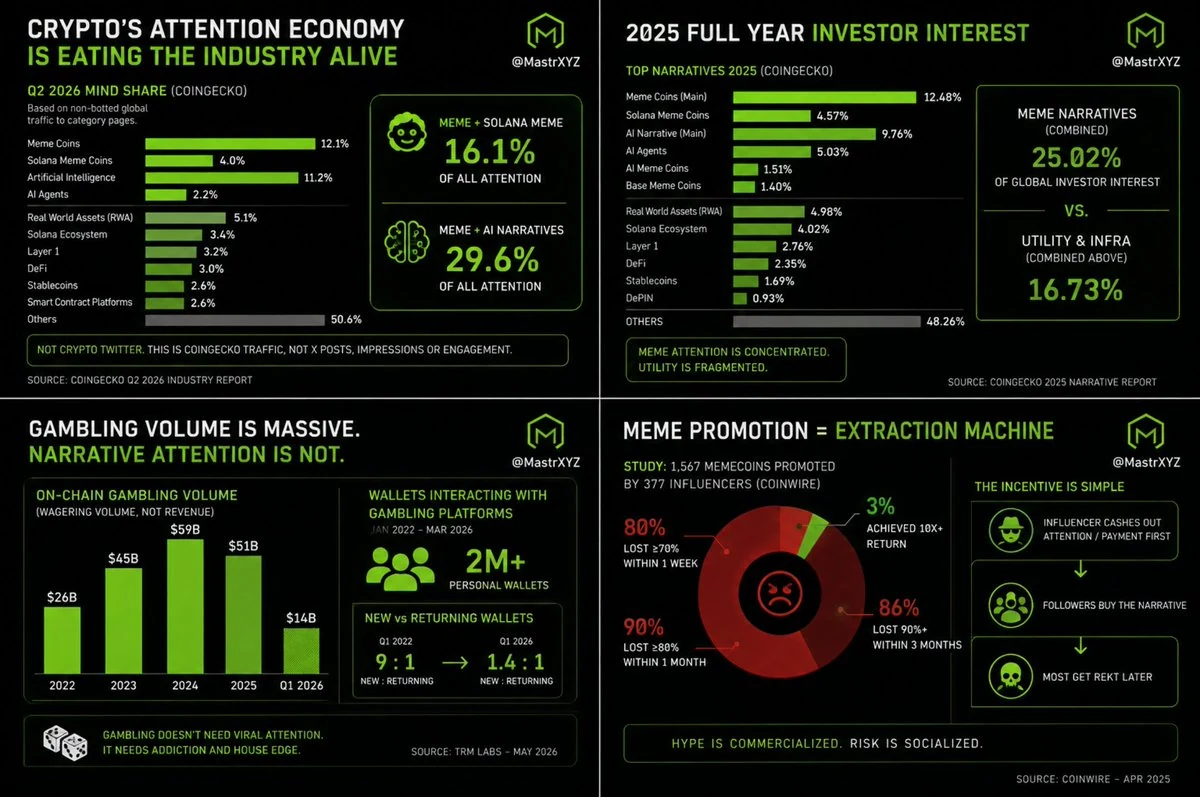
The main Meme Coins category captured 12.1% of measured user attention, while the separate Solana Meme Coins category added another 4.0%.
That means the 2 explicitly listed meme categories alone accounted for at least 16.1%.
Artificial Intelligence reached 11.2%, with AI Agents adding another 2.2%.
CoinGecko therefore described meme and AI related categories as controlling roughly 29.6% of Q2 mindshare.
Real World Assets received 5.1%, the broader Solana ecosystem 3.4%, Layer 1 projects 3.2%, DeFi 3.0%, stablecoins 2.6% and smart contract platforms 2.6%.
These numbers are not a measurement of Crypto Twitter itself.
CoinGecko calculates them from non botted global traffic to its category pages.
They measure investor curiosity on CoinGecko, not X impressions, posts, trading volume, TVL, revenue or unique buyers.
They should therefore be treated as an attention proxy rather than a scientific map of the entire crypto market.
But even with that limitation, the pattern is difficult to ignore. Memecoins appear as one instantly understandable product category. Useful infrastructure is divided across dozens of smaller technical categories that compete against each other for attention.
The full year data makes this even clearer.
In 2025, CoinGecko calculated that the main meme category and 35 related meme trends captured a combined 25.02% of global investor interest.
That was lower than the extraordinary 30.67% recorded in 2024, but it still left memes as crypto’s dominant narrative complex.
The main meme category alone represented 12.48% in 2025, followed by Solana Meme Coins at 4.57%, AI Meme Coins at 1.51% and Base Meme Coins at 1.40%. AI related narratives collectively reached 22.39%, including 9.76% for the main AI category and 5.03% for AI Agents.
Compare that with categories associated with actual financial or technical infrastructure.
RWA received 4.98% of 2025 investor interest, the Solana ecosystem 4.02%, Layer 1 networks 2.76%, DeFi 2.35%, stablecoins 1.69% and DePIN only 0.93%.
Read.that.again DePIN 0.93%.
These categories should not simply be added together as though they were mutually exclusive.
Projects and tokens can belong to overlapping sectors, and category traffic is not the same as capital allocation.
The relevant point is fragmentation. Memecoins package speculation, humour, tribal identity, entertainment and gambling into one simple narrative.
Utility is split between lending, trading, storage, payments, tokenization, data availability, oracles, physical infrastructure and countless other subjects that require far more effort to understand.
That difference is important because modern crypto distribution is built for emotional compression.
A memecoin can be explained with a picture, a ticker and the promise that someone else will buy it at a higher price.
A decentralized oracle network, lending market or cryptographically verifiable storage system requires an explanation of architecture, incentives, security assumptions, integrations and actual demand.
One produces instant stimulation. The other requires concentration. Algorithms, influencers and retail speculation predictably reward the first.
The casino sector exposes the opposite side of the same economy.
It does not always dominate public narratives because it does not need to.
TRM Labs measured $51 billion in onchain gambling volume during 2025, including a record $15 billion in Q4.
Another $14 billion followed in Q1 2026, while prediction markets reached $36.6 billion during the same quarter.
The $14 billion represents wagering volume, not casino revenue, but it still reveals an enormous financial system operating beneath a comparatively quiet narrative footprint.
This was not merely a temporary wave of new users.
TRM identified more than 2 million personal wallets interacting with gambling platforms between January 2022 and March 2026.
New wallet inflows declined by roughly 54% after their 2022 peak, while returning gambling wallets increased approximately 4 times.
The ratio between new and returning wallets narrowed from 9 to 1 in Q1 2022 to 1.4 to 1 by Q1 2026. Growth increasingly came from habitual users spending more, not from endless mainstream adoption.
Memecoin promotion follows a similarly efficient extraction model.
A widely circulated CoinWire analysis examined 1,567 memecoins promoted by 377 influencers.
It reported that 80% lost at least 70% within 1 week, 90% had fallen 80% after 1 month and 86% had declined by a factor of 10 after 3 months.
Only 3% of the promoted tokens reportedly achieved a 10 times increase.
This was an industry analysis rather than a peer reviewed academic study, so its methodology should not be treated as unquestionable.
Its results nevertheless describe the incentive structure remarkably well: promoters receive attention or payment immediately, while followers inherit the downside later.
None of this means every memecoin is fraudulent or that entertainment has no legitimate place in crypto.
It means attention, value and adoption are 3 different measurements, yet the industry constantly pretends they are interchangeable.
A token can dominate the timeline without producing a useful product.
A casino can process billions without creating economic value for its users.
A technically serious protocol can receive little social engagement while providing infrastructure that other applications depend on every day.
@chainlink connects smart contracts with external data through decentralized oracle networks.
@Filecoin operates a decentralized storage network secured by cryptographic proofs.
@aave provides non custodial lending and borrowing infrastructure.
@Ondo builds products around tokenized treasuries and other traditional financial assets.
Their existence does not guarantee that every token attached to them is correctly valued, but there is at least a product, a system and a measurable function to examine.
Crypto Twitter therefore offers a distorted map of the industry.
It shows what is easiest to promote, what creates the strongest emotional reaction and what can be converted into liquidity fastest.
It does not reliably show which systems are secure, which products generate durable demand or which teams are building infrastructure that will still matter after the current narrative dies.
Memecoins dominate attention because attention is their product.
Casinos dominate money flow because the house edge is their business.
Serious Web3 projects build the rails underneath both, then receive a fraction of the recognition because infrastructure is harder to turn into a viral post.
CT is a map of stimulation. It was never a map of value.