

MASTR · CRYPTO & WEB3
Privacy after the public ledger: what zero knowledge does and does not hide
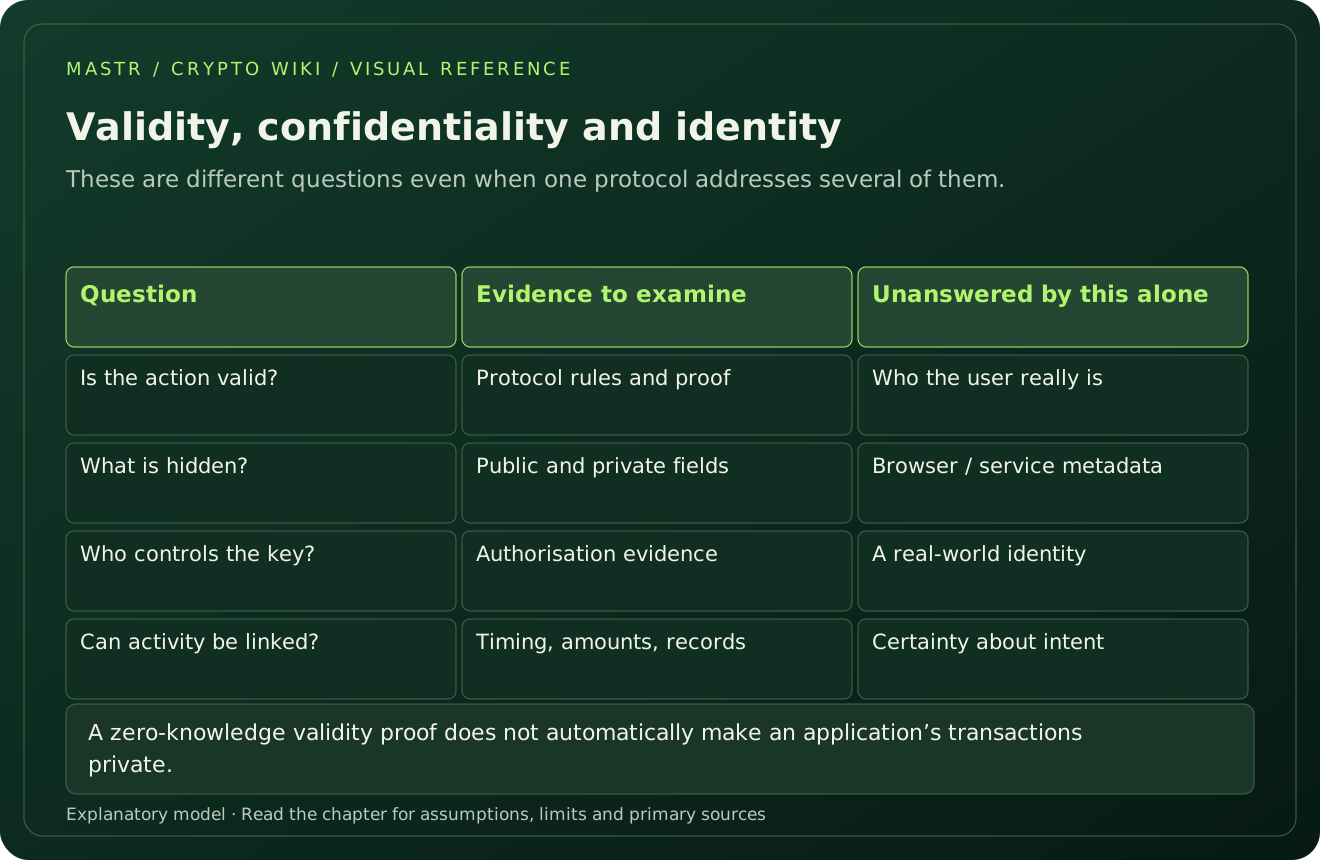
A valid proof, a hidden amount and an anonymous user are three different claims. Privacy has to be assessed across the whole interaction.
Les chapitres et schémas techniques sont en anglais. La navigation existe en sept langues.
What remains visible even when a cryptographic proof reveals little?
Public verification and personal privacy can conflict
A public ledger makes transactions inspectable, which is valuable for verification and research. The same visibility can expose relationships, balances and habits. Reusing an address or publishing it beside a real-world identity can connect otherwise pseudonymous activity. Privacy is therefore not simply the absence of a passport field. It depends on which observations different parties can combine over time.
A proof verifies a statement
A zero-knowledge proof can establish that a defined statement is true without disclosing the secret information used to demonstrate it. What is public and private depends on the particular protocol. A proof used to verify a rollup’s computation does not necessarily make its transactions private. The adjective zero-knowledge describes a property of the proof system and its use, not a universal privacy guarantee for everything around it.
Payment privacy requires a complete design
Shielded payment protocols have to prevent double spending while limiting what observers learn about the transaction. The Zcash protocol specification is a primary source for such mechanisms. Read the actual pool, transaction type and public fields rather than transferring every property of the protocol to every possible wallet action. Entering or leaving a privacy system can also create observable timing and amount relationships.
Metadata lives outside the proof
A wallet can contact an RPC provider, a website can collect network information and an exchange can hold identity records. Backups, screenshots and public posts can connect a person to an address. An otherwise strong proof does not erase those records. The practical analytical mistake is to evaluate only the chain while ignoring the browser, device, service accounts and counterparties.
Research requires calibrated claims
A path through a public graph may support a relationship between addresses. It may not establish that one person controlled every address on that path. A missing visible link does not prove there was no relationship either. State exactly which observation is available and which hypothesis remains unresolved. The same discipline protects both legitimate privacy and the credibility of investigations into misuse.
Exemple expliqué
A private transfer can conceal a relationship onchain while its sender publicly posts the deposit address and exact time. Conversely, a public transaction may remain unattributed when there is no reliable identity evidence. Privacy is a property of combined information, not a badge attached to one token.
Questions à retenir
- List the public fields.
- Separate validity from confidentiality.
- Account for metadata outside the chain.