Réseaux et infrastructure
Coinbase’s AI costs and infrastructure dependencies
I went through Brian Armstrong’s own numbers and the follow-up reporting around Coinbase’s AI costs, and the story is much bigger than “company saves money on tokens.”
 MASTR
MASTRPremière publication 3 min · 471 mots
Original publication · 28 Jun 2026. Figures, claims and opinions reflect the original publication date.
Les publications originales sont en anglais. La navigation est disponible en sept langues.
I went through Brian Armstrong’s own numbers and the follow-up reporting around Coinbase’s AI costs, and the story is much bigger than “company saves money on tokens.”
Coinbase is showing something uncomfortable: Chinese AI models are now cheap and useful enough that a major American crypto company can route serious internal work away from expensive US frontier models and still cut costs hard.
And Coinbase moving large parts of its AI usage toward Chinese models should get more attention than it probably will.
According to Brian Armstrong, Coinbase is now using models like GLM 5.2 and Kimi 2.7, while automatic routing decides which model handles which task based on cost, caching and performance.
Developers can still use whatever they want, but the message is obvious: the default economic gravity is shifting away from expensive American frontier AI and toward cheaper Chinese alternatives.
The numbers make it even more interesting:
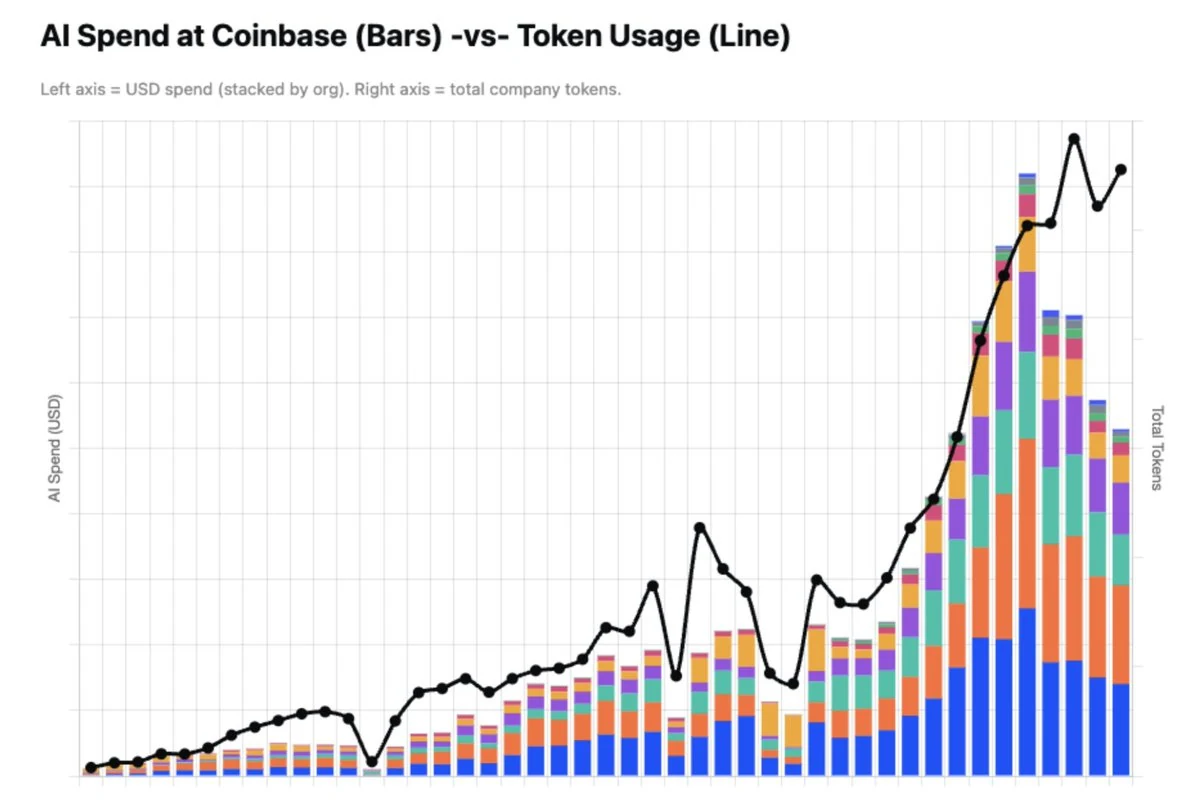
Coinbase reportedly cut its AI spending by 50 percent while token usage kept rising.
Better caching pushed hit rates from 5 percent to 60 percent. 91 percent of developers never even reached their previous usage limits.
On paper, this looks like clean engineering discipline. Less waste, better routing, more accountability. Spend more tokens only if you can prove real output.
But there is a larger warning hidden inside this story:
For years, the West sold AI dominance as a strategic moat.
OpenAI, Anthropic and the rest were treated like untouchable infrastructure companies, sitting at the centre of the next economic layer.
Now major American companies are quietly discovering that cheaper Chinese models may be good enough for a large part of daily work.
That matters because AI infrastructure is not just another SaaS bill.
Once companies start routing more work through foreign models because the price is better, dependency moves with it.
The question is who controls the rails, where sensitive context flows, what gets cached, what gets optimised away, and how much of the Western AI premium was built on hype, fear and investor storytelling.
Coinbase may present this as efficiency, and to some degree it is.
But it also shows how quickly “American AI leadership” becomes negotiable when the invoice gets ugly.
If Chinese models can cut costs in half while usage keeps growing, every CFO in tech will ask the same uncomfortable question: why are we paying Silicon Valley prices for work that cheaper models can already do?
The story is that the AI market is entering the same brutal phase every overhyped tech sector eventually reaches.
The narrative was national dominance, the reality is price pressure, routing systems, token accounting and companies quietly choosing whatever works.
And when even Coinbase, one of the most visible American crypto companies, starts proving that cheaper Chinese AI can replace expensive Western AI for serious internal workflows, the warning is not subtle.