Méthodes de recherche
Ranking chain attention with an explicit proxy model
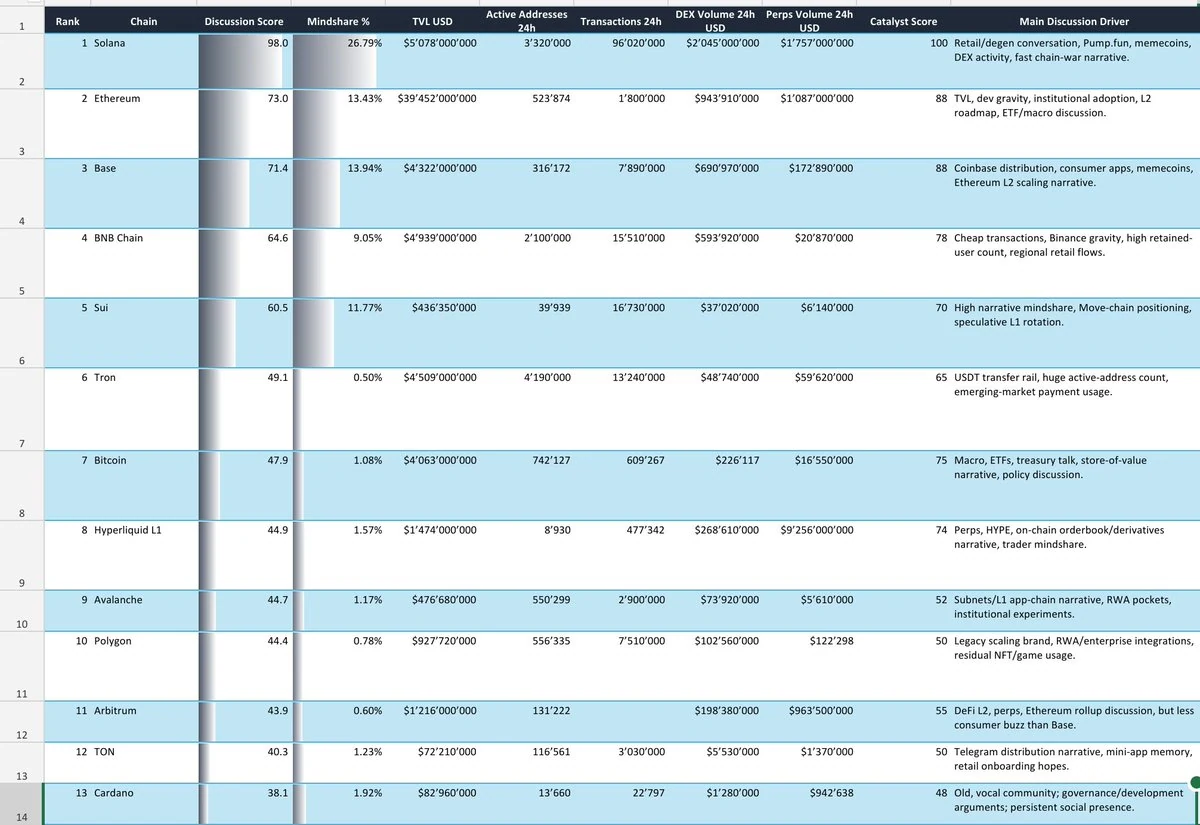
I tried to rank the major chains using a proxy model instead of pretending there is one perfect public dashboard for X mentions, web reports, on-chain activity, TVL and trading noise combined.
 MASTR
MASTRPremière publication 4 min · 880 mots
Original publication · 3 Jul 2026. Figures, claims and opinions reflect the original publication date.
Les publications originales sont en anglais. La navigation est disponible en sept langues.
Which blockchain is being discussed the most in 2026 so far?
Market analysis, but from a different angle.
If you want to understand it, you should read until the end.
I tried to rank the major chains using a proxy model instead of pretending there is one perfect public dashboard for X mentions, web reports, on-chain activity, TVL and trading noise combined.
➡️Sources and metrics used are:
CoinGecko ecosystem mindshare, CoinGecko user retention data, DeFiLlama chain metrics, DeFiLlama TVL, DeFiLlama active addresses, DeFiLlama DEX volume, DeFiLlama stablecoin data and DeFiLlama Pumpfun protocol data and many more.
➡️ Using that model, the result is clear:
Solana is still the loudest blockchain in crypto in 2026.
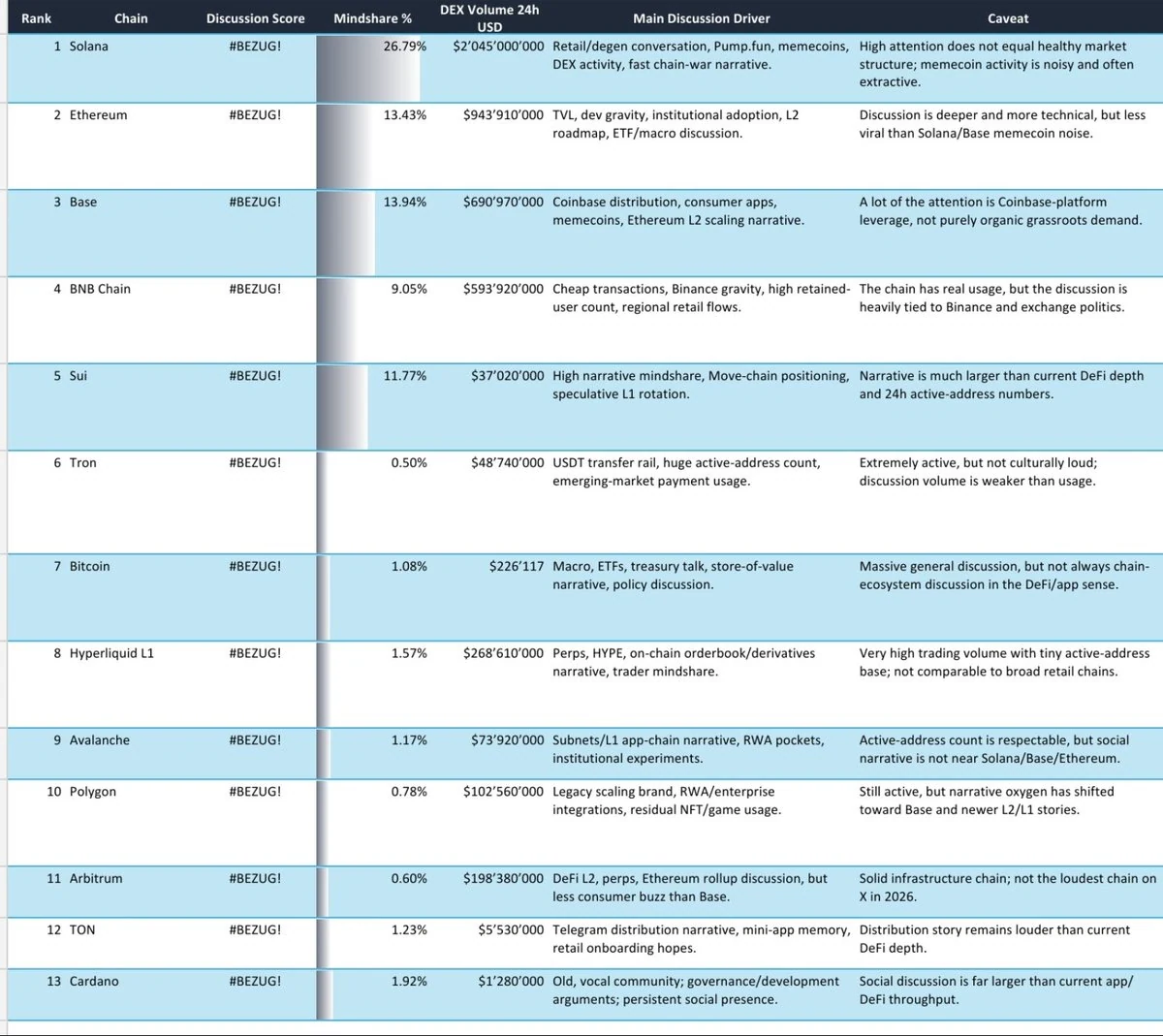
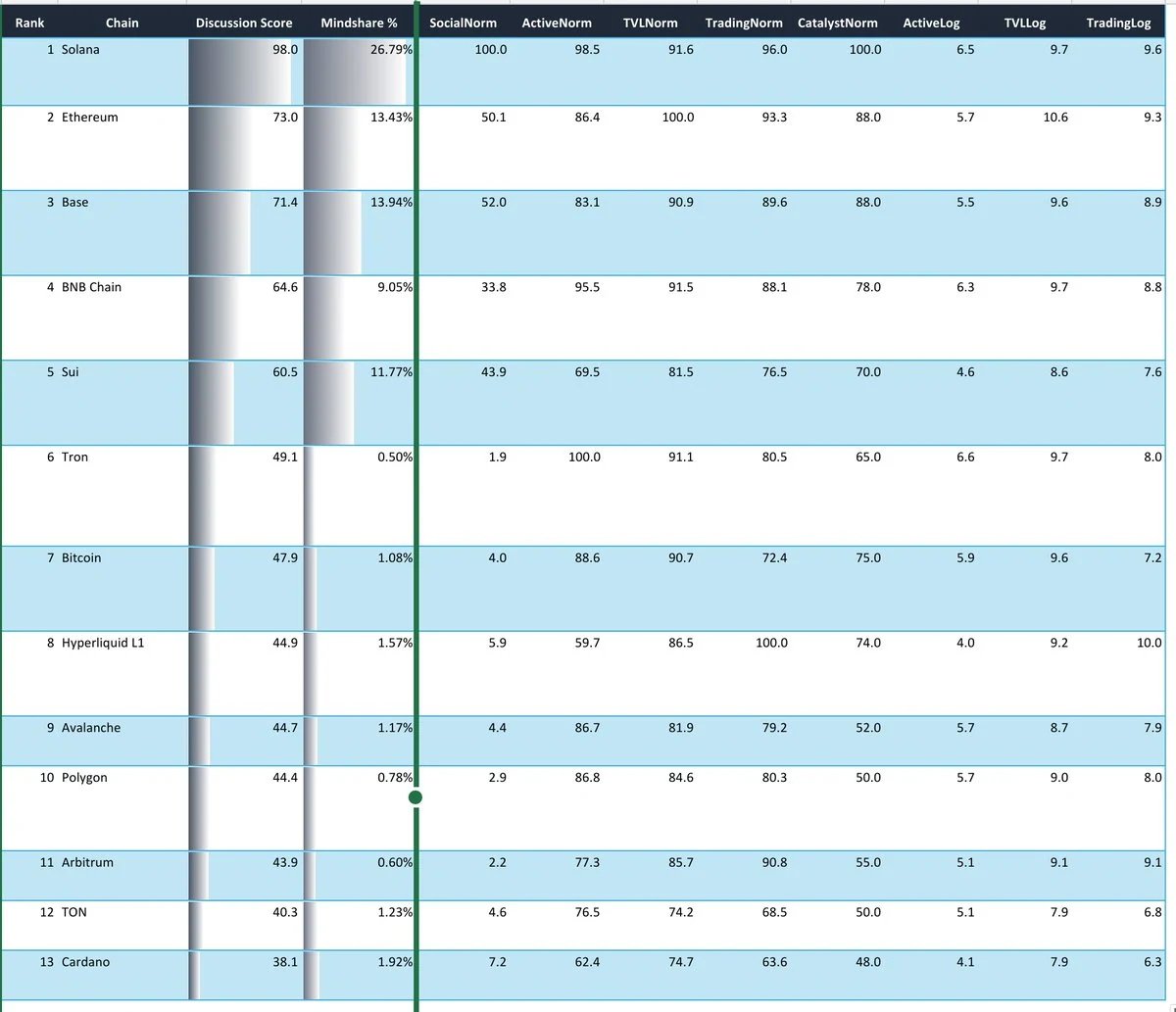
CoinGecko’s latest comparable ecosystem mindshare dataset has Solana at 26.79%, ahead of Base at 13.94% and Ethereum at 13.43%, with Sui and BNB Chain behind them.
That does not mean Solana is the “best” chain.
It means Solana is where the loudest part of the market spends its time, its money (very often..... its last remaining common sense)
Solana wins the discussion war because it built the perfect attention machine: fast execution, cheap transactions, endless memecoin launches, Pumpfun, trench culture and permanent retail gambling dressed up as ecosystem growth.
DeFiLlama currently shows Solana with billions in TVL, millions of active addresses, massive daily transaction count and more than $2B in 24h DEX volume, while Pumpfun alone produces serious fee, revenue and volume numbers.
That is, some would say, an industrialised attention casino with chain metrics attached.
➡️ Ethereum is still the heavyweight.
It is not the loudest chain in the retail trenches, but it dominates capital depth and serious infrastructure discussion.
Ethereum still has the largest TVL by a wide margin, the deepest developer culture, the strongest institutional narrative and the most important L2 ecosystem around it.
CoinGecko’s retention study also ranks Ethereum highest in user retention among the measured chains.
The Ethereum conversation is less viral, but deeper: L2s, staking, settlement, regulation, institutions, DeFi infrastructure and long-term architecture.
➡️ Base is the interesting middle layer:
Ethereum security narrative, Coinbase distribution and enough memecoin garbage to stay culturally relevant.
That combination makes it one of the hottest ecosystems to discuss in 2026. (Says the data!)
But people should be careful here.
🚨 Coinbase distribution is not the same thing as organic decentralised culture, and a chain being easy to onboard into does not magically make every app on it meaningful.
➡️BNB Chain and Tron expose the gap between hype and usage.
BNB Chain has huge activity and strong retained-user numbers.
Tron is basically one of the biggest stablecoin rails in crypto, with absurd address activity and a massive stablecoin footprint.
They are heavily used, but they do not dominate the cultural conversation the way Solana and Base do.
Crypto does not reward usage alone.
It rewards attention, liquidity, narrative and the ability to keep retail staring at the screen....
(Yes, it's that...again)
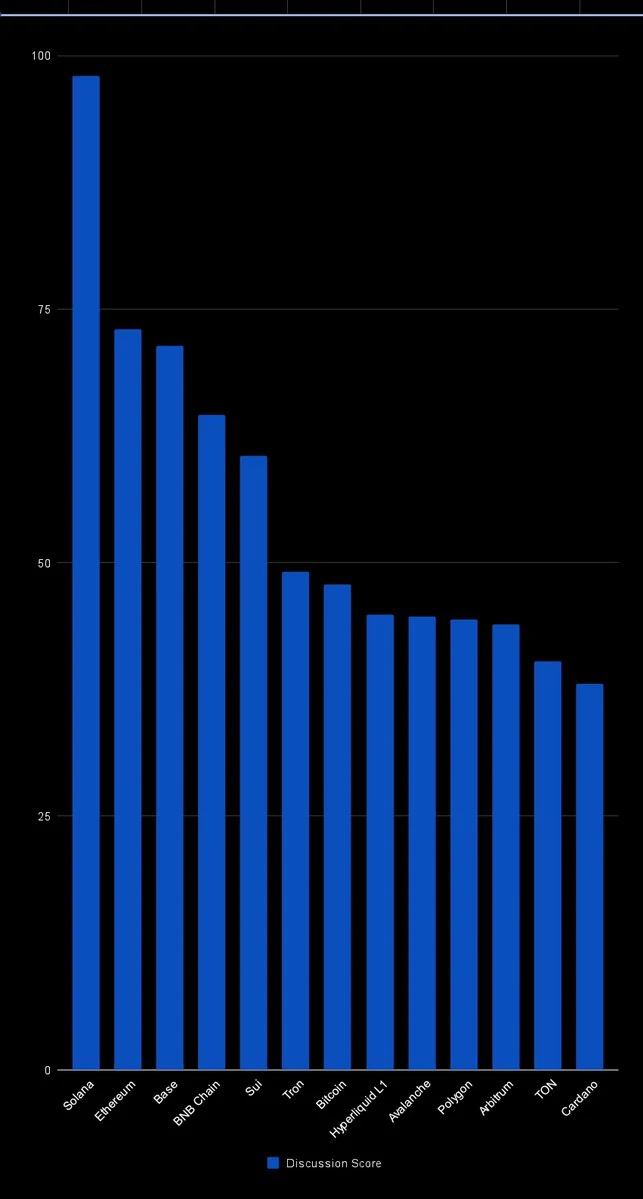
My final proxy ranking is:
1. Solana
2. Ethereum
3. Base
4. BNB Chain
5. Sui
6. Tron
7. Bitcoin
8. Hyperliquid
9. Avalanche
10. Polygon
11. Arbitrum
12. TON
13. Cardano
My own conclusion is simple: the most discussed chain is maybe not automatically "the best chain".
Sometimes it is simply the place where the extraction machine learned how to drain attention.
I think the next 3 to 4 years will be decisive.
Users and their culture will shape blockchains far more than many people realise.
If the culture is builders, serious users and long-term capital, the ecosystem will probably mature.
If the culture is paid shillers, insider groups, Telegram calls, memecoin casinos and retail extraction, then the chain can have great metrics and still rot from the inside.
Think about that?
Thoughts?
Hyperliquid is probably the strangest chain in this whole ranking, because the statistics do not look like a normal ecosystem, or like the others.
It does not have Solana-style millions of daily active addresses or Ethereum’s broad developer universe. It does not have Base’s Coinbase-powered consumer funnel.
What it has is concentrated financial intensity.
DeFiLlama currently shows Hyperliquid L1 with only around 8,900 active addresses in 24h, but more than $9B in 24h perps volume, around $46B in 7d perps volume, $5.9B in stablecoin market cap, $8.3B bridged TVL and roughly 477k transactions in 24h.
That is a smaller group of users moving serious size and Hyperliquid has a high concentration of wealthy users moving serious size.
VanEck reported that Hyperliquid processed $633B in trading volume in Q1 2026 alone, with around 32% of all on-chain perpetual futures volume and more than 6% of the entire global perps market, including centralised exchanges.
That is a very different kind of mindshare.
Less meme noise, more trader gravity.
It is "winning" because the people who do use it are exactly the type of users crypto markets pay attention to: traders, whales, market makers, leverage addicts and people who care about execution more than slogans.
That makes it important, but also culturally, maybe, narrow.
If Solana is the retail attention casino and Ethereum is the institutional infrastructure layer, Hyperliquid is the on-chain trading floor. Clean, fast, brutal and almost entirely shaped by PnL culture.
The risk is obvious: the chain built around traders can become incredibly efficient without ever becoming a broad ecosystem.