Exchanges & custody
Crypto.com: Monaco, MCO and the company’s earlier record
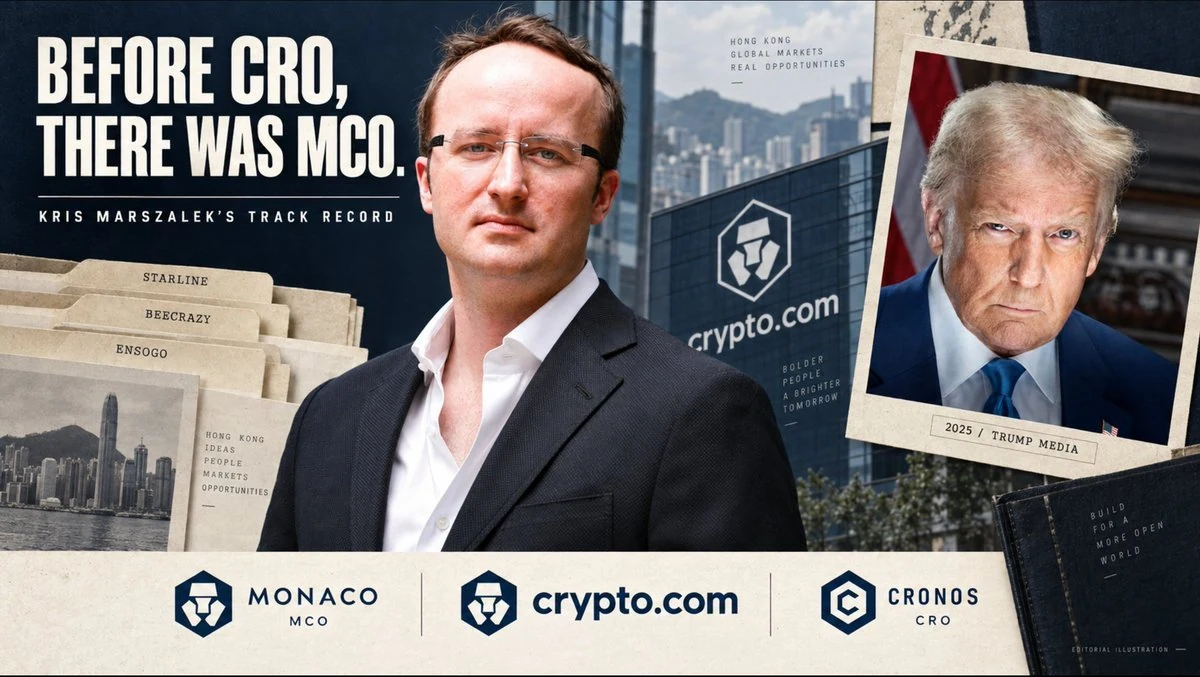
So I looked into Kris Marszalek’s history, including Monaco and $MCO. I went through court records, company filings and the original announcements.
 MASTR
MASTRFirst published 4 min · 737 words
Original publication · 6 Sep 2026. Figures, claims and opinions reflect the original publication date.
The original publications are in English. Navigation is available in seven languages.
I didn’t expect my Cronos/Trump post to get this much attention
Crypto com kissing Trump’s ass has hardly been a secret.
So I looked into Kris Marszalek’s history, including Monaco and $MCO. I went through court records, company filings and the original announcements.
The MCO story deserves attention. Some of the promises used to sell it were abandoned long before the token itself was replaced.
➡️ 2009–2013: Starline.
Starline was wound up on 14 October 2009. Marszalek was declared bankrupt the same day. His bankruptcy was annulled on 22 May 2012.
A June 2013 civil judgment examined 19 payments made during 2008–2009:
- To Marszalek: US$1 million plus HK$285,000.
- To his business partner: US$1.64 million plus HK$2.01 million.
Considering Starline’s financial position, Judge Anthony Chan wrote that “it appears that there was a concerted effort to strip the cash from Starline.”
That is paragraph 20 of the judgment: https://t.co/LmO3sXb6rp
This was a civil case. A subsequent decision records an appeal, whose final outcome I have not verified: https://t.co/frW23ZIBL0
Marszalek later attributed the failure to the financial crisis, customer defaults and personally guaranteed bank debt.
His explanation is here: https://t.co/ZmN8QSvnzM
➡️2013–2016: BeeCrazy, iBuy and Ensogo.
iBuy’s prospectus documented a US$21 million acquisition deal for Buy Together, the business behind BeeCrazy: US$8.4 million in cash and US$12.6 million in shares.
The purchase terms are on printed page 12: https://t.co/8GEN2s6xVe
Marszalek became CEO in August 2014. His resignation took effect on 20 June 2016: https://t.co/sV9uJzzeH0
All e-commerce operations stopped effective 21 June 2016, following a collective board decision.
Those dates are 1 day apart. That timing alone does not establish misconduct, but it belongs in his business history:
Hong Kong’s Consumer Council subsequently identified BeeCrazy’s default when discussing how poorly protected customers were after paying businesses in advance:
➡️ 2017: Monaco sells MCO. Then changes the pitch.
Monaco reported raising over US$26.7 million in its token sale:
The pitch included an MCO Asset Contract. A 1% fee on qualifying cryptocurrency card spending would accumulate assets for token holders.
The company called this mechanism “absolutely essential” to creating value for MCO holders. Marszalek forecast that its value could reach US$500 million over 5 years.
That was a forecast, but the mechanism itself was a central selling point.
It is still in Monaco’s own ICO announcement: https://t.co/6I0IRHgb3p
By November 2017, the asset-contract model had been dropped. Marszalek cited legal and commercial concerns and described the decision as protecting holders’ long-term value.
Something presented as essential when collecting money became something holders were supposedly better off without:
➡️ 2018–2019: CRO arrives. Another commitment changes.
Monaco became https://t.co/bjpu5tgZx9, and was introduced alongside MCO.
The CRO whitepaper specified monthly airdrops to eligible MCO holders for 5 years, starting 7 December 2018. Allocations carried a 12-month lock and conditions tied to continued MCO holdings.
The rules are on pages 27–28: https://t.co/UOulM7nf35
The programme was ended effective 25 June 2019, roughly 6 months after it began. That ended new allocations; previously allocated tokens had their own release conditions. Contemporary reporting linked the decision to regulatory concerns ahead of the US card launch.
A 5-year programme lasted roughly half a year: https://t.co/0L4oYHMnae
➡️ 2020: MCO loses its company-supported utility.
On 3 August, https://t.co/bjpu5tgZx9 announced the MCO-to-CRO swap:
- 1 MCO = 27.6439 CRO.
- With the 20% early-swap bonus: 33.1726 CRO.
- Early-bonus deadline: 2 September.
- Final programme deadline: 2 November.
Unswapped MCO could continue existing on Ethereum. https://t.co/bjpu5tgZx9 would stop supporting its use in company products.
You could keep your token. You could not make the company keep supporting the reasons you bought it: https://t.co/m4jeZykaph
➡️ 2021–2025: Even the celebrated supply reduction gets reversed in the proposal.
In 2021, https://t.co/bjpu5tgZx9 celebrated burning 70 billion CRO and linked that milestone to a fully decentralised blockchain:
In March 2025, Cronos proposed issuing 70 billion CRO again, restoring total supply to 100 billion. It explicitly described this as reversing the earlier burn. The new justification included institutional adoption, ETFs and US expansion:
These are separate events. They do not establish one continuous fraud. But well...
But the token record is clear enough to demand an answer. The asset contract was abandoned. The 5-year airdrop programme ended early. MCO lost its company-supported utility.
Then the celebrated CRO supply reduction became something the project wanted to undo.
Kris, what protection do holders actually have against the next rewrite once their money is already committed?
Sources & original posts
Original evidence (16)
- vlex.hk/vid/lau-siu-hung-and-862557451
- vlex.hk/vid/lau-siu-hung-and-862557387
- cryptodaily.co.uk/2022/12/crypto-com-ceo-tells-how-past-failure-made-him-stronger
- www.asx.com.au/asxpdf/20131219/pdf/42lr4pwjpfg2b9.pdf
- www.asx.com.au/asxpdf/20160621/pdf/4380md8f69nkr6.pdf
- www.asx.com.au/asxpdf/20211203/pdf/453s20nrstktlk.pdf
- www.consumer.org.hk/f/annual_report/300361/AR16_10-13_Chief_Executive_Message_0.pdf
- www.prnewswire.com/news-releases/monaco-mco-token-to-list-on-binancecom-chinas-fastest-growing-exchange-300505134.html
- www.prnewswire.com/news-releases/monaco-visa-worlds-best-cryptocurrency-card-comes-out-of-stealth-mode-launches-ico-starting-may-18th-300459357.html
- cointelegraph.com/news/monaco-prepaid-card-bins-asset-contract-token-dives-40-in-a-day
- Crypto.com
- www.allcryptowhitepapers.com/wp-content/uploads/2018/12/cryptoCom-chain_whitepaper.pdf
- cryptobriefing.com/crypto-com-cro-mco-tokens/
- cryptoslate.com/mco-jumps-20-as-crypto-coms-swap-program-goes-live/
- crypto.com/us/company-news/crypto-com-2021-highlights-the-year-crypto-went-mainstream
- blog.cronos-pos.org/p/the-new-golden-age-for-cronos