Market structure
James Wynn: public leverage, liquidations and attention
JamesWynnReal did not fall in private, but in full public view. That is what makes his story so strange, so brutal, and so perfectly crypto.
 MASTR
MASTRFirst published 10 min · 2,087 words
Original publication · 10 May 2026. Figures, claims and opinions reflect the original publication date.
The original publications are in English. Navigation is available in seven languages.
The Downfall of James Wynn. The whole story here:
How crypto turned a whale into a public liquidation machine...
@JamesWynnReal did not fall in private, but in full public view.
That is what makes his story so strange, so brutal, and so perfectly crypto.
In traditional finance, a trader can implode behind closed doors.
The losses move through internal systems, risk teams, prime brokers, lawyers, and maybe, months later, a carefully worded report.
In crypto, especially on a platform like Hyperliquid, the collapse can happen in public, transaction by transaction, liquidation by liquidation, watched by analysts, copy traders, enemies, fans, vultures, bots, and anonymous spectators who refresh the wallet like it is a live sports feed.
It is not only that he allegedly turned a small meme coin position into tens of millions.
It is not only that he became famous for one of the largest publicly visible Bitcoin perpetual positions ever seen.
It is not only that he lost around $100M in a matter of days.
It is that the whole thing became entertainment. A sad one.
The blockchain did not blink. It recorded everything.
➡️ Let's begin;
Wynn, known publicly as @JamesWynnReal, became famous as a pseudonymous crypto trader who combined meme coin conviction, social media performance, and extreme leverage into one radioactive persona.
The community described him as a trader who first gained attention after reportedly turning roughly $7,000 in PEPE into about $25M, then later became notorious for highly leveraged trades on Hyperliquid, where his Bitcoin exposure reached about $1.269B notional, representing 11,588 BTC at 40x leverage.
That trade ultimately contributed to more than $100M in total losses and made him both a cult figure and a cautionary case study.
The first chapter of the legend was ethereum:0x6982508145454ce325ddbe47a25d4ec3d2311933 .
Wynn was not originally seen as a disciplined derivatives trader.
His reputation came from meme coin hunting, timing, conviction, and the ability to identify a narrative before the broader market understood it.
Several reports trace his rise to an early PEPE call when the token was still tiny, with claims that a position of roughly $7,000 became about $25M as PEPE later exploded into a multibillion dollar meme coin.
That story gave him the aura every crypto influencer wants: the man who saw it before everyone else.
➡️ But a meme coin win and a serious trading career are not the same thing...
The fatal transition came when Wynn moved from being a meme coin personality into the world of perpetual futures.
Hyperliquid made the entire spectacle possible because large positions could be followed publicly, almost in real time.
What would normally be hidden inside a centralised exchange became visible to everyone. The size, the leverage, the liquidation price, the deposits, the withdrawals, the pain. All of it could be watched.
By May 2025, Wynn had become the main character of crypto trading.
His positions were no longer just trades.
They were events. DL News reported that he placed a bullish Bitcoin bet worth more than $1B on Hyperliquid, initially putting about $20M at stake and using leverage to control a position 40x larger.
As Bitcoin reached a new all time high, his unrealised profits reportedly approached $100M.
Then the market turned.
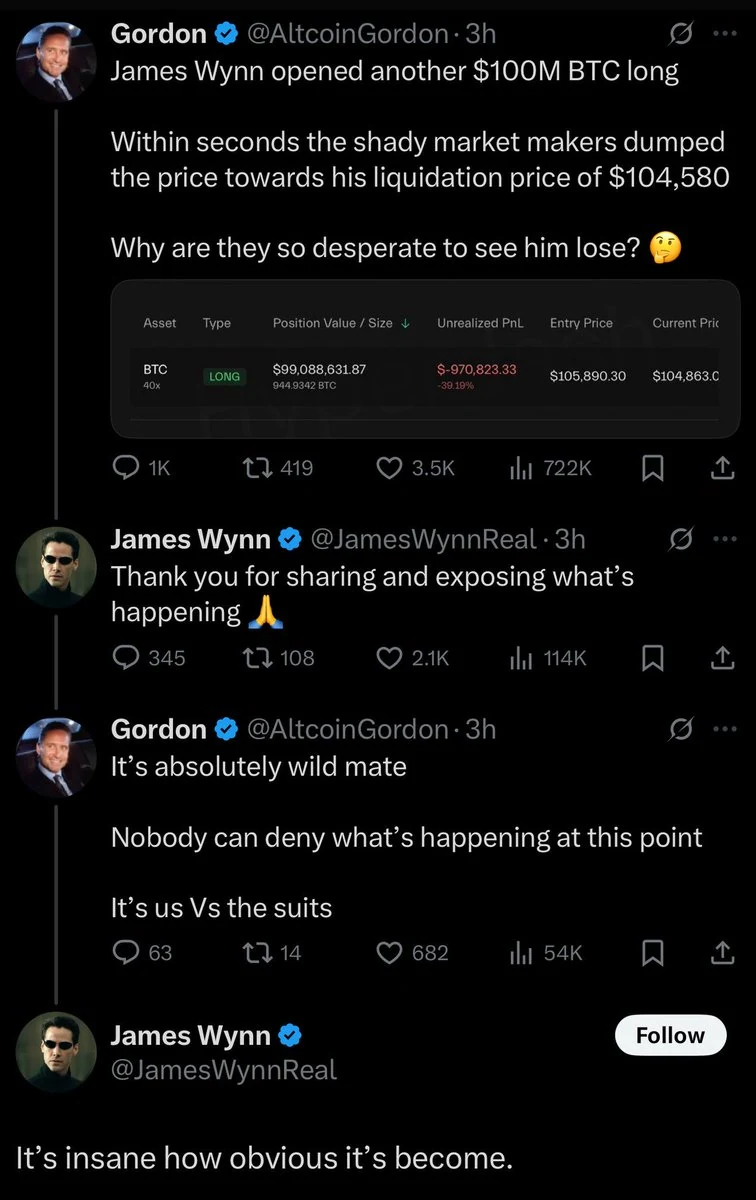
Bitcoin dropped more than 6% to around $105,000 after Trump threatened 50% tariffs on European Union imports, and Wynn’s position was hit by major liquidations totalling 949 BTC, worth roughly $100M.
That was one of the moments the myth cracked.
The insane part is that Bitcoin did not need to collapse for Wynn to collapse.
At 40x leverage, the margin for error is microscopic. A trader can look brilliant until a normal market move becomes fatal.
The trade was tied to wallet 0x5078c2fbea2b2ad61bc840bc023e35fce56bedb6, tagged by Arkham Intelligence as belonging to James Wynn, and that the wallet had first interacted with Hyperliquid about 2 months earlier after depositing $3M in stablecoins.
The liquidation happened even though Bitcoin had stayed within a relatively narrow range, a detail that makes the story even more revealing.
This was leverage doing exactly what leverage does.
After the wipeout, Wynn gave the kind of confession crypto almost never gets from its public gamblers.
Wynn said he had started trading perpetual contracts only in March, had never traded seriously before, had mostly traded meme coins, had turned about $3M into $100M within 1 month, and then lost it all in 1 week on Hyperliquid.
He admitted that the public nature of the account changed his behaviour, that hundreds of thousands of people watching made the whole thing spiral, and that he understood it was essentially gambling.
He also described the fear of being laughed at for failing to keep $100M, and said the numbers on the screen became a virtual game while greed took over.
That confession matters because it strips the glamour away.
It was not alpha. It was not genius. It was not some deep institutional strategy that normal people failed to understand.
By his own description, it became gambling under public pressure, amplified by ego, audience, shame, and the desperate instinct to win back what had already been lost.
And still, he came back.
On June 6, 2025, another Wynn long was liquidated for 155.38 BTC, worth about $16.14M at the time, with a liquidation price around $103,981.
On June 7, he liquidated the remaining on chain funds and transferred about $1.91M to KuCoin, MEXC, and Gate.
On June 8, instead of walking away, he opened another 40x Bitcoin long with only $468.62 as principal.
That detail is almost absurd, but it is also the whole story in miniature: from billion dollar notional exposure to an “entire fortune” of a few hundred dollars, still placed back into the same machine.
He became a mirror.
Crypto did not only watch him lose. It studied him, mocked him, copied him, faded him, and built narratives around him.
His wallet became a theatre. Every new deposit became a new episode. Every 40x trade became a dare.
Every liquidation became content. The most disturbing part is that the audience was not separate from the collapse. The audience helped create the pressure that Wynn himself later described.
By 2026, the story had become darker and smaller at the same time on April 6, 2026, Wynn suffered his 6th forced liquidation in 2 weeks on Hyperliquid, with on chain data compiled by Arkham and relayed by Lookonchain showing his balance had dropped from about $100M to less than $900.
By the end of March 2026, his historical liquidation count had already reached 194, after earlier waves of 9 liquidations in a few days and 45 over 2 months.
MEXC’s March 2026 report described one of Wynn’s later “ant positions,” a tiny position compared with his former whale scale.
The report said that after 194 tracked liquidations and estimated historical losses of about $98.5M from his May 2025 peak, Wynn was still opening 40x Bitcoin shorts, including one where a move of roughly 1.2% against him would liquidate the position.
The contrast is brutal: the man once controlling more than $1B in notional exposure was now risking tiny balances just to stay inside the same public arena.
➡️ There is also a second layer to the Wynn story, and it is uglier than liquidation.
The accusations around him are not only about reckless trading. They involve meme coin promotion, private allocations, follower dumping, and hypocrisy.
They are central to why many people stopped seeing Wynn as merely a tragic degen and started seeing him as something more corrosive.
In May 2025, many of us accused Wynn of pushing meme coin scams while publicly warning followers about scam tokens using his name.
Wynn profited about $68,000 from BabyPepe after allegedly requesting a private allocation, promoting the token, and then selling.
Backpack’s profile of Wynn summarised similar accusations: accepting allocations, promoting low market cap coins through Telegram, selling quickly for profit, and being linked by critics to tokens such as BabyPepe, WLON, ELON, and MOONPIG.
The same source notes that Wynn denied wrongdoing and framed himself as an investor rather than a developer or manipulator.
That denial matters, but so does the pattern critics describe, because the core issue is not one isolated token.
It is the recurring tension between influence, private positioning, public promotion, and retail exit liquidity.
The later $ASSDAQ episode turned that tension into another public controversy.
Wynn faced scam allegations after the $ASSDAQ presale, with claims of token sniping, a pump and dump, and deleted project posts.
After severe Hyperliquid losses, Wynn launched a donation style Solana presale, raised an estimated $8,000 to $13,000, allegedly acquired more than 50% of the token supply, pushed the market cap to about $322,000, exited for roughly $70,000 in profit, and deleted related posts.
Bitget’s coverage of the same period described Wynn launching ASSDAQ after his account had been reduced to roughly $900 following 6 liquidations in 2 weeks.
It also reported that he had previously solicited donations from followers after losing more than $85M, receiving approximately $50,000, and sent part of those donated funds back into 40x leveraged positions. That is the kind of detail that turns a trading story into a moral one.
Because once followers become the refill mechanism, it becomes socialised damage.
And if you think these are all the scams linked to him, you are badly mistaken.
The list is long.
In crypto, a large account is not just a voice.
It is liquidity.
It is distribution.
It is attention.
It can move small markets, manufacture confidence, create panic, trigger copy trades, attract donations, and convert reputation into capital.
When that influence is attached to a person losing control in public, the result is a gravity field that pulls smaller traders into the blast radius.
The tragedy of James Wynn is therefore not that a gambler lost money. Many gamblers lose money.
The tragedy is that his fall revealed how easily crypto transforms loss into spectacle, spectacle into marketing, marketing into new liquidity, and new liquidity into the next loss.
A normal financial system would see this as a risk event. Crypto saw it as content.
The defenders will say Wynn showed courage by trading transparently.
They will say his PEPE call was real, his early gains were real, his losses were his own, and nobody was forced to follow him. Some of that is true.
The blockchain confirms that the numbers were not imaginary. His wins were not pure fiction. His risk tolerance was not fake. His collapse was not staged by critics.
But transparency does not automatically equal virtue.
A public wallet can still be reckless. A visible trade can still be irresponsible. A trader can still become dangerous when followers confuse visibility with credibility.
Wynn’s own confession is the key to the entire story.
He did not describe a calm professional operation. He described a psychological trap: public attention, greed, fear of ridicule, the desire to recover losses, and numbers on a screen becoming unreal.
By 2026, James Wynn was no longer just the PEPE caller, the Hyperliquid whale, or the man behind a historic Bitcoin position.
He had become a living warning about what happens when leverage, ego, audience capture, meme coin culture, and public loss combine into one feedback loop.
The rise was simple enough to understand. A poor outsider finds crypto, catches PEPE early, makes millions, becomes a cult figure, discovers that attention itself has market value, then scales from meme coins into perps where every move is visible.
The fall was even simpler. He used too much leverage, stayed too public, chased losses, ignored his own warnings, and kept returning to the same table after admitting the game had consumed him.
The blockchain remembers it without emotion.
$7,000 into $25M.
$3M into $100M.
$1.269B notional.
949 BTC liquidated.
About $100M gone.
A few hundred dollars left.
194 liquidations.
Then another position.
Then another controversy.
Then another post.
James Wynn’s downfall is not really about one man. It is about an industry that still struggles to distinguish courage from addiction, transparency from performance, conviction from delusion, and influence from responsibility.
Crypto loves the whale until the whale becomes chum.
And in James Wynn’s case, the water was public, the sharks were watching, and the liquidation engine never looked away.
@JamesWynnReal Summary for those who do not want to read every nuance.:
-$7,000 into $25M.
-$3M into $100M.
-$1.269B notional.
-949 BTC liquidated.
-About $100M gone.
-A few hundred dollars left.
-194 liquidations.
-Then another position.
-Then another controversy.
-Then another post.
And in… https://t.co/knmcm8I10a