Politics & conflicts
Political money, exchanges and Trump-linked tokens
MASTR’s analysis of the overlap between political finance, exchange interests and Trump-linked crypto ventures.
 MASTR
MASTRFirst published 4 min · 864 words
Original publication · 24 Jan 2026. Figures, claims and opinions reflect the original publication date.
The original publications are in English. Navigation is available in seven languages.
Originally published as “The Crypto Downfall and Power Grab: How Political Money, Exchanges and Tokens Converged Around Trump”
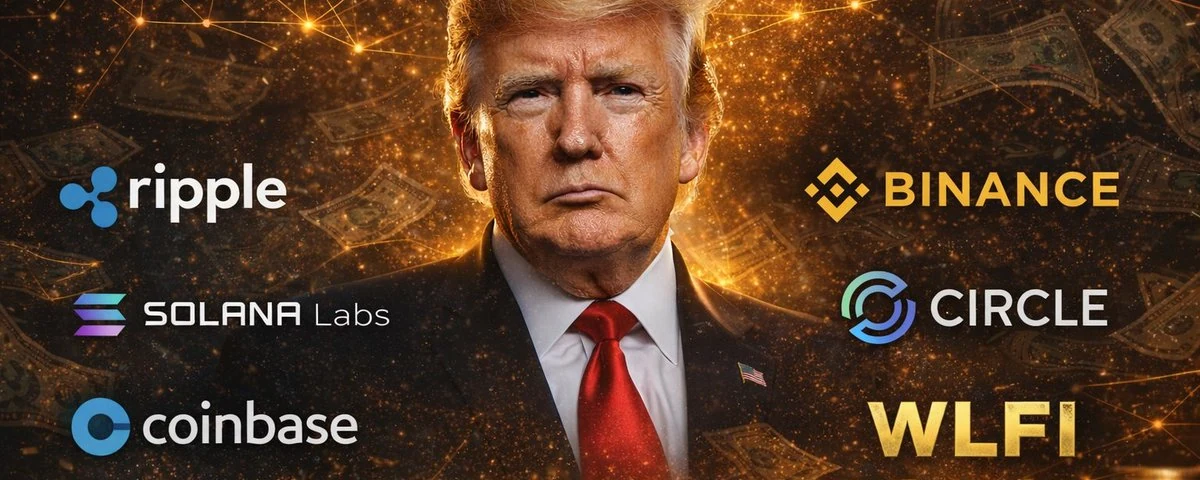
From Ripple to Solana Labs, Coinbase, Binance and Circle, multiple major crypto companies are involved and share responsibility for the downfall of crypto together with Trump.
A pattern has emerged over the past year that directly contradicts the core ideas of decentralization, independence and resistance to political capture.
Some of the largest and most influential firms in crypto financially aligned themselves with Donald Trump’s political network through donations to his 2025 inauguration fund and related political committees.
Public reporting and FEC related disclosures show that more than $18,000,000 from crypto linked firms went into Trump’s inauguration effort.
➡️ Reported donors include:
🔺 Ripple about $4,900,000 in XRP
🔺 Robinhood about $2,000,000
🔺 Coinbase about $1,000,000
🔺 Kraken about $1,000,000
🔺 Crypto com about $1,000,000
🔺 Circle about $1,000,000
🔺 Solana Labs about $1,000,000
🔺 Galaxy Digital about $1,000,000
🔺 Ondo Finance about $1,000,000
🔺 Input Output Global Cardano about $250,000
🔺 Yuga Labs about $100,000
🔺 Consensys about $100,000
🔺 Fred Ehrsam III about $1,000,000
🔺 Charles Cascarilla about $988,426
🔺 Paradigm Operations LP about $1,000,000
🔺 Payward Inc Kraken about $1,000,000
🔺 Kyle Samani about $250,000
In addition, Foris DAX Inc, the operator behind Crypto com, reportedly gave about $20,000,000 to the Trump aligned MAGA Inc super PAC.
One bootlicker example Armstrong:
➡️ Observed outcomes within about 365 days of Trump:
Trump family net worth increased from about $3.9 billion to about $7.0 to $7.3 billion, a rise of about 80% to 90%.
Trump family crypto related income exceeded $800,000,000 from tokens, licensing, crypto ventures and related deals.
Total crypto extracted by Trump linked projects is estimated at $1,000,000,000 to $1,200,000,000.
US billionaires overall became about $1,500,000,000,000 richer.
His 20 wealthiest political donors became about $380,000,000,000 richer.
➡️ Tokens connected to this ecosystem:
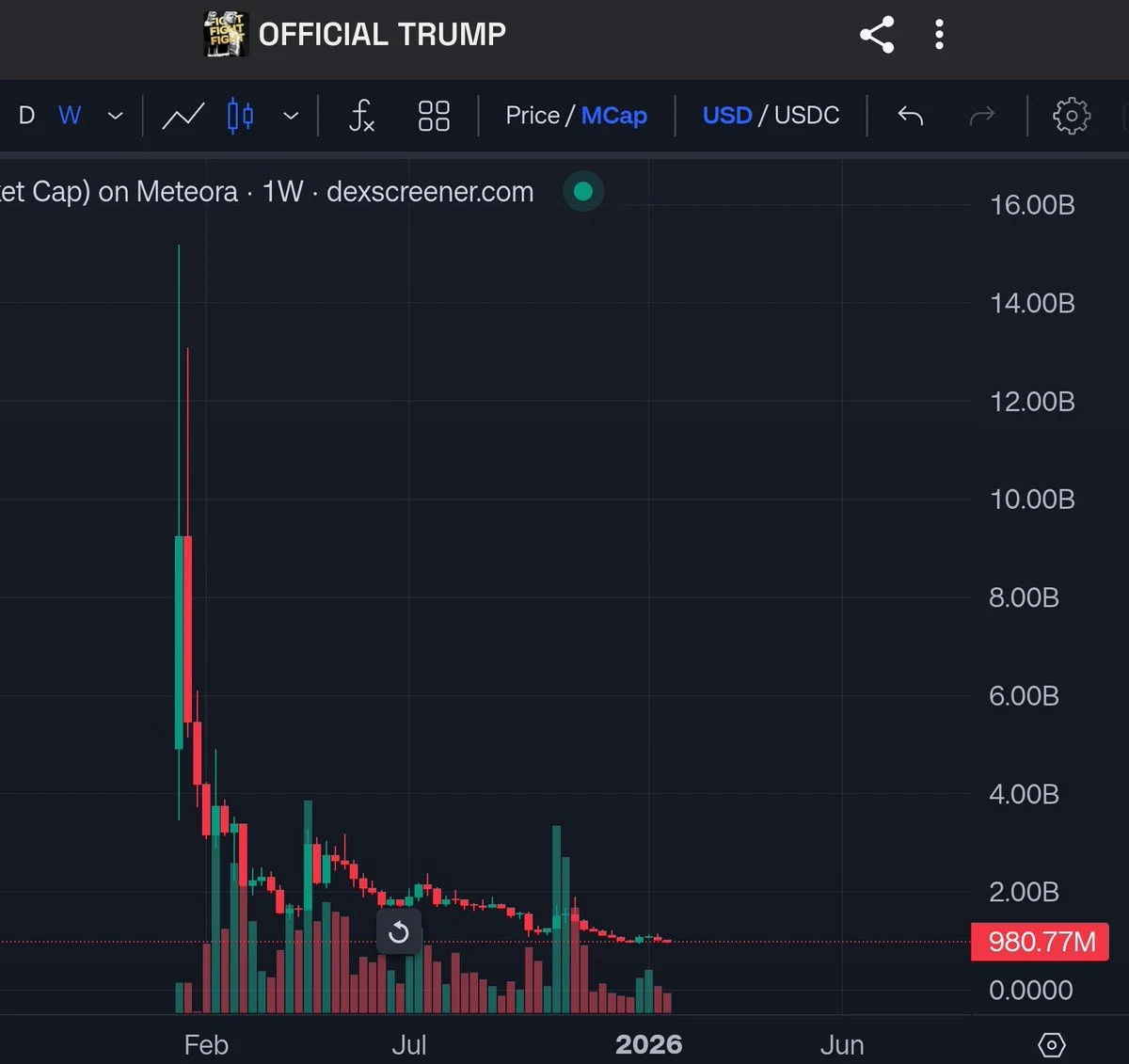
$TRUMP token dropped about 86% from its peak. Almost all supply was controlled by insiders or Trump linked entities at launch.
$MELANIA token dropped about 99% from its peak.
$WLFI is positioned as the next large extraction mechanism. Highly concentrated and bundled.
➡️ Binance, CZ and the UAE connection
Changpeng Zhao spent time in the UAE. Shortly after, Binance shifted key structures to the UAE, a jurisdiction known for light regulation.
Before that, a $2,000,000,000 investment flowed into Binance through MGX, an Abu Dhabi based investment firm.
The entire $2,000,000,000 was paid in USD1, the stablecoin issued by the Trump family backed World Liberty Financial.
USD1 is backed by US Treasuries. As long as Binance does not redeem the $2,000,000,000, World Liberty Financial earns an estimated $60,000,000 to $80,000,000 per year in yield.
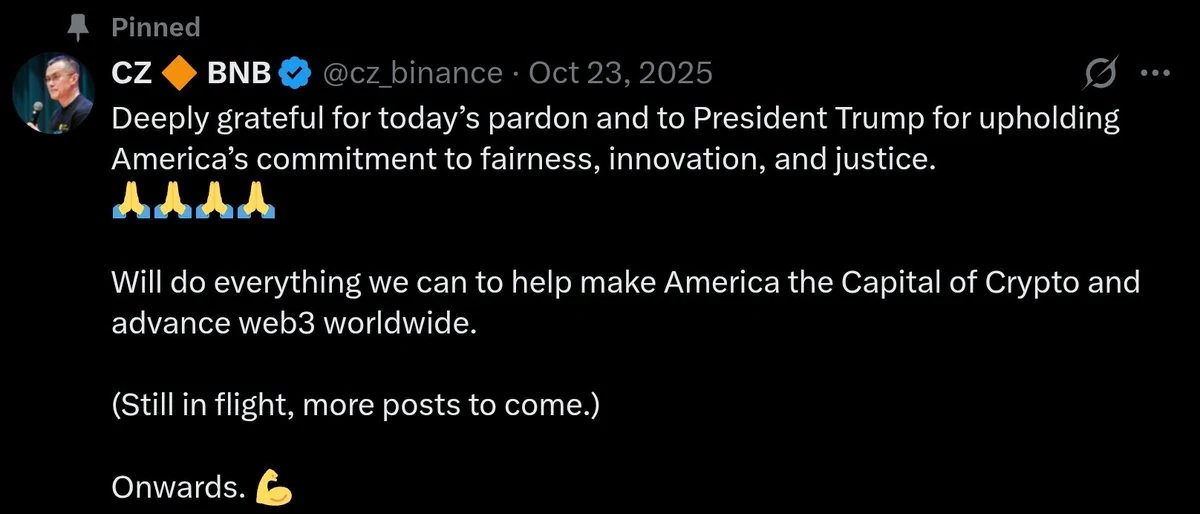
The money path is clear. Funds originate from the UAE, move through MGX into Binance, support WLFI’s stablecoin, and months later CZ receives a presidential pardon.
➡️ Bitcoin enters the picture through Trump family ABTC
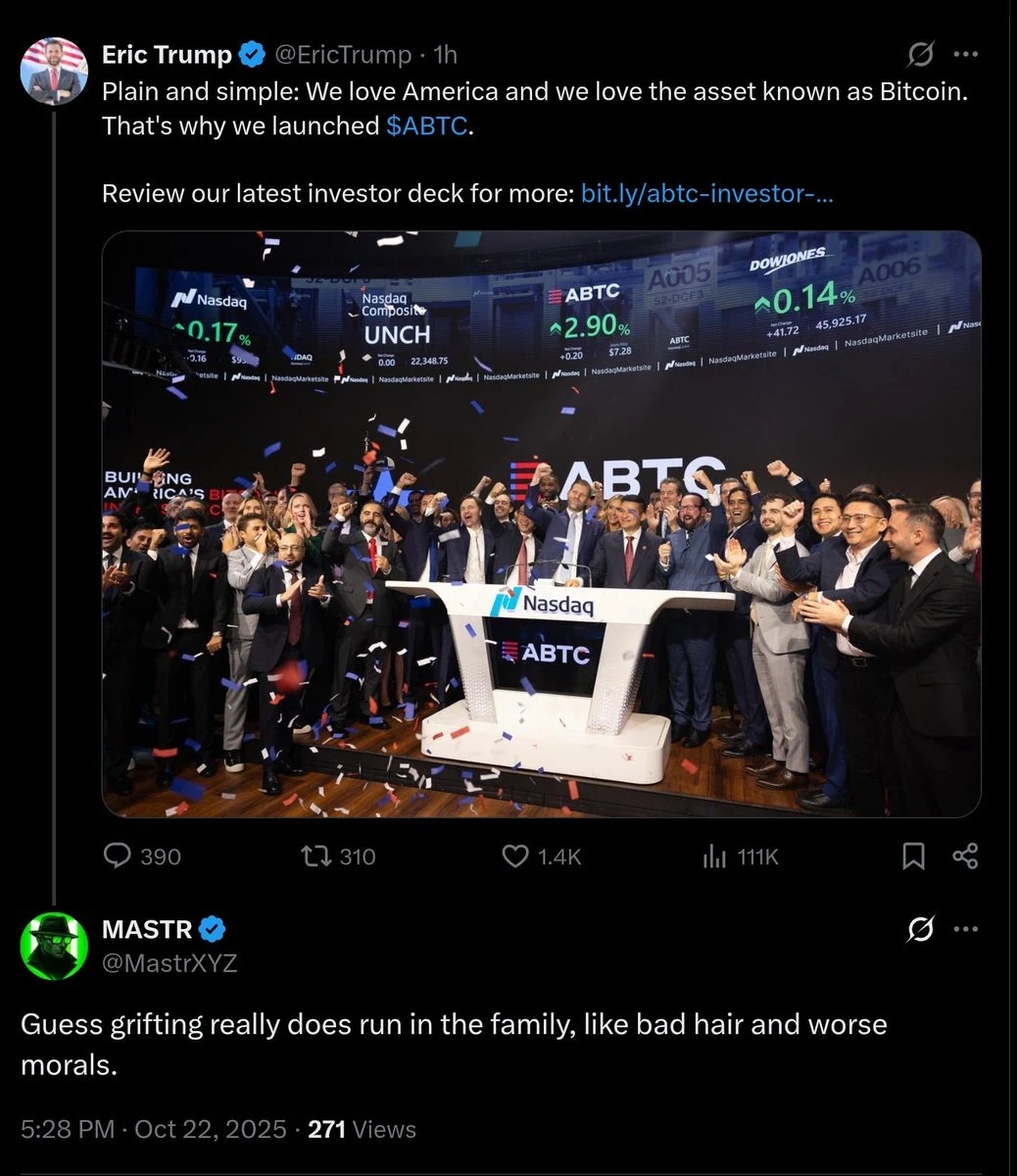
ABTC is marketed as a Bitcoin treasury success story.
There is no full public disclosure on custody structure, governance controls, counterparty risk or independent audits comparable to serious treasury operators.
Rankings are marketing optics, not proof of resilience.
Bitcoin in this context appears as a reputation laundering layer rather than an adoption driven by conviction.
A clean narrative that overwrites years of opaque money flows, documented violations and political profiteering.
➡️ The meme coin phase:
This began in parallel with meme coins tied to Trump and Melania.
These tokens launched without utility, without governance and without any credible long term purpose.
They relied entirely on name recognition and political fame.
Liquidity flowed in rapidly, early insiders and Trump linked wallets exited profitably, and retail investors were left holding collapsing narratives instead of value.
➡️ World Liberty Financial and USD1
World Liberty Financial and USD1 were presented as financial freedom and innovation.
In practice, they remain opaque, HIGHLY centralised and structurally dependent on trust rather than verifiable transparency.
There are NO disclosures comparable to serious financial instruments, NO robust independent audits, and NO decentralised control mechanisms.
What is marketed as stability is, in practice, discretionary power concentrated behind closed doors.

➡️ The structural picture
The Trump family’s crypto business signs a $2,000,000,000 deal with Binance.
Months later, a president named Trump pardons the former CEO of the same exchange who admitted to running a platform that violated US money laundering laws at scale.
Major centralized exchanges and crypto firms make material financial contributions to political networks while publicly presenting themselves as builders of a decentralized future.
At the same time, Trump branded tokens and ventures extract hundreds of millions from retail participants through meme coins and politically charged narratives.
On one side, political actors monetize crypto attention and retail liquidity.
On the other side, centralized exchanges and infrastructure firms financially support those same political actors.
The result is an ecosystem where influence, access and alignment with political power start to resemble the traditional financial system crypto originally claimed to replace.
When exchanges, stablecoin issuers, infrastructure providers and token projects fund political networks at this scale, questions about conflicts of interest, regulatory favoritism, insider access and long term accountability become reasonable and necessary.
Crypto was meant to reduce dependence on powerful intermediaries.
Parts of the industry appear to be moving closer to political and corporate power structures than ever before.
This shift deserves scrutiny.