Networks & infrastructure
The access stack: RPCs, oracles, sequencers and cloud providers
Decentralized” describes consensus. Most users, developers, and front ends do not touch consensus. They touch an access stack: RPC gateways, oracle networks, sequencers, MEV relays, stablecoin issuers, indexers, GitHub, and cloud. That…
 MASTR
MASTRFirst published 8 min · 1,596 words
Original publication · 28 Dec 2025. Figures, claims and opinions reflect the original publication date.
The original publications are in English. Navigation is available in seven languages.
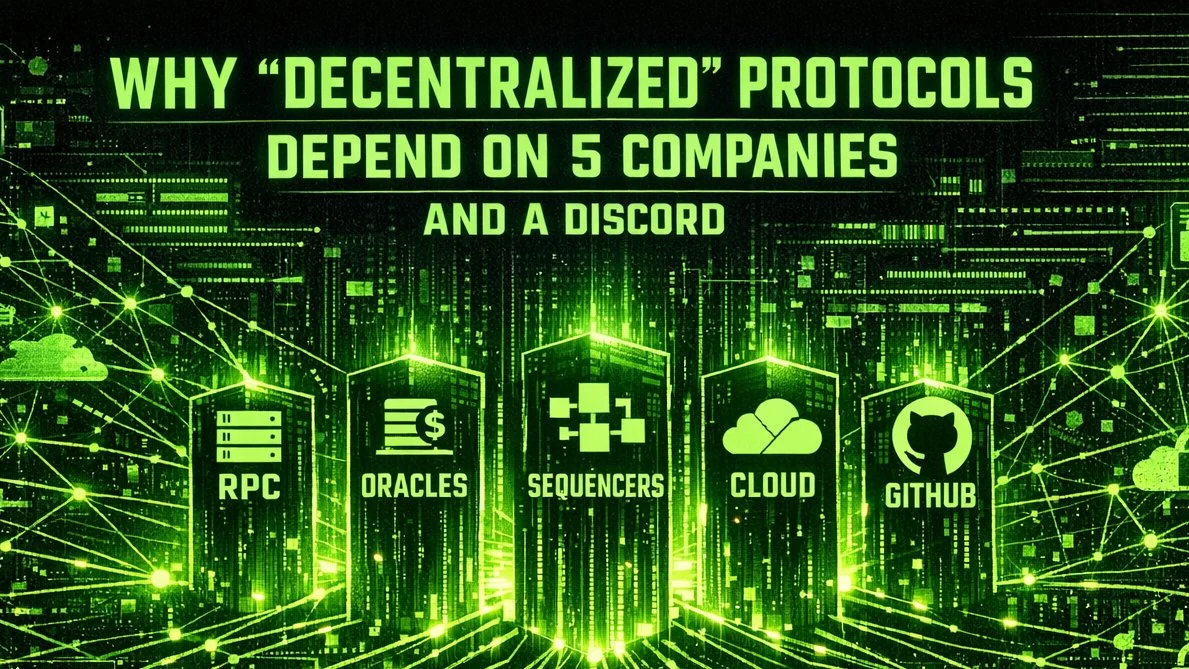
Decentralized Protocols Now Depend on "5 Companies and a Discord"?
(Very long)
“Decentralized” describes consensus.
Most users, developers, and front ends do not touch consensus. They touch an access stack: RPC gateways, oracle networks, sequencers, MEV relays, stablecoin issuers, indexers, GitHub, and cloud. That access stack is highly concentrated, and you can quantify it.
🔺1) RPC is the silent choke point
Most users do not run their own nodes. Most apps do not ask users to run nodes. They rely on remote procedure call providers, meaning a small number of companies sit between users and the chain for reads, transaction submission, and indexing.
A 2025 research paper that measured dApp dependencies found Infura used by 47.52% of dApps and Alchemy by 31.07%, with the next providers far behind: Binance 12.01%, Ankr 9.4%, Cloudflare 6.79%.
This is the first major dependency cluster. If a few providers degrade, throttle, or change policy, large parts of the dApp layer break without consensus breaking.
That fragility is not hypothetical. A Cloudflare outage on November 18, 2025 was caused by an internal bug and impacted many Cloudflare services globally. If a crypto front end, API, or RPC endpoint routes through that layer, users experience “crypto is down” even when the chain is live.
🔺 2) Oracles centralise reality into 1 dominant network
Smart contracts cannot directly observe the real world. They rely on oracles. The practical result is that many DeFi markets depend on one dominant oracle system for pricing and data delivery.
Messari reported that Chainlink commanded about 69.9% of the oracle market by value secured as of October 2025 and secured more than $100 billion in value across DeFi markets.
Other reporting citing DeFiLlama data similarly describes Chainlink holding around 62% share of the oracle sector.
Consensus decentralisation does not help if your liquidation inputs are effectively centralised. You can have thousands of validators and still have 1 dominant data rail for the variables that decide collateral health.
🔺3) Rollup sequencers are still mostly single operator systems
Layer 2 rollups often market decentralisation through Ethereum settlement. But the day to day transaction ordering, inclusion, and liveness is commonly run by a single sequencer operator today.
Jump Crypto noted that both Arbitrum and Optimism operate with a single centralized sequencer for ordering transactions.
Arbitrum’s own documentation describes the sequencer’s role in ordering and processing transactions, which is the exact surface area where censorship and outage risk concentrates before settlement.
Academic work on rollups also states that most rollups today operate through a single centralized sequencer.
So even if settlement is decentralised, the user experience is typically mediated by 1 entity deciding ordering and inclusion in the short run. That is not a philosophical point. It is an operational dependency.
🔺4) Cloud and front ends remain a real single point of failure:
Even when contracts are unstoppable, most users do not interact with contracts directly. They use a website, APIs, indexers, and hosted assets, often behind a small set of CDN and cloud providers.
Galaxy Research explicitly pointed to the November 2025 Cloudflare outage as evidence of DeFi front end centralisation risk.
Cloudflare’s own postmortem confirms a global outage with broad service impact.
This produces a recurring pattern: the chain is live, but users cannot reach it.
🔺5) GitHub and the software supply chain are a systemic dependency:
Most core crypto code, tooling, and deployment pipelines flow through GitHub and GitHub Actions. That makes supply chain compromise a protocol level risk, because compromised CI can ship malicious releases, leak secrets, and poison dependencies.
Even if consensus is perfect, you still ship software, and software ships through centralised platforms. That is not a crypto specific weakness. It is a modern software fact.
🔺6) MEV infrastructure concentrates censorship and ordering above consensus:
After the Merge, proposer builder separation via MEV Boost became dominant in Ethereum block production. Public dashboards show MEV Boost producing the large majority of blocks, around 90% plus in recent windows.
Once block building is outsourced, relays become a policy layer. Relay market share is not evenly distributed either. Rated’s relay landscape shows a small set of relays controlling large shares of MEV Boost block flow in short time windows.
This is where “neutral protocol” meets real world compliance pressure. MEV Watch tracks the share of blocks built via OFAC compliant relays and frames this as censorship risk.
In October 2022, reporting cited MEV Watch data showing 63% of Ethereum transaction blocks were OFAC compliant at that time.
Independent research has also documented that multiple relays commit to OFAC compliance in a market where most blocks are produced via MEV Boost.
This is not consensus censorship. It is a concentrated middleware market shaping inclusion and ordering.
🔺7) Stablecoins reintroduce issuer control into “permissionless” finance
A large portion of DeFi collateral and settlement runs through centrally issued stablecoins. Those tokens have blacklist and freeze controls, and issuers have used them.
Circle documented that USDC addresses related to Tornado Cash sanctions were blocked as part of compliance.
Reporting has also documented USDC freezes at law enforcement request.
So you can have unstoppable smart contracts sitting on a chain with decentralised consensus, and still have critical value flows become permissioned at the issuer layer.
🔺8) Indexing is another hidden dependency layer
Many apps do not query chain state directly. They query indexed data through services that aggregate, transform, and serve it. The Graph became a default indexing layer for many dApps, and it historically operated a hosted service as a bootstrap layer.
The Graph announced that its hosted service would sunset and that dApps should migrate to the decentralised network.
Messari’s Q3 2025 report on The Graph notes that hosted service endpoints were retired as part of an upgrade completed in June 2024, reinforcing that production ecosystems had real reliance on hosted endpoints for years.
Decentralised indexing exists, but the point is structural: data availability for apps is often mediated by specialised middle layers that can centralise in practice.
🔺9) Bridges are the interoperability layer, and they are a historic failure magnet:
Cross chain bridges repeatedly fail because they inherit weaker security assumptions than the base chains they connect. The losses are not small.
A 2025 academic survey on bridge design flaws states that bridges were targets of hacks causing damage in the range of $1.5 to $2 billion in 2022.
Wormhole lost 120,000 ETH worth around $320 to $325 million in 2022.
Ronin’s bridge theft is widely reported in the $540 to $625 million range depending on valuation timing and breakdown.
Bridges are often governed by small validator sets, multisigs, or operational committees. That is “decentralised enough” until it is not, and then it becomes the single biggest target in the stack.
🔺10) Upgradability and admin keys mean “the code is law” is often marketing:
A large portion of DeFi is upgradeable. Upgradeability is not automatically bad, but it creates a control plane. Someone can change the logic. Someone holds the keys, usually a multisig and sometimes an EOA, sometimes behind a timelock, sometimes not.
Security guidance on upgradeable proxy systems explicitly calls out proxy admin key risk and the centralisation risk that proxy brings.
Technical writeups also describe how a single ProxyAdmin can control upgrades for multiple proxies, meaning a single governance surface can control an entire product suite.
So even if the chain is decentralised, your favourite protocol can still have a small control group with the ability to change outcomes.
🔺11) “And a Discord” is not a joke, it is an attack surface:
A surprising amount of protocol governance, incident response, and “official communications” happens through Discord and a handful of social accounts. That is operationally centralised, and it repeatedly gets exploited.
TRM Labs documented a surge in Discord compromises affecting NFT communities and noted phishing attacks through compromised Discord accounts.
Bored Ape Yacht Club suffered a Discord compromise that resulted in large NFT theft, reported around 200 ETH, roughly $360,000 at the time.
KrebsOnSecurity reported crypto focused Discord communities being hacked after administrators were tricked into running malicious bookmarks.
Check Point Research and Kaspersky described invite link hijacking as a real and ongoing Discord abuse vector used for malware and credential theft.
🔺12) Cloudflare:
And do not forget the Cloudflare disaster. A single CDN outage was enough to make large parts of so called decentralized apps unreachable, even though the underlying chains were fully operational. That incident made it painfully clear that decentralization at consensus level means very little when access, front ends, and APIs depend on centralized infrastructure like Cloudflare.
🔺What “5 companies and a Discord” really means:
It means the practical decentralisation of Web3 is bounded by infrastructure concentration.
RPC access is dominated by a small set of providers.
Oracle data is dominated by 1 network by value secured.
L2 ordering is commonly controlled by single sequencers.
Front ends and APIs depend on centralised cloud and CDN layers.
Block building is mediated by MEV Boost and a concentrated relay market, with documented censorship pressure dynamics.
Stablecoins add issuer level permissioning into DeFi.
Indexing and data delivery add additional dependency layers.
Bridges repeatedly demonstrate weaker security guarantees than base chains, with losses measured in billions.
Upgradeable contracts and admin keys create central control planes inside “decentralised” apps.
And social coordination layers like Discord have a long, documented history of compromise driven theft.
Consensus decentralisation is necessary, but it is not sufficient. Most users live above consensus. If the layers above consensus centralise, the system becomes decentralised in theory and permissioned in practice.
Thank you very much for reading this far and for sharing your thoughts on it.