The Solana Bot Economy: Who Actually Extracts the Money Before Retail Even Gets a Chance?
Subscriber Investigation, August 8, 2026
If you trade Solana as if everyone is standing in the same marketplace waiting for the same opportunity, you are playing a game that does not exist.
What looks like a simple swap in your wallet sits on top of a fairly brutal execution economy. Searchers monitor state changes. Arbitrage systems scan venues. Snipers react to launches. Trading terminals charge for speed. Validators collect priority fees. Jito runs auctions for transaction inclusion. Launchpads collect fees from the flow. And around memecoin launches, coordinated wallets can accumulate inventory before the crowd even understands what it is buying.
The result is a market where the average trader sees a chart, while sophisticated participants see an execution problem.
And there is finally enough data to measure parts of this properly.
Solana is currently doing roughly $43.7 billion in DEX volume over 30 days, with around $1.2 billion changing hands in a single day. Pump alone accounts for roughly $15.9 billion of that 30-day DEX volume.
That volume is impressive. Solana's speed is impressive. I still think the technology itself is among the best things crypto has built.
But speed does something else extremely well: it industrialises extraction.
44 million transactions later, the bots are no longer a side story
A new paper published on July 30 is probably one of the most interesting Solana studies I've read in a while.
Researchers analysed 586 public Solana bot repositories, then separately examined 200 known bot-associated addresses responsible for 44,118,825 transactions. Their taxonomy found 15 different bot categories. The largest groups included 137 repositories focused on order execution and management, 134 on sniping, 47 on arbitrage, 41 on transaction-ordering exploitation and 21 on wash trading.
The paper cites bot-related Solana DEX trading volume exceeding $250 million per day in January 2026.
Before people turn that into another stupid viral statistic, there is an important distinction.
$250 million of bot trading volume does not mean bots made $250 million.
In fact, one of the most useful findings of the study is exactly the opposite. A huge amount of automated activity is unsuccessful, unprofitable or economically marginal.
The researchers found one MEV cluster submitting around 1.36 transactions per second, while 72.73% of the addresses in that cluster had success rates below 20%. Another MEV cluster submitted fewer transactions, around 0.457 per second, while averaging a 91.8% execution success rate. And when the researchers looked at profits, transaction frequency and execution success did not translate cleanly into profitability. One group produced frequent small losses, another showed heavy downside tails.
That matters because the interesting question is not whether bots exist.
The interesting question is which bots have an actual edge, where that edge comes from, and who gets paid while everybody competes for it.
Speed matters. Access seems to matter even more.
One result buried in the paper deserves far more attention.
A group the researchers classify as aggregator-centric MEV interacted heavily with Jupiter and several other venues, including proprietary AMMs. Transactions in this cluster that invoked HumidiFi were profitable 62.30% of the time, while transactions that did not invoke HumidiFi were profitable only 21.01% of the time.
The average HumidiFi-invoking transaction produced a positive result of 143,661 lamports. The non-HumidiFi transactions averaged a loss of 8,693 lamports. The researchers correctly describe this as an association rather than proof that HumidiFi itself caused the profitability difference.
Still, the implication is important.
The serious bot economy is not simply some teenager running sniperbot.exe from a GitHub repository.
Execution infrastructure matters. Routing matters. Latency matters. Liquidity access matters. Where your transaction goes matters. How it gets there matters.
The researchers themselves conclude that bot outcomes appear to depend on the interaction between execution infrastructure, venue integration and execution regime, rather than trading logic alone.
That is a completely different market from the one presented to retail.
Retail gets a green BUY button.
Professional execution gets infrastructure.
Follow the money and the picture gets clearer
A Solana transaction has a base fee of 5,000 lamports per signature. Half is burned and half goes to the validator. Priority fees are different: 100% of the priority fee currently goes to the block-producing validator.
Then you have Jito.
Jito bundles allow traders and searchers to bid for inclusion. Its auction currently operates in 50 millisecond ticks, choosing combinations of bundles based partly on tip efficiency. Winning bundles are forwarded to validators and the tips are distributed to validators and stakers.
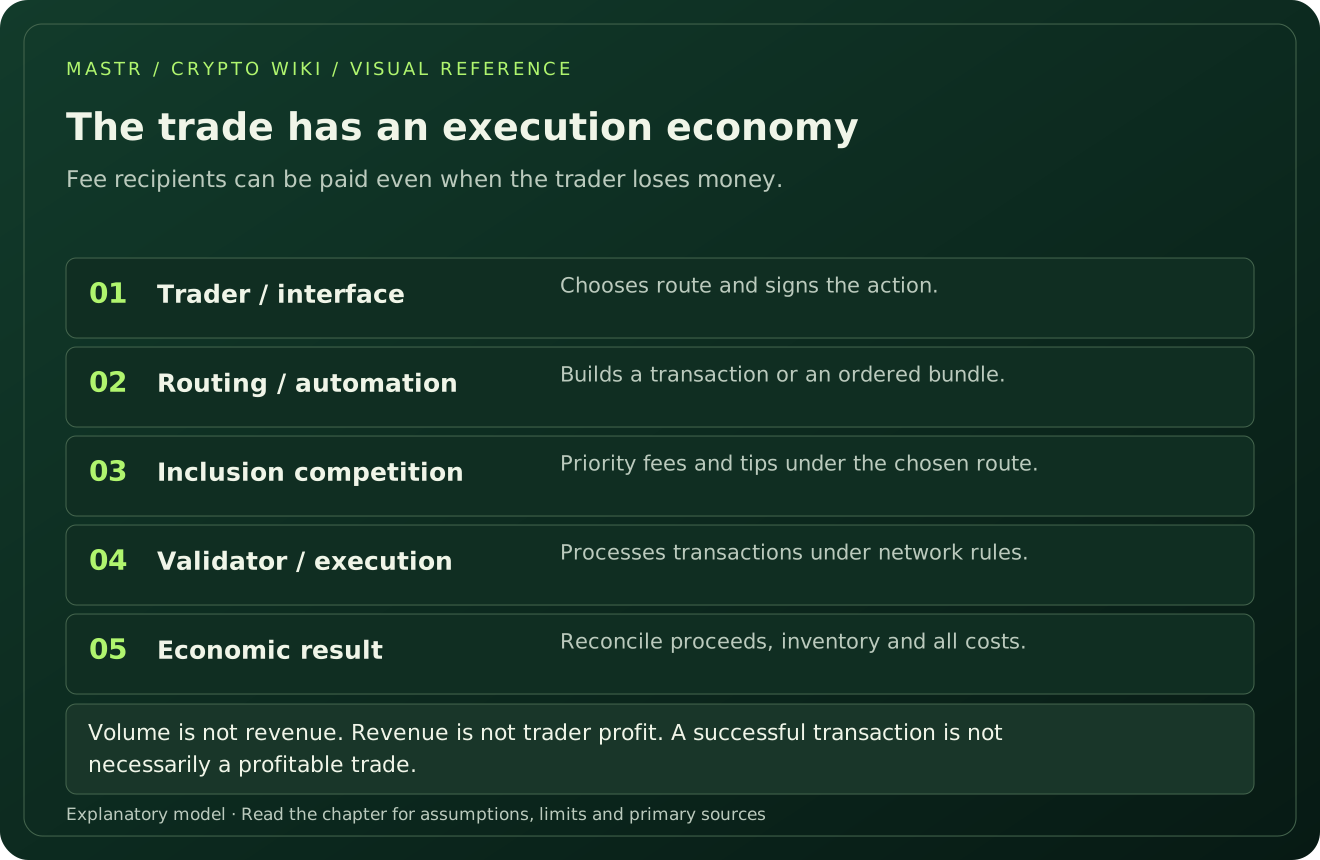
So once execution becomes valuable, a market forms around execution itself.
The trader wants the opportunity.
The bot wants the opportunity first.
The searcher pays for better execution.
The validator monetises demand for inclusion.
The infrastructure provider monetises the auction.
And the entire process can happen before a human has finished moving a mouse.
Jito is now moving further in this direction with BAM, its Block Assembly Marketplace. BAM reached roughly 28% of Solana network stake by the end of Q1 2026, with 119.3 million SOL delegated across 363 validators during the quarter. Jito reported $19.85 million in tips during Q1. Its first BAM plugin, Maker Priority, entered testing in April and gives enrolled proprietary AMMs deterministic top-of-batch execution on a dedicated TPU port every 50 milliseconds. According to Jito, teams representing roughly 40% of Solana spot volume and 85% of proprietary AMM volume participated in designing it.
There are perfectly legitimate reasons for this. Market makers need reliable execution. Better ordering can reduce duplicate spam, tighten spreads and make markets function better.
But this is exactly why I dislike the childish version of the discussion where everything is reduced to "fast chain = fair market."
Fast for whom?
And under which rules?
Then there is the retail bot industry
There is another group of bots that people strangely don't think about when talking about extraction: the tools retail itself uses.
Axiom, Trojan, Photon, GMGN and similar terminals promise faster discovery, sniping, copy trading and quicker execution. Those products solve a real problem. They are not doing anything inherently wrong by charging for their service.
But look at the economics.
According to DefiLlama, Axiom collected $22.61 million in trading fees during the last 30 days and retained $13.85 million as protocol revenue, while processing around $1.27 billion of Solana DEX volume.
Trojan collected another $939,090 in 30-day Solana fees, retaining $716,528 as revenue. Photon collected roughly $499,000, all classified as protocol revenue by DefiLlama.
GMGN recorded another $2.93 million of Solana-side fees during the same period, with about $2.19 million classified as Solana revenue.
Those 4 services alone therefore represent roughly $27 million in Solana-side user fees over 30 days, using DefiLlama's respective methodologies. That figure should not be mistaken for the size of the entire trading-bot market, and the methodologies are not identical. It does, however, show that selling traders faster access to speculative markets is itself an extremely real business.
The 44 million transaction study gives us an even more interesting glimpse into this machinery.
Among the Pump.fun-centric trading cluster, 61.26% of measured transfer outflows went to Trojan-labelled accounts, 10.17% to Jito tip accounts and 6.48% to https://t.co/QXqoP4WBTM accounts. Those percentages are transfer-recipient classifications, not a revenue split, so treating them as "who took 61% of trader losses" would be wrong. But as a map of where money moves while these systems operate, it is revealing.
Retail isn't merely trading a token.
Retail is feeding an execution stack.
And then we reach the ugliest part: the launch itself
This is where the whole discussion becomes much harder to dismiss as ordinary market efficiency.
Another 2026 study examined 41,470 https://t.co/QXqoP4WBTM memecoins that successfully migrated to DEX trading, covering more than 218 million transactions from December 1, 2024 through March 1, 2025. The researchers reconstructed behaviour before and immediately after migration and also attempted to identify wallets that appeared independent on-chain but were probably controlled together.
The numbers are insane.
Of the 30.8 million pre-migration transactions, researchers classified 21.4% as wash trades. And 98.7% of token creation events occurred together with a developer purchase, meaning the developer was already acquiring inventory at the earliest pricing tier in almost every observed case.
Then they reconstructed wallet relationships.
They used same-transaction purchases, common funding sources and shared Jito bundle IDs to identify wallets likely controlled by the same entity. Once those relationships were taken into account, 28.13% of holders were associated with bundled groups controlling 36.5% of token supply at migration. For tokens the study classified as high risk, grouping those apparently separate wallets increased the median top-10 concentration by 24 percentage points.
Think about what this means from the perspective of someone staring at a token scanner.
You can see 20 wallets and believe there are 20 independent buyers.
There may be considerably fewer humans behind them.
You can see apparently distributed ownership.
The economic ownership can be substantially more concentrated.
You can see a token racing through its bonding curve and interpret that as organic demand.
Some of the activity may be coordinated.
And when the real crowd arrives, early participants are sitting on inventory acquired at prices the later buyer could never access.
The study's risk classification is aggressive and should not be confused with a legal finding of fraud. But even with that qualification, its market data is ugly: 60.26% of the migrated tokens fell below 20% of their migration price within 20 minutes, and roughly 73% fell below 40% of their migration price. Under the researchers' combined statistical and manual methodology, 84.13% of the analysed launches were classified as high risk.
This is why I get tired of hearing that memecoin markets are simply free markets where consenting adults speculate against one another.
Technically, yes.
Economically, the information and execution asymmetry can be enormous.
MEV is also more complicated than "bots stealing from retail"
There is another mistake worth avoiding.
Arbitrage itself is not automatically malicious. If SOL trades at different prices on 2 venues, an arbitrageur closing that gap improves price consistency. Liquidation bots keep lending protocols solvent. Market makers provide liquidity.
Even the researchers examining Solana bots found enormous amounts of bot activity that was barely profitable or outright loss-making. Calling every automated participant an exploiter would be intellectually lazy.
Sandwich attacks are different because there is an identifiable victim whose execution is deliberately worsened.
A 2025 academic measurement of Jito found 521,903 sandwich attacks during roughly 4 months of early-2025 data, producing more than $7.7 million in victim losses. Yet those attacks represented only around 0.038% of measured Jito bundles. Users nevertheless spent more than $2.4 million on defensive bundling during the observation period.
That combination is fascinating.
The attack itself was statistically rare relative to all bundles, but the possibility of being attacked became valuable enough that users paid millions to protect themselves.
Even the fear of extraction becomes monetisable.
Jito had already shut down its public mempool because of sandwiching concerns, and its newer BAM architecture explicitly aims to make ordering more deterministic and mitigate harmful MEV. So taking the 2025 sandwich numbers and pretending they describe Solana unchanged in August 2026 would also be dishonest. The infrastructure is actively changing.
The broader economic problem remains.
Whenever order matters, access to order becomes valuable.
Whenever access becomes valuable, somebody will build a market around selling it.
So who actually makes money before retail gets a chance?
After going through the data, I think the answer is more interesting than "MEV bots."
The strongest position belongs to participants who own some part of the execution advantage. Searchers with better routing can monetise discrepancies. Sophisticated market makers get infrastructure designed around predictable execution. Validators earn priority fees and tips. Trading terminals collect fees whether the customer ends the month profitable or down 80%. Launchpads collect from activity. Coordinated early buyers can acquire inventory before later buyers. And infrastructure providers can monetise the competition between all of them.
The retail trader sits at the end of that chain and generally pays rather than gets paid for execution.
That does not mean retail can never win. It means the system does not require retail to win for most of the machinery surrounding the trade to make money.
That distinction matters enormously.
Axiom does not need your memecoin to go up to collect a trading fee.
A validator does not need you to be profitable to collect your priority fee.
A Jito tip does not care whether your position dumps 30 seconds later.
A launchpad does not need the token to survive for 3 years to monetise trading activity.
An arbitrageur does not need you to make good decisions. It needs a price discrepancy.
And an insider holding cheap inventory needs somebody willing to buy it later.
That is a remarkably efficient economic machine.
The uncomfortable conclusion
I don't think Solana's bot economy proves that Solana is broken. In several ways it proves the opposite. You don't build this level of execution competition around infrastructure nobody uses. Solana is fast enough, liquid enough and cheap enough to support an extraordinarily sophisticated automated market.
But there is a huge difference between technological performance and market fairness.
Solana has become very good at the first.
The second deserves far more scrutiny.
The question I would ask before touching another newly launched token is no longer simply who created it, whether liquidity is locked or whether the top holder owns 8%.
I want to know who bought first. Which wallets share funding. Which wallets landed together in bundles. Who is paying Jito. Which trading service is routing the order. Whether proprietary liquidity is involved. How much inventory apparently independent wallets actually control together. How much of the visible volume is wash activity. And who gets paid at every stage of the trade before I have made or lost a single dollar.
Because when you look underneath the chart, the Solana casino has an enormous amount of infrastructure behind it.
And the house is considerably bigger than most traders realise.