网络与基础设施
A map of the Solana ecosystem
A detailed map of Solana’s infrastructure, from validator clients and RPCs to wallets, liquidity, security and payments.
 MASTR
MASTR首次发表 15 min · 3,189 词
Original publication · 30 Jul 2026. Figures, claims and opinions reflect the original publication date.
原文为英语,导航提供七种语言。
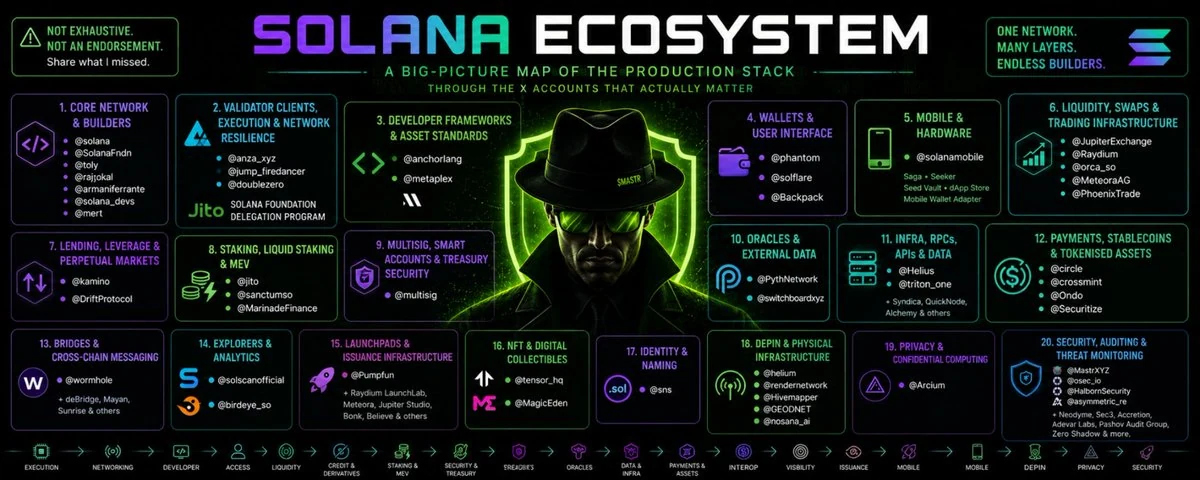
Originally published as “A Big-Picture Map of the Solana Ecosystem”
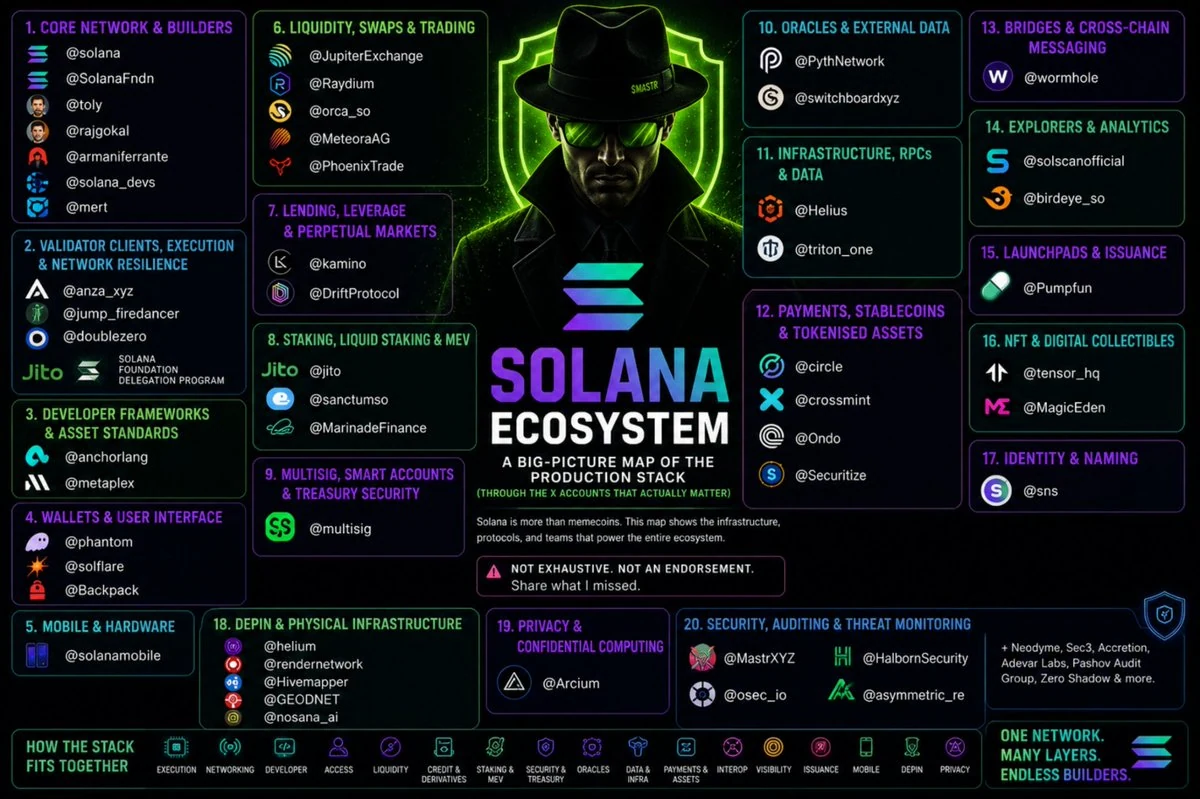
I have tried to build a big-picture map of the Solana ecosystem through the X accounts behind its most important infrastructure.
Please share the original post instead of copying it and passing it off as your own work.
Mentioning an account here is **not** an endorsement, not a shill and not backing.
I do not agree with everything some of these teams or individuals do or have done.
They are simply part of the stack that currently matters for understanding how Solana actually works.
.
Most people see Solana through whatever token, launchpad, controversy or application happens to dominate the timeline that week.
That produces a distorted picture. Underneath the noise sits a large production stack covering validator clients, wallets, liquidity, staking, MEV, RPCs, indexing, asset standards, price data, bridges, security, mobile hardware, payments, tokenised assets, DePIN, confidential computing and treasury infrastructure.
This compilation focuses on the accounts that matter for understanding that stack.
🚨 It is not exhaustive, and inclusion should not be interpreted as an endorsement.
Please reply with anything I got wrong or may have missed.
——————————————
➡️ Core network, foundation and key builders
• @solana — The official network account. It covers ecosystem announcements, network upgrades, integrations, institutional activity and major technical developments.
• @SolanaFndn — The Solana Foundation. It focuses on decentralisation, network security, validator programmes, grants, ecosystem development and public infrastructure.
• @toly — Anatoly Yakovenko, Solana co-founder. One of the most important accounts for understanding the network’s technical direction, execution model, validator architecture, performance work and future consensus design.
• @rajgokal — Solana co-founder. More focused on ecosystem growth, founders, applications, adoption and the broader strategic direction of the network.
• @armaniferrante — Founder and CEO of Backpack, creator of the Anchor framework and closely associated with Mad Lads. Relevant across wallets, exchanges, application infrastructure and Solana development standards.
• @solana_devs — Developer-focused updates, technical resources, tooling, releases, jobs and ecosystem education.
• @mert — Mert Mumtaz, CEO of Helius. One of the most influential voices discussing Solana infrastructure, RPC performance, transaction data, MEV, validator economics and network design.
——————————————
➡️ Validator clients, execution and network resilience
Solana’s long-term reliability depends on more than applications and liquidity. It also depends on validator performance, independent software implementations and reducing the risk of the network relying on one dominant client codebase.
• @anza_xyz — Anza maintains Agave, the majority validator client and continuation of the original Solana Labs validator software. It is central to runtime development, core protocol upgrades, performance improvements and the transition towards Alpenglow.
• @jump_firedancer — The official account for Firedancer, the independent Solana validator client developed by Jump Crypto. Firedancer is written in C and designed independently with a strong focus on performance, security and client diversity.
Frankendancer should not be treated as identical to Firedancer. Frankendancer is the hybrid implementation that combines Firedancer components with parts of the Agave runtime, while Firedancer is the fully independent client.
• @doublezero — DoubleZero operates a high-performance network layer designed for distributed systems such as Solana validators. It provides dedicated connectivity and low-latency data delivery rather than behaving like another ordinary RPC provider.
Client diversity matters because several independently developed clients reduce exposure to a single implementation bug, software failure or performance bottleneck.
The wider validator layer also includes the Solana Foundation Delegation Program, Jito’s validator infrastructure, block-building systems, validator monitoring and tools measuring stake concentration, latency and client adoption.
——————————————
➡️ Developer frameworks and asset standards
Applications need more than validator clients. They also depend on frameworks, programme libraries, token standards and standardised ways of retrieving asset data.
• @anchorlang — Anchor is the most widely recognised Solana programme-development framework. It provides conventions, account validation, interface definitions and tooling that make complex Solana programmes easier to build and maintain.
• @metaplex — Metaplex provides foundational programmes and standards for tokens, NFTs and digital assets on Solana. Its infrastructure includes Token Metadata, Core, Bubblegum compressed assets, Candy Machine and the Digital Asset Standard API.
Metaplex was one of the largest omissions from the original list. It is not merely an NFT marketplace tool. Its standards sit underneath a substantial part of Solana’s token issuance and digital-asset infrastructure.
——————————————
➡️ Wallets and user-facing infrastructure
Wallets are not merely storage interfaces. They determine how users sign transactions, discover applications, manage assets, interact with hardware security and understand what they are approving.
• @phantom — One of the largest consumer access points to Solana. Phantom has expanded across several networks but remains deeply integrated with Solana applications, tokens, collectibles and transaction flows.
• @solflare — A major Solana-native self-custodial wallet with staking, swapping, asset-management and hardware-security features.
• @Backpack — A wallet and broader financial interface designed heavily around power users, developers and the Solana application layer. It is connected to Backpack Exchange, xNFTs and Mad Lads.
Wallet competition matters because transaction simulation, phishing protection, signing transparency, application discovery and key security remain major failure points for ordinary users.
——————————————
➡️ Mobile and hardware infrastructure
• @solanamobile — The official account for Solana Mobile, Saga, Seeker, Seed Vault, the mobile dApp Store and the wider mobile-native ecosystem.
Seeker represents an attempt to build hardware-secured signing and permissionless application distribution around Solana. Its important components are the Seed Vault architecture, Mobile Wallet Adapter, the dApp Store, mobile signing and direct distribution of on-chain applications.
The strategic significance lies in reducing the ecosystem’s dependence on conventional mobile gatekeepers and their application-distribution rules. Whether the hardware itself becomes a mass-market product remains a separate question.
——————————————
➡️ Liquidity, swaps and trading infrastructure
Solana’s liquidity stack is concentrated around several protocols that perform different but interconnected functions.
• @JupiterExchange — A central routing and aggregation layer for Solana trading. Jupiter connects liquidity across venues and now covers spot trading, perpetuals, lending, limit orders, recurring orders and developer APIs.
• @Raydium — One of Solana’s core automated-market-maker and liquidity protocols. Raydium supports swaps, liquidity pools, farms, token launches through LaunchLab and additional trading products.
• @orca_so — One of Solana’s longest-running automated market makers and concentrated-liquidity protocols. Its Whirlpools infrastructure is widely integrated across the ecosystem.
• @MeteoraAG — Dynamic liquidity infrastructure for liquidity providers, launchpads and token issuers. Meteora is particularly relevant for volatile assets, concentrated liquidity and day-one token liquidity.
• @PhoenixTrade — An on-chain central-limit-order-book exchange (now also strong in perpetuals). Phoenix provides a different market structure from conventional automated market makers.
Jupiter, Raydium, Orca, Meteora and Phoenix form a substantial part of the routing, market-making and execution layer used across Solana.
——————————————
➡️ Lending, leverage and perpetual markets
• @kamino — One of Solana’s most important credit-infrastructure protocols. Kamino combines lending, borrowing, automated liquidity management, vaults and leveraged strategies.
• @DriftProtocol — A major decentralised derivatives and perpetuals venue with cross-margin trading, lending and broader trading infrastructure.
These protocols matter because leverage, collateral management, liquidations and oracle dependencies create some of the most technically and financially sensitive infrastructure in DeFi.
Their risks are not limited to smart-contract exploits. Bad debt, market manipulation, oracle failures, liquidation design, governance permissions and administrative controls can be equally important.
——————————————
➡️ Staking, liquid staking and MEV
Staking infrastructure determines how SOL is delegated, how validators earn revenue and how staked capital remains usable throughout DeFi.
• @jito — Jito operates liquid-staking, validator, MEV and market infrastructure. JitoSOL is deeply integrated across Solana DeFi, while Jito’s validator software and block-building systems affect transaction ordering and block production.
• @sanctumso — A major liquid-staking infrastructure and liquidity layer. Sanctum connects different staked-SOL assets and expands the usefulness of validator-specific liquid-staking tokens.
• @MarinadeFinance — One of Solana’s longest-running staking protocols. It provides liquid staking, native stake automation and systems for distributing delegated stake across validators.
The staking layer affects validator incentives, stake distribution, liquidity concentration, governance influence and the economic security of the network.
——————————————
➡️ Multisig, smart accounts and treasury security
• @multisig — Solana’s leading multisig and smart-account infrastructure (Squads). Used by teams and protocols to manage treasuries, programme upgrade authorities, operational permissions and high-value assets.
This is one of the least glamorous but most important parts of the ecosystem. A protocol can have audited contracts and still lose everything if its treasury keys, upgrade authority or administrative permissions are badly secured.
Multisig infrastructure reduces dependence on individual private keys and has become foundational for professional protocol operations.
——————————————
➡️ Oracles and external data
DeFi programmes do not independently know the market price of an asset. They depend on external data systems. Delayed, incorrect or manipulable information can produce wrongful liquidations, bad debt and protocol losses.
• @PythNetwork — A major market-data and oracle network that originated within the Solana ecosystem. Pyth supplies data used by trading, lending, derivatives and risk-management applications across many networks.
• @switchboardxyz — A permissionless and customisable oracle network with deep roots in Solana. Switchboard provides price feeds, randomness and other verifiable data services.
Pyth is the larger name, but excluding Switchboard would leave out an important part of Solana’s oracle infrastructure.
——————————————
➡️ RPCs, APIs, streaming and indexing
Applications cannot reliably interact with Solana by repeatedly asking the raw blockchain for everything they need. Production systems depend on RPC providers, indexed data, transaction streams, webhooks and specialised APIs.
• @Helius — One of the leading Solana-native infrastructure providers. Helius supplies RPC access, enhanced transaction APIs, digital-asset indexing, webhooks, streaming systems and infrastructure used by wallets, trading systems, marketplaces and applications.
• @triton_one — A foundational provider of high-performance Solana RPC and data infrastructure. Triton One’s work around Yellowstone gRPC has influenced how many production applications consume real-time blockchain data.
Other relevant providers include Syndica, QuickNode, Alchemy and specialised bare-metal or high-performance RPC operators serving institutional and trading workloads.
The Light Protocol team joined Helius in 2026 to work on Solana privacy infrastructure, so that work is now better followed through Helius rather than presented as an entirely separate current infrastructure organisation.
This layer remains largely invisible until it fails. When RPC services are overloaded, delayed or inconsistent, applications can appear broken even while the underlying network continues producing blocks.
——————————————
➡️ Payments, stablecoins and tokenised assets
This was the other major omission from the original version. By 2026, a Solana infrastructure map that excludes stablecoins, payment rails and tokenised financial assets is incomplete.
• @circle — The issuer of USDC, one of the principal settlement and liquidity assets used throughout Solana DeFi, payments and institutional applications.
• @crossmint — Infrastructure for wallets, payments, stablecoin flows, tokenisation and enterprise integrations. Crossmint is also involved in Solana Developer Platform and payment deployments such as Western Union’s USDPT infrastructure.
• @Ondo — A major issuer and distribution platform for tokenised stocks and ETFs available on Solana.
• @Securitize — Institutional tokenisation and transfer-agent infrastructure for regulated funds and securities. Its role is particularly relevant as traditional assets increasingly move onto public blockchains.
This layer also includes PYUSD, USDT, regional stablecoins, tokenised treasuries, funds, equities, commodities and specialist issuers.
The token may settle on Solana, but the legal claim, custody model, redemption mechanism and issuer permissions frequently remain off-chain. Those differences should never be hidden behind the word “tokenisation.”
——————————————
➡️ Bridges and cross-chain messaging
• @wormhole — One of the largest cross-chain messaging and interoperability systems connected to Solana. Wormhole allows information and assets to move between different blockchain ecosystems.
Bridges have enormous systemic importance because they often secure large amounts of capital while depending on complex verification, guardian, messaging and smart-contract systems.
Wormhole also carries historical security significance following its major 2022 exploit. Its continued relevance makes it important to follow for both interoperability and risk.
Other relevant cross-chain execution and bridging systems include deBridge, Mayan and Sunrise, but Wormhole remains one of the most systemically recognisable accounts in the Solana stack.
——————————————
➡️ Explorers, analytics and visibility
• @solscanofficial — One of the most widely used Solana block explorers. Solscan allows users to inspect transactions, tokens, programmes, holders, account activity and on-chain history.
• @birdeye_so — A major real-time market-data and wallet-analysis platform providing charts, token discovery, liquidity data, trades and wallet tracking.
Explorers and analytics platforms are not neutral windows into perfect information. Labels, indexing quality, token metadata, attribution systems and interface design materially affect what users believe they are seeing.
——————————————
➡️ Token launchpads and issuance infrastructure
• @Pumpfun — The largest culturally and economically significant retail memecoin launchpad on Solana. Its bonding-curve model and automated path towards decentralised-exchange liquidity reshaped how speculative tokens are created, distributed and traded.
Pump.fun has generated enormous activity and fees, but it has also industrialised low-effort issuance, manipulation, gambling and retail extraction.
Other issuance surfaces include Raydium LaunchLab, Meteora-based structures, Jupiter Studio, Bonk-related systems, Believe and competing launchpads.
Token issuance is now infrastructure. The platform deciding how tokens launch, migrate, receive liquidity and gain visibility can shape the market around them.
——————————————
➡️ NFT and digital-collectible infrastructure
• @tensor_hq — A professional-oriented trading interface and marketplace for Solana NFTs, compressed assets and active collection trading.
• @MagicEden — A major multi-chain marketplace with deep historical and commercial importance to Solana’s NFT ecosystem.
NFT speculation is no longer the centre of Solana’s public narrative, but the standards and infrastructure developed during that period continue to influence gaming, identity, loyalty systems, ticketing and digital ownership.
Metaplex belongs above these marketplaces at the standards layer because marketplaces can change while the underlying asset programmes remain embedded throughout the ecosystem.
——————————————
➡️ Identity and naming
• @sns — Solana Name Service provides .sol domains and on-chain naming infrastructure.
Naming systems improve usability by replacing long addresses with readable identities. They also introduce questions around ownership, impersonation, renewals, trademarks and how applications resolve names.
——————————————
➡️ DePIN and physical infrastructure
Solana has become an important settlement and coordination layer for decentralised physical infrastructure networks. These systems connect on-chain incentives with wireless connectivity, computing, mapping, sensors and other real-world resources.
• @helium — Helium operates decentralised wireless infrastructure covering IoT and mobile connectivity. The network migrated its blockchain operations to Solana in 2023.
• @rendernetwork — A distributed GPU-rendering and compute network whose upgraded RENDER token and important network operations use Solana.
• @Hivemapper — A decentralised mapping network that rewards contributors for collecting street-level imagery and geographic data.
• @GEODNET — A decentralised geospatial reference network providing high-precision positioning data.
• @nosana_ai — A distributed computing network focused on supplying GPU resources for AI and other computational workloads.
DePIN is one of the clearest tests of whether blockchain infrastructure can coordinate something beyond trading. The serious questions concern customer demand, revenue, hardware economics, data quality and whether token incentives create sustainable networks or merely subsidised activity.
——————————————
➡️ Privacy and confidential computing
• @Arcium — Arcium is building confidential-computation infrastructure that allows applications to process encrypted information while keeping the underlying inputs hidden.
Its architecture uses multi-party computation and other cryptographic systems to support confidential DeFi, private payments, encrypted AI workloads and applications requiring selective disclosure.
Privacy infrastructure matters because public blockchains expose balances, counterparties and transaction history by default. That is useful for auditability but unsuitable for many commercial, institutional and personal applications.
The technical challenge is adding confidentiality without destroying composability, performance or verifiability.
——————————————
➡️ Security, auditing and threat monitoring
Security should not be treated as a decorative badge added after deployment. Solana protocols combine programme logic, upgrade authorities, multisigs, frontend infrastructure, APIs, oracles, bridges, wallets and external dependencies. Any one of them can become the failure point.
• @MastrXYZ — A crypto and Solana watchdog focused on fraud exposure, scam investigations, on-chain analysis, anti-scam education and retail-protection tools. Useful for following risks that official project channels, paid promoters and ecosystem marketing accounts often avoid discussing.
• @osec_io — OtterSec is one of the most established security firms associated with Solana. It has audited important protocols and contributed to security research across the ecosystem.
• @HalbornSecurity — A large multi-chain security company with experience auditing Solana projects and infrastructure.
• @asymmetric_re — Asymmetric Research leads STRIDE, a Solana Foundation-supported security programme covering protocol evaluation, operational security, threat monitoring and formal verification for major DeFi systems.
Other relevant teams include Neodyme, Sec3, Accretion, Adevar Labs, Pashov Audit Group, Zero Shadow and specialist researchers working on fuzzing, runtime analysis, incident response and formal verification.
Large protocols increasingly commission several audits, use multisigs and add monitoring systems. That is progress, but an audit does not guarantee safety. Business-logic errors, compromised administrators, frontend attacks, malicious upgrades, oracle failures and access-control mistakes remain major risks.
——————————————
➡️ How the stack fits together
At the execution layer, Agave, Anza, Firedancer and Solana’s consensus upgrades determine how the network processes transactions and survives software failures.
At the networking layer, DoubleZero and validator infrastructure determine how quickly data moves between geographically distributed participants.
At the developer layer, Anchor, Metaplex and Solana’s programme libraries determine how applications and digital assets are built.
At the access layer, Phantom, Solflare, Backpack and Solana Mobile determine how users hold keys, sign transactions and reach applications.
At the liquidity layer, Jupiter routes trades across Raydium, Orca, Meteora, Phoenix and other venues.
At the credit and derivatives layer, Kamino and Drift provide lending, leverage and perpetual markets.
At the staking layer, Jito, Sanctum and Marinade connect validator economics with liquid capital.
At the operational-security layer, Squads protects treasuries, upgrade authorities and administrative permissions.
At the oracle layer, Pyth and Switchboard provide external data used by financial applications.
At the data layer, Helius, Triton One and other providers supply RPC access, indexing and real-time transaction streams.
At the payments and asset layer, Circle, Crossmint, Ondo, Securitize and other issuers connect stablecoins, payments and tokenised financial products to Solana.
At the interoperability layer, Wormhole and other messaging systems connect Solana to external ecosystems.
At the visibility layer, Solscan and Birdeye help users interpret transactions, wallets, liquidity and markets.
At the issuance layer, Pump.fun and competing launch systems determine how huge numbers of new tokens enter the market.
At the consumer layer, Solana Mobile is attempting to create hardware and application distribution built around direct on-chain ownership.
At the physical-infrastructure layer, Helium, Render, Hivemapper, GEODNET and Nosana connect tokens with wireless networks, GPUs, mapping and physical resources.
At the confidentiality layer, Arcium and related systems are attempting to make sensitive computation possible without abandoning blockchain verification.
At the security layer, auditors, monitoring systems and independent watchdogs examine what every other layer gets wrong.
Solana is often reduced to memecoins because that is the loudest and easiest activity to observe. The actual ecosystem is significantly broader and more complicated. It contains serious infrastructure, technically ambitious systems, centralised dependencies, unresolved governance risks, productive applications and an industrial-scale casino operating beside them.
Understanding Solana requires following all of those layers rather than treating the latest token, founder or narrative as the entire ecosystem.
This is a living snapshot, not a finished directory. Accounts change, protocols lose relevance, infrastructure consolidates, liquidity migrates and technical roadmaps are delayed or replaced.
These accounts nevertheless provide a strong starting point for understanding who builds, operates, secures, monetises and controls the infrastructure beneath Solana’s visible activity.
Thank you for reading, and thank you for following, liking, subscribing and sharing.
Support independent Web3 research.
https://linktr.ee/askmastr.xyz