政治与利益冲突
The TRUMP memecoin launch and its market impact
A January 2025 analysis of the TRUMP launch, supply structure and the effects of presidential branding.
 MASTR
MASTR首次发表 5 min · 1,015 词
Original publication · 22 Jan 2025. Figures, claims and opinions reflect the original publication date.
原文为英语,导航提供七种语言。
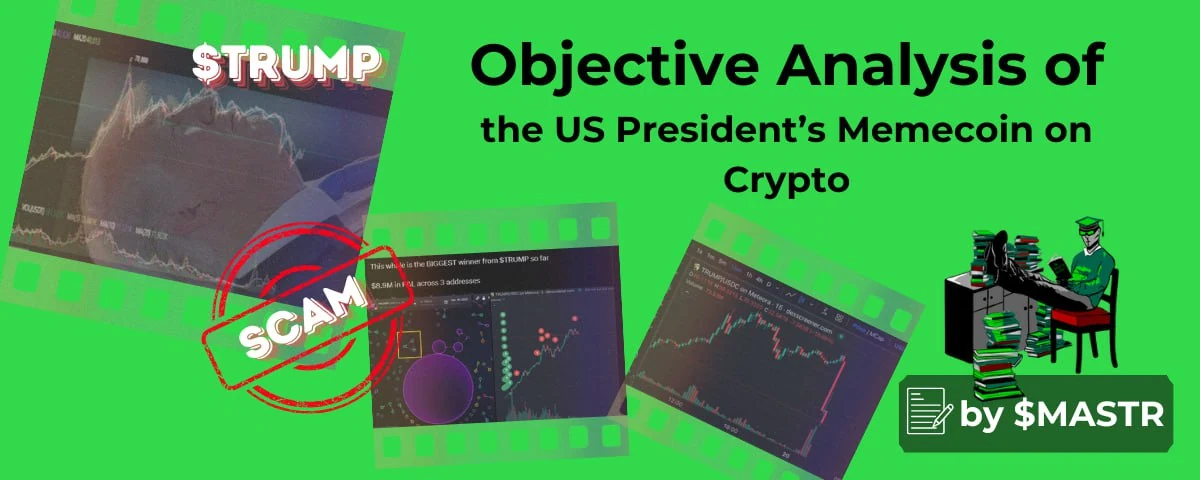
Originally published as “Objective Analysis and Impacts of the US President's $TRUMP Memecoin on Crypto”
Introduction:
The crypto world is no stranger to manipulation, but the rise of politically charged memecoins has taken this trend to a whole new level. Tokens like $TRUMP and $MELANIA are touted as symbols of loyalty and power on X, but beneath the surface lies a web of market manipulation and exploitation.
In this Article, we’ll dive into the mechanisms, strategies, and impacts of these coins. From sophisticated bot networks driving fake volume to the staggering $210M in Sol liquidity that fuels this machine, we’ll expose the reality behind the hype.
This isn’t just about one token or one name—it’s a critical conversation about the future of crypto, Web3, and #DeFi. Let’s get into it.
The $TRUMP coin and $MELANIA coin are glaring examples of a manipulated market in a world where crime might as well be legal, accepted as normal, and even celebrated. A sophisticated bot network drives fake volume, farming money from buyers on both the way up and down. Insiders control liquidity, recycle funds through wash trades, and strategically manage sell pressure to maintain hype and artificially inflate prices.
It’s not even about the 80% supply control—that’s not the main issue right now. (Wait until those wallets unlock, it’ll be entertaining.) The real problem lies in the systematic exploitation of buyers. The rich are getting richer, while the very people who admire them are the first to be taken advantage of. This isn’t about emotions, politics, or loyalties; it’s about cold, hard, on-chain facts anyone can verify.
Yes, with enough skill and experience, even regular degens can make some profits. No one is claiming that investing here guarantees losses. But the math doesn’t lie: when millions are funneled into the wallets of the token’s namesake, there simply isn’t enough money left for most participants to win. To add insult to injury, the token’s namesake conveniently chooses whether to claim they know "a lot" or "nothing" about the token, depending on the context.
This is also why exchanges like @binance and @coinbase experienced delays in processing withdrawals. Of course, they won’t admit it openly, as they want to avoid bad press. But is it really believable that such large CEXs were technically unable to process token transfers for nearly 48 hours?
The Solana liquidity was completely drained by this scam, leaving exchanges unable to meet demand as funds were funneled into external wallets and, eventually, back into the token starter’s ecosystem.
And yes, this was also the main reason $TRUMP was listed so quickly on these platforms: to keep the Sol liquidity circulating internally, minimizing external movement. And of course to make profit by listing it..
The bloodbath across other tokens, as every degen jumped onto $TRUMP, doesn’t even need to be mentioned. Ironically, those who lost the most in this frenzy were the followers of the namesake himself—those who trusted the illusion the most, including those who had already launched Trump-glorifying or related tokens.
Backed by over $210M in Sol (!!!) liquidity, these insiders manipulate the market with precision. They can even push the market cap higher when good optics are needed, (political or whatever) maintaining the illusion of organic growth. Every flashy million-dollar trade you see is part of their carefully crafted system, designed to extract value while keeping people trapped in this illusion.
The key question everyone must ask themselves is: do you want to support this, or does it disgust you?
This isn’t just a discussion about a token; it’s a conversation about the future of crypto, Web3, and #DeFi.
If this monopolistic behavior from billionaires—who manipulate the system to their benefit—becomes the standard, then the future of crypto will be anything but free for the average user.
Remember: This isn’t financial advice, and we’re not here to be political. We’re just presenting the facts. In the end, you are the $MASTR of your fate. Always know where the money flows and only invest what you can afford to lose.
Summary
Analysis: What This Means for Crypto
- Erosion of Trust
The blatant manipulation described—bot-driven fake volume, recycled liquidity, and strategic sell pressure—undermines trust in the crypto space. For new investors, these tactics distort the line between legitimate projects and scams, potentially driving people away from crypto altogether. If trust continues to erode, adoption could stagnate, affecting the industry’s long-term growth. - Centralized Exchanges Under Scrutiny
The suggestion that major exchanges like Binance and Coinbase fast-tracked listings for $TRUMP to protect internal liquidity raises concerns about the integrity of centralized platforms. If users begin to suspect these exchanges are complicit in or benefiting from manipulation, they may migrate to decentralized alternatives, further reshaping the industry landscape. - Concentration of Wealth
The analysis highlights a troubling trend: the increasing concentration of wealth in the hands of insiders and project founders. This centralization contradicts the ethos of decentralization, which is foundational to blockchain technology. If this trend continues, crypto could mirror traditional financial systems, with a few entities holding disproportionate power. - Ripple Effects Across Tokens
The “bloodbath” in other tokens as degens flocked to $TRUMP demonstrates how a single manipulated project can destabilize markets. This concentration of liquidity in one token drains funds from other legitimate projects, reducing their potential and harming the ecosystem’s overall health. - Regulatory Backlash
The growing prevalence of such schemes invites increased regulatory scrutiny. If regulators perceive the crypto space as rife with manipulation and fraud, they may impose stricter controls, potentially stifling innovation while attempting to protect consumers. - A Crossroads for Web3 and DeFi
Ultimately, this situation raises questions about the direction of Web3 and DeFi. Will the crypto community tolerate such monopolistic behaviors, or will it demand greater transparency and fairness? The future of crypto depends on whether the industry can self-regulate and uphold the principles of decentralization and equity.
Conclusion
This isn’t just about a single token or a specific set of manipulative practices—it’s about the trajectory of the entire crypto ecosystem. If these behaviors become the norm, the industry risks alienating its base, inviting harsh regulation, and stalling adoption. The community must decide whether to accept these practices or push back to protect crypto’s foundational ideals.