Reference / REFERENCE
IPFS: content identity is not a storage guarantee
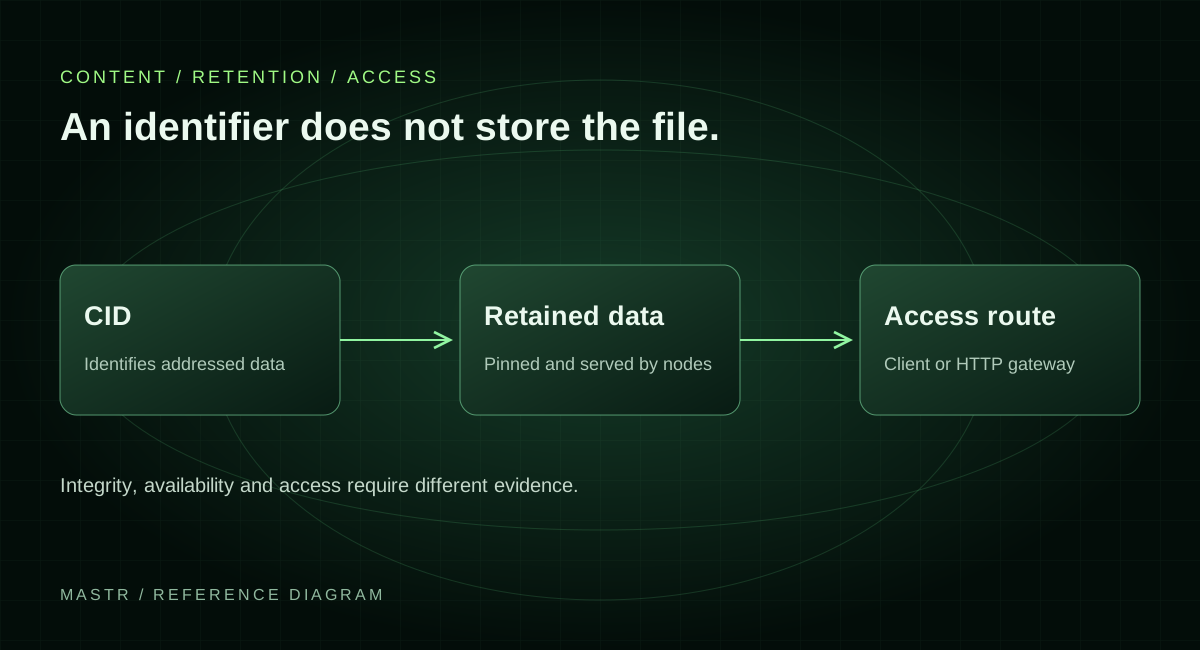
A CID helps identify content. Keeping that content available requires someone to retain and serve the necessary data.
Reference text in English · Navigation in 7 languages
On this page
What a CID identifies
IPFS uses content identifiers, or CIDs, to refer to addressed data rather than a particular hosting location. A CID includes information about its encoding and content. It is not always the same as the hash of the original file: chunking, codecs and the structure used to represent a file can affect the resulting identifier. The IPFS documentation explicitly distinguishes these cases. [1]
Retention is a separate task
A correct identifier does not cause storage to persist by itself. Pinning tells an IPFS node to retain particular data against its normal garbage collection. A recursive pin includes child blocks. A remote pinning service provides retention on another operator’s nodes, which introduces an operational dependency on that service. For a useful availability claim, identify who retains the data and whether independent copies exist. [2]
The gateway is another dependency
An HTTP gateway lets an ordinary web client access IPFS content. Gateways differ in how they retrieve, serve and support verification of that content. A familiar HTTPS URL may therefore put a particular operator between a visitor and the addressed data. An unavailable gateway is not, by itself, proof that every copy of the content has disappeared. Conversely, a working gateway today is not a promise that the same route will work indefinitely. [3]
Apply this to an NFT or a research archive
Inspect what is actually referenced. Is the onchain value a CID, an HTTP URL or a pointer to metadata that contains another URL? Are the image and metadata retained separately? Can the reference be changed? These questions determine what the token or archive commitment really binds to. The presence of IPFS in a description is insufficient to answer them.
A reproducible preservation note
For evidence preservation, record the CID, retrieval date, gateway or client used and any independently computed file hash. Keep the retrieved bytes where the rights and purpose permit it. State which properties were verified: content integrity, current retrievability or a provider’s retention commitment. These are related assurances, but a report becomes misleading when it treats them as interchangeable.